A Treatise on Electricity and Magnetism/Volume 1/Chapter 3
CHAPTER III.
SYSTEMS OF CONDUCTORS.
On the Superposition of Electrical Systems.
84.] Let be a given electrified system of which the potential at a point is , and let be another electrified system of which the potential at the same point would be if did not exist. Then, if and exist together, the potential of the combined system will be .


Hence, if be the potential of an electrified system , if the electrification of every part of be increased in the ratio of to 1 , the potential of the new system will be .


Energy of an Electrified System.
85.] Let the system be divided into parts, , , &c. so small that the potential in each part may be considered constant through out its extent. Let , , &c. be the quantities of electricity in each of these parts, and let , &c. be their potentials.


If now is altered to , to , &c., then the potentials will become , , &c.


Let us consider the effect of changing into in all these expressions. It will be equivalent to charging with a quantity of electricity , with , &c. These charges must be supposed to be brought from a distance at which the electrical action of the system is insensible. The work done in bringing of electricity to , whose potential before the charge is , and after the charge , lf must lie between


and .


In the limit we may neglect the square of , and write the expression

|
|

Similarly the work required to increase the charge of is , so that the whole work done in increasing the charge of the system is

|
. |

If we suppose this process repeated an indefinitely great number of times, each charge being indefinitely small, till the total effect becomes sensible, the work done will be
|
; |

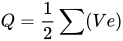
where means the sum of all the products of the potential of each element into the quantity of electricity in that element when , and is the initial and the final value of .


If we make and , we find for the work required to charge an unelectrified system so that the electricity is and the potential in each element,


|
. |
General Theory of a System of Conductors.
86.] Let be any number of conductors of any form. Let the charge or total quantity of electricity on each of these be and let their potentials be respectively.



Let us suppose the conductors to be all insulated and originally free of charge, and at potential zero.
Now let be charged with unit of electricity, the other bodies being without charge. The effect of this charge on will be to raise the potential of to , that of to , and that of to , where , &c. are quantities depending on the form and relative position of the conductors. The quantity may be called the Potential Coefficient of on itself, and may be called the Potential Coefficient of on , and so on.


If the charge upon is now made , then, by the principle of superposition, we shall have
|
. |

Now let be discharged, and charged with unit of electricity, and let the potentials of ... be ,,... potentials due to on will be


|
. |

Similarly let us denote the potential of due to a unit charge on by , and let us call the Potential Coefficient of on , then we shall have the following equations determining the potentials in terms of the charges:


|
| (1) |
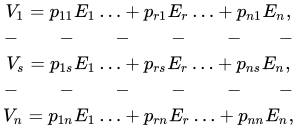
We have here linear equations containing coefficients of potential.

87.] By solving these equations for , , &c. we should obtain equations of the form
|
| (2) |
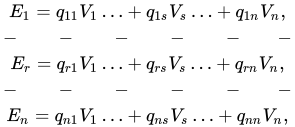
The coefficients in these equations may be obtained directly from those in the former equations. They may be called Coefficients of Induction.
Of these is numerically equal to the quantity of electricity on when is at potential unity and all the other bodies are at potential zero. This is called the Capacity of . It depends on the form and position of all the conductors in the system.

Of the rest is the charge induced on when is maintained at potential unity and all the other conductors at potential zero. This is called the Coefficient of Induction of on .

The mathematical determination of the coefficients of potential and of capacity from the known forms and positions of the conductors is in general difficult. We shall afterwards prove that they have always determinate values, and we shall determine their values in certain special cases. For the present, however, we may suppose them to be determined by actual experiment.
Dimensions of these Coefficients.
Since the potential of an electrified point at a distance is the charge of electricity divided by the distance, the ratio of a quantity of electricity to a potential may be represented by a line. Hence all the coefficients of capacity and induction are of the nature of lines, and the coefficients of potential are of the nature of the reciprocals of lines.


88.] Theorem I. The coefficients of relative to are equal to those of relative to .

If , the charge on , is increased by , the work spent in bringing from an infinite distance to the conductor whose potential is , is by the definition of potential in Art. 70,


|
, |

and this expresses the increment of the electric energy caused by this increment of charge.
If the charges of the different conductors are increased by , &c., the increment of the electric energy of the system will be

|
. |

If, therefore, the electric energy is expressed as a function of the charges , , &c., the potential of any conductor may be expressed as the partial differential coefficient of this function with respect to the charge on that conductor, or

|
. |

Since the potentials are linear functions of the charges, the energy must be a quadratic function of the charges. If we put

for the term in the expansion of which involves the product , then, by differentiating with respect to , we find the term of the expansion of which involves to be .


Differentiating with respect to , we find the term in the expansion of which involves to be .

Comparing these results with equations (1), Art. 86, we find
|
, |

or, interpreting the symbols and :—

The potential of due to a unit charge on is equal to the potential of due to a unit charge on .
This reciprocal property of the electrical action of one conductor on another was established by Helmholtz and Sir W. Thomson.
If we suppose the conductors and to be indefinitely small, we have the following reciprocal property of any two points :
The potential at any point , due to unit of electricity placed at in presence of any system of conductors, is a function of the positions of and in which the coordinates of and of enter in the same manner, so that the value of the function is unchanged if we exchange and . This function is known by the name of Green's Function.
The coefficients of induction and are also equal. This is easily seen from the process by which these coefficients are obtained from the coefficients of potential. For, in the expression for , and enter in the same way as and do in the expression for . Hence if all pairs of coefficients and are equal, the pairs and are also equal.

89.] Theorem II. Let a charge be placed on , and let all the other conductors he at potential zero, and let the charge induced on be , then if is discharged and insulated, and brought to potential , the other conductors being at potential zero, then the potential of will be .


For, in the first case, if is the potential of , we find by equations (2),
, and .


Hence , and

In the second case, we have
|
. |

Hence .



|
&c. |

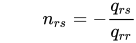
The quantities are evidently numerical quantities, or ratios.

The conductor may be supposed reduced to a point, and , , &c. need not be insulated from each other, but may be different elementary portions of the surface of the same conductor. We shall see the application of this principle when we investigate Green's Functions.
90.] Theorem III. The coefficients of potential are all positive,but none of the coefficients is greater than or .


For let a charge unity be communicated to , the other conductors being uncharged. A system of equipotential surfaces will be formed. Of these one will be the surface of and its potential will be . If is placed in a hollow excavated in so as to be completely enclosed by it, then the potential of will also be .
If, however, is outside of its potential will lie between and zero.
For consider the lines of force issuing from the charged conductor . The charge is measured by the excess of the number of lines which issue from it over those which terminate in it. Hence, if the conductor has no charge, the number of lines which enter the conductor must be equal to the number which issue from it. The lines which enter the conductor come from places of greater potential, and those which issue from it go to places of less potential. Hence the potential of an uncharged conductor must be intermediate between the highest and lowest potentials in the field, and therefore the highest and lowest potentials cannot belong to any of the uncharged bodies.
The highest potential must therefore be , that of the charged body , and the lowest must be that of space at an infinite distance, which is zero, and all the other potentials such as must lie between and zero.
If completely surrounds then = .


91.] Theorem IV. None of the coefficients of induction are positive, and the sum of all those belonging to a single conductor is not numerically greater than the coefficient of capacity of that conductor, which is always positive.
For let be maintained at potential unity while all the other conductors are kept at potential zero, then the charge on is , and that on any other conductor is .

The number of lines of force which issue from is . Of these some terminate in the other conductors, and some may proceed to infinity, but no lines of force can pass between any of the other conductors or from them to infinity, because they are all at potential zero.
No line of force can issue from any of the other conductors such as , because no part of the field has a lower potential than . If is completely cut off from by the closed surface of one of the conductors, then is zero. If is not thus cut off, is a negative quantity.
If one of the conductors completely surrounds , then all the lines of force from fall on and the conductors within it, and the sum of the coefficients of induction of these conductors with respect to will be equal to with its sign changed. But if is not completely surrounded by a conductor the arithmetical sum of the coefficients of induction , &c. will be less than .
We have deduced these two theorems independently by means of electrical considerations. We may leave it to the mathematical student to determine whether one is a mathematical consequence of the other.
Resultant Mechanical Force on any Conductor in terms of the Charges.
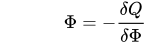
92.] Let be any mechanical displacement of the conductor, and let be the the component of the force tending to produce that displacement, then is the work done by the force during the displacement. If this work is derived from the electrification of the system, then if is the electric energy of the system,


|
, | (3) |

|
or . | (4) |
| Here |
| (5) |

If the bodies are insulated, the variation of must be such that , &c. remain constant. Substituting therefore for the values of the potentials, we have

|
, | (6) |

where the symbol of summation includes all terms of the form within the brackets, and and may each have any values from 1 to . From this we find


|
| (7) |

as the expression for the component of the force which produces variation of the generalized coordinate .

Resultant Mechanical Force in terms of the Potentials.
93.] The expression for in terms of the charges is
|
| (8) |
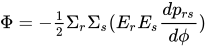
where in the summation and have each every value in succession from 1 to .

|
. | (9) |

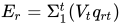
Now the coefficients of potential are connected with those of induction by n equations of the form
|
, | (10) |

and of the form

|
. | (11) |

Differentiating with respect to we get equations of the form

|
, | (12) |

where and may be the same or different.


Hence, putting and equal to and ,
|
, | (13) |
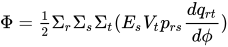
but \Sigma_s(E_s p_{rs})=V_r, so that we may write
|
, | (14) |
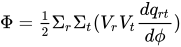
where and may have each every value in succession from 1 to . This expression gives the resultant force in terms of the potentials.
If each conductor is connected with a battery or other contrivance by which its potential is maintained constant during the displacement, then this expression is simply
|
, | (15) |

under the condition that all the potentials are constant.
The work done in this case during the displacement is , and the electrical energy of the system of conductors is increased by ; hence the energy spent by the batteries during the displacement is

|
. | (16) |

It appears from Art. 92, that the resultant force is equal to , under the condition that the charges of the conductors are constant. It is also, by Art. 93, equal to , under the condition that the potentials of the conductors are constant. If the conductors are insulated, they tend to move so that their energy is diminished, and the work done by the electrical forces during the displacement is equal to the diminution of energy.


If the conductors are connected with batteries, so that their potentials are maintained constant, they tend to move so that the energy of the system is increased, and the work done by the electrical forces during the displacement is equal to the increment of the energy of the system. The energy spent by the batteries is equal to double of either of these quantities, and is spent half in mechanical, and half in electrical work.
On the Comparison of Similar Electrified Systems.
94.] If two electrified systems are similar in a geometrical sense., so that the lengths of corresponding lines in the two systems are as to , then if the dielectric which separates the conducting bodies is the same in both systems, the coefficients of induction and of capacity will be in the proportion of to . For if we consider corresponding portions, and , of the two systems, and suppose the quantity of electricity on to be , and that on to be , then the potentials and at corresponding points and , due to this electrification, will be


,and


But is to as to , so that we must have


|
|

But if the inductive capacity of the dielectric is different in the two systems, being in the first and in the second, then if the potential at any point of the first system is to that at the corresponding point of the second as to and if the quantities of electricity on corresponding parts are as to , we shall have


|
|

By this proportion we may find the relation between the total electrification of corresponding parts of two systems, which are in the first place geometrically similar, in the second place composed of dielectric media of which the dielectric inductive capacity at corresponding points is in the proportion of to and in the third place so electrified that the potentials of corresponding points are as to .
From this it appears that if be any coefficient of capacity or induction in the first system, and the corresponding one in the second,


|
; |

and if and denote corresponding coefficients of potential in the two systems,


|
. |
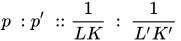
If one of the bodies be displaced in the first system, and the corresponding body in the second system receive a similar displacement, then these displacements are in the proportion of to , and if the forces acting on the two bodies are as to , then the work done in the two systems will be as to .


But the total electrical energy is half the sum of the quantities of electricity multiplied each by the potential of the electrified body, so that in the similar systems, if and be the total electrical energy,

|
, |

and the difference of energy after similar displacements in the two systems will be in the same proportion. Hence, since is proportional to the electrical work done during the displacement,
|
. |

Combining these proportions, we find that the ratio of the resultant force on any body of the first system to that on the corresponding body of the second system is
|
, |

|
or. |

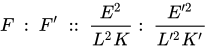
The first of these proportions shews that in similar systems the force is proportional to the square of the electromotive force and to the inductive capacity of the dielectric, but is independent of the actual dimensions of the system.
Hence two conductors placed in a liquid whose inductive capacity is greater than that of air, and electrified to given potentials, will attract each other more than if they had been electrified to the same potentials in air.
The second proportion shews that if the quantity of electricity on each body is given, the forces are proportional to the squares of the electrifications and inversely to the squares of the distances, and also inversely to the inductive capacities of the media.
Hence, if two conductors with given charges are placed in a liquid whose inductive capacity is greater than that of air, they will attract each other less than if they had been surrounded with air and electrified with the same charges of electricity.