A Treatise on Electricity and Magnetism/Volume 1/Chapter 8
CHAPTER VIII.
SIMPLE CASES OF ELECTRIFICATION.
Two Parallel Planes.
124.] We shall consider, in the first place, two parallel plane conducting surfaces of infinite extent, at a distance from each other, maintained respectively at potentials and .


It is manifest that in this case the potential will be a function of the distance from the plane , and will be the same for all points of any parallel plane between and , except near the boundaries of the electrified surfaces, which by the supposition are at an infinitely great distance from the point considered.


Hence, Laplace’s equation becomes reduced to

the integral of which is
;

and since when , , and when , ,


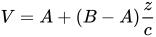
For all points between the planes, the resultant electrical force is normal to the planes, and its magnitude is
.

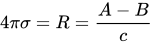
In the substance of the conductors themselves, . Hence the distribution of electricity on the first plane has a surface-density , where


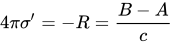
On the other surface, where the potential is , the surface- density will be equal and opposite to , and

Let us next consider a portion of the first surface whose area is , taken so that no part of is near the boundary of the surface.

The quantity of electricity on this surface is , and, by Art. 79, the force acting on every unit of electricity is , so that the whole force acting on the area , and attracting it towards the other plane, is



Here the attraction is expressed in terms of the area , the difference of potentials of the two surfaces (), and the distance between them . The attraction, expressed in terms of the charge , on the area , is


.

The electrical energy due to the distribution of electricity on the area , and that on an area on the surface denned by projecting on the surface by a system of lines of force, which in this case are normals to the planes, is

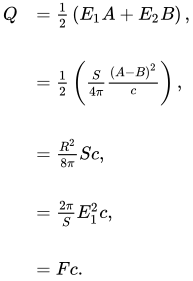
The first of these expressions is the general expression of electrical energy.
The second gives the energy in terms of the area, the distance, and the difference of potentials.
The third gives it in terms of the resultant force , and the volume included between the areas and , and shews that the energy in unit of volume is where .


The attraction between the planes is , or in other words, there is an electrical tension (or negative pressure) equal to on every unit of area.

The fourth expression gives the energy in terms of the charge.
The fifth shews that the electrical energy is equal to the work which would be done by the electric force if the two surfaces were to be brought together, moving parallel to themselves, with their electric charges constant.
To express the charge in terms of the difference of potentials, we have

The coefficient represents the charge due to a difference of potentials equal to unity. This coefficient is called the Capacity of the surface , due to its position relatively to the opposite surface.

Let us now suppose that the medium between the two surfaces is no longer air but some other dielectric substance whose specific inductive capacity is , then the charge due to a given difference of potentials will be times as great as when the dielectric is air, or

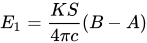
The total energy will be
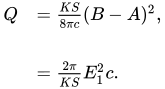
The force between the surfaces will be
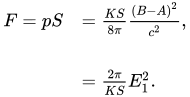
Hence the force between two surfaces kept at given potentials varies directly as , the specific capacity of the dielectric, but the force between two surfaces charged with given quantities of electricity varies inversely as .
Two Concentric Spherical Surfaces.
125.] Let two concentric spherical surfaces of radii and , of which is the greater, be maintained at potentials and respectively, then it is manifest that the potential is a function of the distance from the centre. In this case, Laplace’s equation becomes


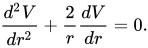
The integral of this is

and the condition that when , and when , gives for the space between the spherical surfaces,


|
|

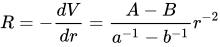
If are the surface-densities on the opposed surfaces of a solid sphere of radius , and a spherical hollow of radius , then


If and be the whole charges of electricity on these surfaces,



The capacity of the enclosed sphere is therefore .

If the outer surface of the shell be also spherical and of radius , then, if there are no other conductors in the neighbourhood, the charge on the outer surface is

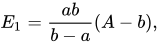
Hence the whole charge on the inner sphere is
and that of the outer

If we put , we have the case of a sphere in an infinite space. The electric capacity of such a sphere is , or it is numerically equal to its radius.

The electric tension on the inner sphere per unit of area is
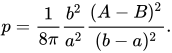
The resultant of this tension over a hemisphere is normal to the base of the hemisphere, and if this is balanced by a surface tension exerted across the circular boundary of the hemisphere, the tension on unit of length being , we have


Hence
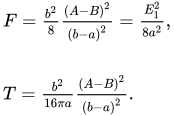
If a spherical soap bubble is electrified to a potential , then, if its radius is , the charge will be , and the surface-density will be


The resultant electrical force just outside the surface will be , and inside the bubble it is zero, so that by Art. 79 the electrical force on unit of area of the surface will be , acting outwards. Hence the electrification will diminish the pressure of the air within the bubble by , or


But it may be shewn that if is the tension which the liquid film exerts across a line of unit length, then the pressure from within required to keep the bubble from collapsing is . If the electrical force is just sufficient to keep the bubble in equilibrium when the air within and without is at the same pressure

Two Infinite Coaxal Cylindric Surfaces.
126.] Let the radius of the outer surface of a conducting cylinder be , and let the radius of the inner surface of a hollow cylinder, having the same axis with the first, be . Let their potentials be and respectively. Then, since the potential is in this case a function of , the distance from the axis, Laplace’s equation becomes
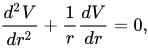
whence

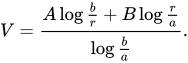
Since when , and when ,
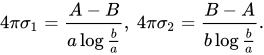
If are the surface-densities on the inner and outer surfaces,
If and are the charges on a portion of the two cylinders of length , measured along the axis,

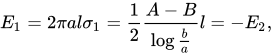
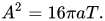
The capacity of a length of the interior cylinder is therefore

If the space between the cylinders is occupied by a dielectric of specific capacity instead of air, then the capacity of the inner cylinder is

The energy of the electrical distribution on the part of the infinite cylinder which we have considered is

127.] Let there be two hollow cylindric conductors and , Fig. 5, of indefinite length, having the axis of for their common axis, one on the positive and the other on the negative side of the origin, and separated by a short interval near the origin of co ordinates.

Let a hollow cylinder of length be placed with its middle point at a distance on the positive side of the origin, so as to extend into both the hollow cylinders.


Let the potential of the positive hollow cylinder be , that of the negative one , and that of the internal one , and let us put for the capacity per unit of length of with respect to , and for the same quantity with respect to .


The capacities of the parts of the cylinders near the origin and near the ends of the inner cylinder will not be affected by the value of provided a considerable length of the inner cylinder enters each of the hollow cylinders. Near the ends of the hollow cylinders, and near the ends of the inner cylinder, there will be distributions of electricity which we are not yet able to calculate, but the distribution near the origin will not be altered by the motion of the inner cylinder provided neither of its ends comes near the origin, and the distributions at the ends of the inner cylinder will move with it, so that the only effect of the motion will be to increase or diminish the length of those parts of the inner cylinder where the distribution is similar to that on an infinite cylinder.
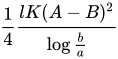
Hence the whole energy of the system will be, so far as it depends on ,
quantities independent of ;

and the resultant force parallel to the axis of the cylinders will be

If the cylinders and are of equal section, and


It appears, therefore, that there is a constant force acting on the inner cylinder tending to draw it into that one of the outer cylinders from which its potential differs most.
If be numerically large and comparatively small, then the force is approximately


so that the difference of the potentials of the two cylinders can be measured if we can measure , and the delicacy of the measurement will be increased by raising , the potential of the inner cylinder.

This principle in a modified form is adopted in Thomson’s Quadrant Electrometer, Art. 219.
The same arrangement of three cylinders may be used as a measure of capacity by connecting and . If the potential of is zero, and that of and is , then the quantity of electricity on will be

so that by moving to the right till becomes the capacity of the cylinder becomes increased by the definite quantity , where


and being the radii of the opposed cylindric surfaces.