87. Introduction. Thus far we have represented the derivative of by the notation
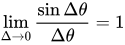
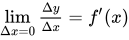
We have taken special pains to impress on the student that the symbol
was to be considered not as an ordinary fraction with dy as numerator and dx as denominator, but as a single symbol denoting the limit of the quotient
as approaches the limit zero.
Problems do occur, however, where it is very convenient to be able to give a meaning to dx and dy separately, and it is especially useful in applications of the Integral Calculus. How this may be done is explained in what follows.
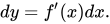
88. Definitions. If is the derivative of for a particular value of x, and is an arbitrarily chosen increment of x, then the differential of , denoted by the symbol , is defined by the equation
showing that when x is the independent variable, the differential of x (= dx) is identical with . Hence, if , (A) may in general be written in the form
The differential of a function equals its derivative multiplied by the differential of the independent variable.
Let us illustrate what this means geometrically.
Graph of function.
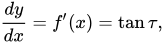
Let be the derivative of at P. Take , then
Therefore , or , is the increment (= QT) of the ordinate of the tangent corresponding to dx.[2]
This gives the following interpretation of the derivative as a fraction.
If an arbitrarily chosen increment of the independent variable x for a point P(x, y) on the curve y = f(x) be denoted by dx, then in the derivative
dy denotes the corresponding increment of the ordinate drawn to the tangent.
89. Infinitesimals. In the Differential Calculus we are usually concerned with the derivative, that is, with the ratio of the differentials dy and dx. In some applications it is also useful to consider dx as an infinitesimal (see §15), that is, as a variable whose values remain numerically small, and which, at some stage of the investigation, approaches the limit zero. Then by (B), §88, and (2), §20, dy is also an infinitesimal.
In problems where several infinitesimals enter we often make use of the following
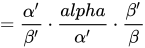
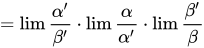
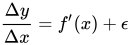
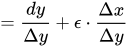
Theorem.In problems involving the limit of the ratio of two infinitesimals, either infinitesimal may be replaced by an infinitesimal so related to it that the limit of their ratio is unity.
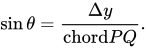
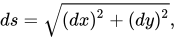
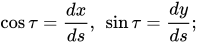
An easy way to remember the relations (24)-(26) differentials dx, dy, ds is to note that they are correctly represented by a right triangle whose hypotenuse is ds, whose sides are dx and dy, and whose angle at the base is . Then
and, dividing by dx or dy, gives (24) or (25) respectively. Also, from the figure,
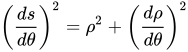
91. Derivative of the arc in polar coördinates. In the derivation which follows we shall employ the same figure and the same notation used in §67
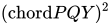
From the right triangle PRQ
.
Dividing throughout by , we get
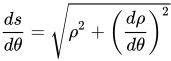
Passing to the limit as diminishes towards zero, we get[4]
.
(30)
∴ .
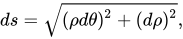
In the notation of differentials this becomes
(31)
.
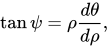
These relations between and the differentials ds, dp, and are correctly represented by a right triangle whose hypotenuse is ds and whose sides are and . Then
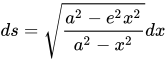
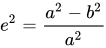
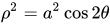
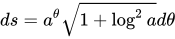
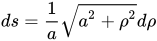
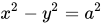
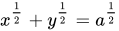
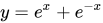
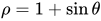
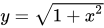
Find the differential of arc in each of the following curves:
1..
Ans.
2..
.
3..
.
4..
.
5..
.
6..
.
HINT. .
7..
8..
9..
.
10..
.
11..
.
12..
.
13.
(a) .
(h) .
(b) .
(i) .
(c) .
(j) .
(d) .
(k) .
(e) .
(l) .
(f) .
(m) .
(g) .
(n) .
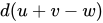
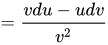
92. Formulas for finding the differentials of functions. Since the differential of a function is its derivative multiplied by the differential of the independent variable, it follows at once that the formulas for finding differentials are the same as those for finding derivatives given in § 33, if we multiply each one by dx.
This gives us
I
.
II
.
III
.
IV
.
V
.
VI
VI
a
.
VII
.
VII
a
.
VIII
.
IX
.
IX
a
.
X
.
XI
.
XII
.
XIII
, etc.
XVIII
, etc.
The term "differentiation" also includes the operation of finding differentials.
In finding differentials the easiest way is to find the derivative as usual, and then multiply the result by dx.
Illustrative Example 1. Find the differential of
Solution.
, Ans.
Illustrative Example 2. Find dy from
Solution.
.
∴
. Ans.
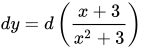
Illustrative Example 3. Find dy from
Solution.
.
∴
.
Illustrative Example 4. Find .
Solution.. Ans.93. Successive differentials. As the differential of a function is in general also a function of the independent variable, we may deal with its differential. Consider the function
.
is called the second differential of (or of the function) and is denoted by the symbol
Similarly, the third differential of, , is written
,
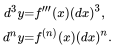
and so on, to the nth differential of ,
.
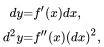
Since , the differential of the independent variable, is independent of (see footnote , p. 131), it must be treated as a constant when differentiating with respect to . Bearing this in mind, we get very simple relations between successive differentials and successive derivatives.For and since dx is regarded as a constant.
Also, and in general
Dividing both sides of each expression by the power of occurring on the right, we get our ordinary derivative notation
.
Powers of an infinitesimal are called infinitesimals of a higher order. More generally, if for the infinitesimals and ,
,
then is said to be an infinitesimal of a higher order than .
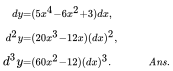
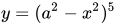
Illustrative Example 1. Find the third differential of
.
Solution.
Note. This is evidently the third derivative of the function multiplied by the cube of the differential of the independent variable. Dividing through by , we get the third derivative
.
EXAMPLES
Differentiate the following, using differentials:
1..
Ans.
.
2..
3..
.
4.
.
5..
.
6..
.
7..
.
8..
.
9..
.
10.
.
11..
.
12..
.
13..
.
14..
15..
16..
17..
↑On account of the position which the derivative here occupies, it is sometimes called the differential coefficient.
The student should observe the important fact that, since dx may be given any arbitrary value whatever, dx is independent of x. Hence, dy is a function of two independent variables x and dx.
↑The student should note especially that the differential (= dy) and the increment (= dy) of the function corresponding to the same value of dx () are not in general equal. For, in the figure, , but .





















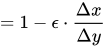
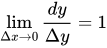
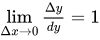
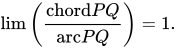
 Denote the increment of s (= arc PQ) by . The definition of the length of arc depends on the assumption that, as Q approaches P,



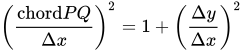
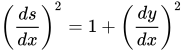







![{\displaystyle ds=\left[1+\left({\frac {dy}{dx}}\right)^{2}\right]^{\frac {1}{2}}dx}](https://wikimedia.org/api/rest_v1/media/math/render/svg/0be4d42393d62651fa28be2ebf16abbe3a7131f9)
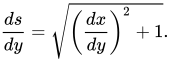
![{\displaystyle ds=\left[\left({\frac {dx}{dy}}\right)^{2}+1\right]^{\frac {1}{2}}dy}](https://wikimedia.org/api/rest_v1/media/math/render/svg/7dd58b7d28b3cb4e49c802e7826e0702e0c3af92)
![{\displaystyle \cos \tau ={\frac {1}{\left[1+\left({\frac {dy}{dx}}\right)^{2}\right]^{\frac {1}{2}}}},\ \sin \tau ={\frac {\frac {dy}{dx}}{\left[1+\left({\frac {dy}{dx}}\right)^{2}\right]^{\frac {1}{2}}}}}](https://wikimedia.org/api/rest_v1/media/math/render/svg/46ad62826e6b1181f896c6853666a9145512c9a5)
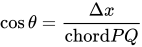
 An easy way to remember the relations (24)-(26) differentials dx, dy, ds is to note that they are correctly represented by a right triangle whose hypotenuse is ds, whose sides are dx and dy, and whose angle at the base is . Then

 From the right triangle PRQ





![{\displaystyle \ ds=\left[\rho ^{2}+\left({\frac {d\rho }{d\theta }}\right)^{2}\right]^{\frac {1}{2}}d\theta }](https://wikimedia.org/api/rest_v1/media/math/render/svg/dfdf4fce3c6dacb64d515471aa2157151154c4e4)




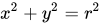

![{\displaystyle ds=\left[1+{\frac {x^{2}}{y^{2}}}\right]^{\frac {1}{2}}dx=\left[{\frac {y^{2}+x^{2}}{y^{2}}}\right]^{\frac {1}{2}}dx=\left[{\frac {r^{2}}{y^{2}}}\right]^{\frac {1}{2}}dx={\frac {rdy}{\sqrt {r^{2}-x^{2}}}}.}](https://wikimedia.org/api/rest_v1/media/math/render/svg/67ca57cdf0c2c4bf4e75ad54330b3e0ff7e2d0e1)
![{\displaystyle ds=\left[1+{\frac {y^{2}}{x^{2}}}\right]^{\frac {1}{2}}dy=\left[{\frac {x^{2}+y^{2}}{x^{2}}}\right]^{\frac {1}{2}}dy=\left[{\frac {r^{2}}{x^{2}}}\right]^{\frac {1}{2}}={\frac {rdy}{\sqrt {r^{2}-y^{2}}}}.}](https://wikimedia.org/api/rest_v1/media/math/render/svg/5742a669df0b774d4fd60565a59e44d8a3d5b196)



![{\displaystyle ds=[a^{2}(1-\cos \theta )^{2}+a^{2}\sin ^{2}\theta ]^{\frac {1}{2}}d\theta =a[2-2\cos \theta ]^{\frac {1}{2}}d\theta =a\left[4\sin ^{2}{\frac {\theta }{2}}\right]^{\frac {1}{2}}d\theta =2a\sin {\frac {\theta }{2}}d\theta .}](https://wikimedia.org/api/rest_v1/media/math/render/svg/d8dd4cb412e1e0e7fffb6e3bfcb1e1a7bf55444a)

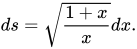





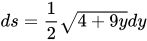
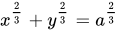
![{\displaystyle ds={\sqrt[{3}]{\frac {a}{y}}}dy}](https://wikimedia.org/api/rest_v1/media/math/render/svg/c9e1a11fddbad008a4d7711e20d2c9a351bdbbba)





























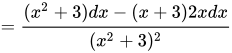
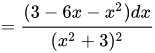






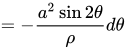
![{\displaystyle d[\arcsin(3t-4t^{3})]}](https://wikimedia.org/api/rest_v1/media/math/render/svg/9c7024053db733fa25d8835e432489fd317f16d6)
![{\displaystyle d[\arcsin(3t-4t^{3})]={\frac {d(3t-4t^{3})}{\sqrt {1-(3t-4t^{3})^{2}}}}={\frac {3dt}{\sqrt {1-t^{2}}}}}](https://wikimedia.org/api/rest_v1/media/math/render/svg/1ba4335bf2c06ae749eb0057815145a7226f3b4e)


![{\displaystyle \scriptstyle {d[d(dy)]}}](https://wikimedia.org/api/rest_v1/media/math/render/svg/d0c1391c1c01f4b9f038d834227636b828354bba)












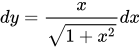
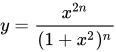
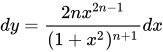
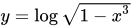
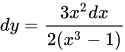



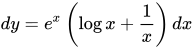
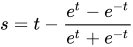
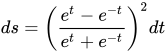

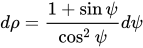
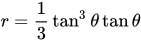
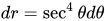
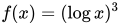
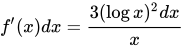
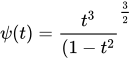
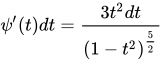
![{\displaystyle d\left[{\frac {x\log x}{1-x}}+\log(1-x)\right]={\frac {\log xdx}{(1-x)^{2}}}}](https://wikimedia.org/api/rest_v1/media/math/render/svg/eba0ec1ae741c66a6b68319d9e51198b98d31622)
![{\displaystyle d[\arctan \log y]={\frac {dy}{y[1+(\log y)^{2}]}}}](https://wikimedia.org/api/rest_v1/media/math/render/svg/5a98fc1ce77b71909a37c62699880affc62458c2)
![{\displaystyle d\left[r\operatorname {arcvers} {\frac {y}{r}}-{\sqrt {2ry-y^{2}}}\right]={\frac {ydy}{\sqrt {2ry-y^{2}}}}}](https://wikimedia.org/api/rest_v1/media/math/render/svg/95651d1868a5efe2c382c813a689b1904dd41c4b)
![{\displaystyle d\left[{\frac {\cos \psi }{2\sin ^{2}\psi }}-{\frac {1}{2}}\log \tan {\frac {\psi }{2}}\right]=-{\frac {d\psi }{\sin ^{3}\psi }}}](https://wikimedia.org/api/rest_v1/media/math/render/svg/c5952925071aa7aa6b3b9573ff5baffb82d943e7)