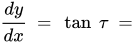
64. Direction of a curve. It was shown in § 32, p. 31, that if
is the equation of a curve (see figure), then
Example of tangents to curve.
slope of line tangent to the curve at any point P.
The direction of a curve at any point is defined to be the same as the direction of the line tangent to the curve at that point. From this it follows at once that
slope of the curve at any point P.
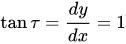
At a particular point whose coördinates are known we write
slope of the curve (or tangent) at point .
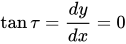
At points such as D, F, H, where the curve (or tangent) is parallel to the axis of X;
= 0°; therefore .
At points such as A, B, G, where the curve (or tangent) is perpendicular to the axis of X;
= 90°; therefore .
At points such as E, where the curve is rising,[1]
an acute angle; therefore a positive number.
The curve (or tangent) has a positive slope to the left of B, between D and F, and to the right of G.
At points such as C, where the curve is falling,[1]
an obtuse angle; therefore a negative number.
The curve ( or tangent) has a negative slope between B and D, and between F and G.
Example curve.
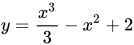
ILLUSTRATIVE EXAMPLE 1. Given the curve (see figure).
(a) Find when .
(b) Find when .
(c) Find the points where the curve is parallel to OX.
(d) Find the points where = 45°.
(e) Find the points where the curve is parallel to the line (line AB).
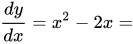
Solution. Differentiating, slope at any point.
(a) ; therefore = 135°. Ans.
(b) ; therefore . Ans.
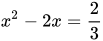
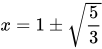
(c) = 0°, ; therefore . Solving this equation, we find that or 2, giving points C and D where the curve (or tangent) is parallel to OX.
(d) = 45°, ; therefore . Solving, we get , giving two points where the slope of the curve (or tangent) is unity.
(e) Slope of line ; therefore . Solving, we get , giving points E and F where curve (or tangent) is parallel to line AB.
Since a curve at any point has the same direction as its tangent at that point, the angle between two curves at a common point will be the angle between their tangents at that point.
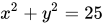
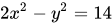
ILLUSTRATIVE EXAMPLE 2. Find the angle of intersection of the circles
(A) ,
(B)
Solution. Solving simultaneously, we find the points of intersection to be (3, 2) and (1, -2).
Two intersecting circles.
from (A).
By §63, p. 69
from (B).
By §63, p. 69
slope of tangent to (A) at (3, 2).
slope of tangent to (B) at (3, 2).
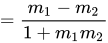
The formula for finding the angle between two lines whose slopes are and is
.
55, p. 3 [§ 1]
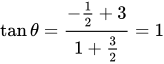
Substituting, ; therefore = 45°. Ans.
This is also the angle of intersection at the point (1, -2).
EXAMPLES
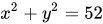
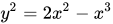
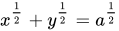
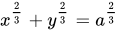
The corresponding figure should be drawn in each of the following examples:
1. Find the slope of at the origin. Ans..
2. What angle does the tangent to the curve at the origin make with the axis of X? Ans. = 135°.
3. What is the direction in which the point generating the graph of tends to move at the instant when ? Ans. Parallel to a line whose slope is 5.
4. Show that (or slope) is constant for a straight line.
5. Find the points where the curve is parallel to the axis of X. Ans. x = 3, x = -1.
6. At what point on is the slope equal to 3? Ans. (2, 4).
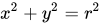
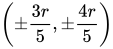
7. At what points on the circle is the slope of the tangent line equal to ? Ans..
8. Where will a point moving on the parabola be moving parallel to the line ? Ans. (6, -3).
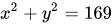
9. Find the points where a particle moving on the circle moves perpendicular to the line . Ans. (± 12, \mp 5).
10. Show that all the curves of the system have the same slope; i.e. the slope is independent of .
11. The path of the projectile from a mortar cannon lies on the parabola ; the unit is 1 mile, OX being horizontal and OY vertical, and the origin being the point of projection. Find the direction of motion of the projectile
(a) at instant of projection;
(b) when it strikes a vertical cliff miles distant.
(c) Where will the path make an inclination of 45° with the horizontal?
(d) Where will the projectile travel horizontally?
Ans. (a) ; (b) 135°; (c) ; (d) (1, 1).
12. If the cannon in the preceding example was situated on a hillside of inclination 45°, at what angle would a shot fired up strike the hillside? Ans. 45°.
13. At what angles does a road following the line intersect a railway track following the parabola . Ans., and .
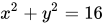
14. Find the angle of intersection between the parabola and the circle . Ans.
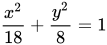
15. Show that the hyperbola and the ellipse intersect at right angles.
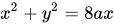
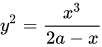
16. Show that the circle and the cissoid
(a) are perpendicular at the origin;
(b) intersect at an angle of 45° at two other points.
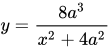
17. Find the angle of intersection of the parabola and the witch . Ans. = 71°33'.9.
18. Show that the tangents to the folium of Descartes at the points where it meets the parabola are parallel to the axis of Y.
19. At how many points will a particle moving on the curve be moving parallel to the axis of X? What are the points?
Ans. Two; at (1, - 4) and ().
20. Find the angle at which the parabolas and intersect. Ans..
21. Find the relation between the coefficients of the conics and when they intersect at right angles. Ans..
65. Equations of tangent and normal, lengths of subtangent and subnormal. Rectangular coördinates. The equation of a straight line passing through the point () and having the slope is
Line tangent to curve AB.
. 54, (c), p. 3 [§ 1]
If this line is tangent to the curve AB at the point P(), then from § 64, p. 73,
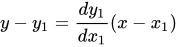
Hence at point of contact the equation of the tangent line TP1 is
(1) .
The normal being perpendicular to tangent, its slope is
.
By 55, p. 3 [§ 1]
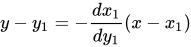
And since it also passes through the point of contact , we have for the equation of the normal
(2) .
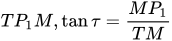
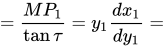
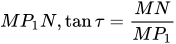
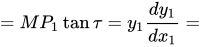
That portion of the tangent which is intercepted between the point of contact and OX is called the length of the tangent (), and its projection on the axis of X is called the length of the sub tangent (= TM). Similarly, we have the length of the normal () and the length of the subnormal (= MN).
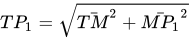
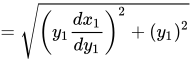
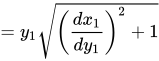
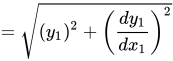
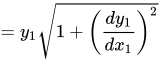
The length of tangent () and the length of normal () may then be found directly from the figure, each being the hypotenuse of a right triangle having the two legs known. Thus
(5)
= length of tangent.
(6)
= length of normal.
The student is advised to get the lengths of the tangent and of the normal directly from the figure rather than by using (5) and (6).
When the length of subtangent or subnormal at a point on a curve is determined, the tangent and normal may be easily constructed.
EXAMPLES
1. Find the equations of tangent and normal, lengths of subtangent, subnormal
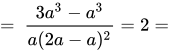
tangent, and normal at the point on the cissoid .
Graph of cissoid
Solution.
.
Hence
slope of tangent.
Substituting in (1) gives
, equation of tangent.
Substituting in (2) gives
, equation of normal.
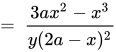
Substituting in (3) gives
length of subtangent.
Substituting in (4) gives
length of subnormal.
Also length of tangent.
and length of normal.
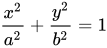
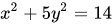
2. Find equations of tangent and normal to the ellipse at the points where .
Ans. At .
At .
3. Find equations of tangent and normal, lengths of subtangent and subnormal at the point on the circle .[5]
Ans..
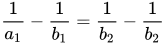
4. Show that the subtangent to the parabola is bisected at the vertex, and that the subnormal is constant and equal to .
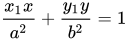
5. Find the equation of the tangent at to the ellipse .
Ans..
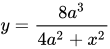
6. Find equations of tangent and normal to the witch as at the point where .
Ans..
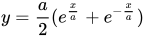
7. Prove that at any point on the catenary the lengths of subnormal and normal are respectively.
8. Find equations of tangent and normal, lengths of subtangent and subnormal, to each of the following curves at the points indicated:
(a) at .
(e) at .
(b) at .
(f) where .
(c) where .
(g) , .
(d) at .
(h) at .
9. Prove that the length of subtangent to is constant and equal to .
10. Get the equation of tangent to the parabola which makes an angle of 45° with the axis of X.
Ans..
HINT. First find point of contact by method of Illustrative Example 1, (d), p. 74 [§ 64].
11. Find equations of tangents to the circle which are parallel to the line .
Ans..
12. Find equations of tangents to the hyperbola which are perpendicular to the line .
Ans..
13. Show that in the equilateral hyperbola the area of the triangle formed by a tangent and the coördinate axes is constant and equal to .
14. Find equations of tangents and normals to the curve at the points where .
Ans. At .
At .
15. Show that the sum of the intercepts of the tangent to the parabola
on the coordinate axes is constant and equal to .
16. Find the equation of tangent to the curve at the origin.
Ans..
17. Show that for the hypocycloid that portion of the tangent included between the coördinate axes is constant and equal to .
18. Show that the curve has a constant subtangent.
66. Parametric equations of a curve. Let the equation of a curve be
(A) .
If is given as a function of a third variable, say, called a parameter, then by virtue of (A) is also a function of , and the same functional relation (A) between and may generally be expressed by means of equations in the form
(B)
Graph of circle showing parameters.
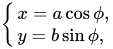
each value of giving a value of and a value of . Equations (B) are called parametric equations of the curve. If we eliminate between equations (B), it is evident that the relation (A) must result. For example, take equation of circle
or .
Let
; then
, and we have
(C)
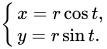
as parametric equations of the circle in the figure, being the parameter.
If we eliminate between equations (C) by squaring and adding the results, we have
,
the rectangular equation of the circle. It is evident that if varies from 0 to , the point will describe a complete circumference.
In § 71 we shall discuss the motion of a point P, which motion is defined by equations such as
.
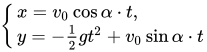
We call these the parametric equations of the path, the time being the parameter. Thus in Ex. 2, p. 93, we see that
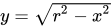
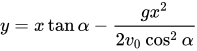
are really the parametric equations of the trajectory of a projectile, the time being the parameter. The elimination of gives the rectangular equation of the trajectory
.
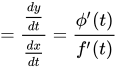
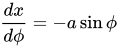
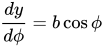
Since from (B) is given as a function of , and as a function of , we have
by XXV
;
by XXVI
that is,
(D)
.
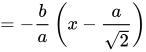
Hence, if the parametric equations of a curve are given, we can find equations of tangent and normal, lengths of subtangent and subnormal at a given point on the curve, by first finding the value of at that point from (D) and then substituting in formulas (1), (2), (3), (4) of the last section.
ILLUSTRATIVE EXAMPLE 1. Find equations of tangent and normal, lengths of subtangent and subnormal to the ellipse
↑By this notation is meant that we should first find , then in the result substitute for and for . The student is warned against interpreting the symbol to mean the derivative ofwith respect to, for that has no meaning whatever, since and are both constants.
↑If subtangent extends to the right of T, we consider it positive; if to the left, negative.
↑If subnormal extends to the right of M, we consider it positive; if to the left, negative.
↑In Exs. 3 and 5 the student should notice that if we drop the subscripts in equations of tangents, they reduce to the equations of the curves themselves.
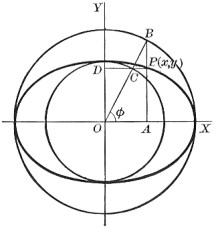
↑As in the figure draw the major and minor auxiliary circles of the ellipse. Through two points B and C on the same radius draw lines parallel to the axes of coördinates. These lines will intersect in a point on the ellipse, because
Major and minor auxiliary circles of the ellipse.
and
,
or,
and .
Now squaring and adding, we get
,
the rectangular equation of the ellipse. is sometimes called the eccentric angle of the ellipse at the point P.
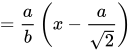
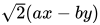
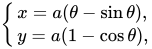
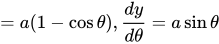
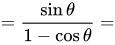
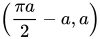
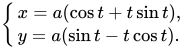
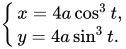
↑Plot of a cycloid. The path described by a point on the circumference of a circle which rolls without sliding on a fixed straight line is called the cycloid. Let the radius of the rolling circle be , P the generating point, and M the point of contact with the fixed line OX, which is called the base. If arc PM equals OM in length, then P will touch at O if the circle is rolled to the left. We have, denoting angle POM by θ,
,
,
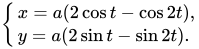
the parametric equations of the cycloid, the angle θ through which the rolling circle turns being the parameter. is called the base of one arch of the cycloid, and the point V is called the vertex. Eliminating θ, we get the rectangular equation


![{\displaystyle \left[{\frac {dy}{dx}}\right]_{x=x_{1},y=y_{1}}\ =}](https://wikimedia.org/api/rest_v1/media/math/render/svg/f58a55a96b1d5123ee04c16ec254eaa7388c279e)




![{\displaystyle \tan \tau =\left[{\frac {dy}{dx}}\right]_{x=1}=1-2=-1}](https://wikimedia.org/api/rest_v1/media/math/render/svg/403a4f73dec5a95d0b5dbfbbea42baa258de3a67)
![{\displaystyle \tan \tau =\left[{\frac {dy}{dx}}\right]_{x=3}=9-6=3}](https://wikimedia.org/api/rest_v1/media/math/render/svg/61eda046284ebd3ea187ee62e59624cd3a71769d)









![{\displaystyle \left[{\frac {2-x}{y}}\right]_{x=3,y=2}}](https://wikimedia.org/api/rest_v1/media/math/render/svg/a3a3387fa6aaba80e18fbd6ae487fb52fc027413)

![{\displaystyle \left[{\frac {x}{1-y}}\right]_{x=3,y=2}}](https://wikimedia.org/api/rest_v1/media/math/render/svg/8c7e8440b08191c43ca14e9001ab2aa75bf67771)































![{\displaystyle m=\tan \tau =\left[{\frac {dy}{dx}}\right]_{x=x_{1},y=y_{1}}={\frac {dy_{1}}{dx_{1}}}}](https://wikimedia.org/api/rest_v1/media/math/render/svg/a8c913af87d6cf73886c9164afe6744648e0a1f8)










![{\displaystyle {\frac {dy_{1}}{dx_{1}}}=\left[{\frac {dy}{dx}}\right]_{x=a,y=a}}](https://wikimedia.org/api/rest_v1/media/math/render/svg/c2e41005f23087a3a902958644528e7c9c2ff351)