On Einstein's Theory of gravitation


"On Einstein's Theory of gravitation." By Prof. H. A. Lorentz.
I.
(Communicated in the meeting of February 26, 1916).
§ 1. In pursuance of his important researches on gravitation Einstein has recently attained the aim which he had constantly kept in view; he has succeeded in establishing equations whose form is not changed by an arbitrarily chosen change of the system of coordinates[1]. Shortly afterwards, working out an idea that had been expressed already in one of Einstein's papers, Hilbert[2] has shown the use that may be made of a variation law that may be regarded as Hamilton's principle in a suitably generalized form. By these results the "general theory of relativity" may be said to have taken a definitive form, though much remains still to be done in further developing it and in applying it to special problems. It will also be desirable to present the fundamental ideas in a form as simple as possible.
In this communication it will be shown that a four-dimensional geometric representation may be of much use for this latter purpose; by means of it we shall be able to indicate for a system containing a number of material points and an electromagnetic field (or eventually only one of these) the quantity , which occurs in the variation theorem, and which we may call the principal function. This quantity consists of three parts, of which the first relates to the material points, the second to the electromagnetic field and the third to the gravitation field itself.

As to the material points, it will be assumed that the only connexion between them is that which results from their mutual gravitational attraction.
§ 2. We shall be concerned with a four-dimensional extension , in which "space" and "time" are combined, so that each point in it indicates a definite place and at the same time a definite moment of time . If we say that refers to a material point we mean that at the time this point is found at the place . In the course of time the material point is represented every moment by a new point ; all these points lie on the "world-line", which represents the state of motion (or eventually the state of rest) of the material point[3]. In the same sense we may speak of the world-line of a propagated light-vibration. An intersection of two world-lines means that the two objects to which they belong meet at a certain moment, that a "coincidence" takes place[4]. Now Einstein has made the striking remark[5] that the only thing we can learn from our observations and with which our theories are essentially concerned, is the existence of these coincidences. Let us suppose e.g. that we have observed an occultation of a star by the moon or rather the reappearance of a star at the moon's border. Then the world-line of a certain light-vibration starting from a point on the world-line of the star has in its further course intersected the world-line of a point of the border of the moon and finally that of the observer's eye. A similar remark may be made when the moment of reappearance is read on a clock. Let us suppose that the light-vibration itself lights the dial-plate, reaching it when the hand is at the point ; then we may say that three world-lines, viz. that of the light-vibration, that of the hand and that of the point intersect.


§ 3. We may imagine that, in order to investigate a gravitation field as e.g. that of the sun, a great number of material points, moving in all directions and with different velocities, are thrown into it, that light-beams are also made to traverse the field and that all coincidences are noted[6]. It would be possible to represent the results of these observations by world-lines in a four-dimensional figure — let us say in a "field-figure" — the lines being drawn in such a way that each observed coincidence is represented by an intersection of two lines and that the points of intersection of one line with a number of the others succeed each other in the right order.
Now, as we have to attend only to the intersections, we have a great degree of liberty in the construction of the "field-figure". If, independently of each other, two persons were to describe the same observations, their figures would probably look quite different and if these figures were deformed in an arbitrary way, without break of continuity, they would not cease to serve the purpose.
After having constructed a field-figure we may introduce "coordinates", by which we mean that to each point we ascribe four numbers , in such a way that along any line in the field-figure these numbers change continuously and that never two different points get the same four numbers. Having done this we may for each point seek a point in a four-dimensional extension , in which the numbers ascribed to are the Cartesian coordinates of the point . In this way we obtain in a figure , which just as well as can serve as field-figure and which of course may be quite different according to the choice of the numbers , that have been ascribed to the points of .




If now it is true that the coincidences only are of importance it must be possible to express the fundamental laws of the phenomena by geometric considerations referring to the field-figure, in such a way that this mode of expression is the same for all possible field-figures; from our point of view all these figures can be considered as being the same. In such a geometric treatment the introduction of coordinates will be of secondary importance; with a single exception (§ 13) it only serves for short calculations which we have to intercalate (for the proof of certain geometric propositions) and for establishing the final equations, which have to be used for the solution of special problems. In the discussion of the general principles coordinates play no part; and it is thus seen that the formulation of these principles can take place in the same way whatever be our choice of coordinates. So we are sure beforehand of the general covariancy of the equations that was postulated by Einstein.
§ 4. Einstein ascribes to a line-element in the field-figure a length defined by the equation


| (1) |
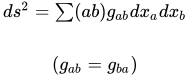
Here are the changes of the coordinates when we pass from to , while the coefficients depend in one way or another on the coordinates. The gravitation field is known when these 10 quantities are given as functions of . Here it must be remarked that in all real cases the coordinates can be chosen in such a way that for one point arbitrarily chosen (1) becomes



This requires that the determinant of the coefficients of (1) be always negative. The minor of this determinant corresponding to the coefficient will be denoted by .


Around each point of the field-figure as a centre we may now construct an infinitesimal surface[7], which, when is chosen as origin of coordinates, is determined by the equation
| (2) |

where is an infinitely small positive constant which we shall fix once for all. This surface, which we shall call the indicatrix, is a hyperboloid with one real axis and three imaginary ones. We shall also introduce the surface determined by the equation

| (3) |

which differs from (2) only by the sign of . We shall call this the conjugate indicatrix. It is to be understood that the indicatrices and conjugate indicatrices take part in the changes to which the field-figure may be subjected. As these surfaces are infinitely small, they always remain hyperboloids of the said kind. The gravitation field will now be determined by these indicatrices, which we can imagine to have been constructed in the field-figure without the introduction of coordinates. When we have occasion to use these latter, we shall so choose them that the "axes" intersect the conjugate indicatrix constructed around their starting point, while the indicatrix itself is intersected by the axis . This involves that the coefficients are negative and that is positive.


§ 5. The indicatrices will give us the units in which we shall express the length of lines in the field-figure and the magnitude of two-, three or four-dimensional extensions. When we use these units we shall say that the quantities in question are expressed in natural measure.
In the case of a line-element the unit might simply be the radius-vector in the direction of the indicatrix or the conjugate indicatrix described about . It is however desirable to distinguish the two cases that intersects the indicatrix itself or the conjugate indicatrix. In the latter case we shall ascribe an imaginary length to the line-element[8]. Besides, by taking as unit not the radius-vector itself but a length proportional to it, the numerical value of a line-element may be made to be independent of the choice of the quantity .
These considerations lead us to define the length that will be ascribed to line-elements by the assumption that each radius-vector of the indicatrix has in natural measure the length , while each radius-vector of the conjugate indicatrix has the length .[9]

It will now be clear that the length of an arbitrary line in the field-figure can be found by integration, each of its elements being measured by means of the indicatrix or the conjugate indicatrix belonging to the position of the element. In virtue of our definitions a deformation of the field-figure will not change the length of lines expressed in natural measure and a geodetic line will remain a geodetic line.
§ 6. We are now in a position to indicate the first part of the principal function (§ 1). Let be a closed surface in the field-figure and let us confine ourselves to the principal function so far as it belongs to the space enclosed by that surface. Then the quantity is the sum, taken with the negative sign, of the lengths of all world-lines of material points so far as they lie within , each length multiplied by a constant , characteristic of the point in question and to be called its mass.[10]


It must be remarked that the elements of the world-lines of material points intersect the corresponding indicatrices themselves. The lengths of these lines are therefore real positive quantities.
A deformation of the field-figure leaves unchanged.
§ 7. We shall now pass on to the part of the principal function belonging to the gravitation field. The mathematical expression for this part was communicated to me by Einstein in our correspondence. It is also to be found in Hilbert's paper in which it is remarked that the quantity in question may be regarded as the measure of the curvature of the four-dimensional extension to which (1) relates. Here we have to speak only of the interpretation of this quantity. To find this the following geometrical considerations may be used.
Let and be two line-elements starting from a point of the field-figure, the line-element joining the extremities and . If then the lengths of these elements in natural measure are


we define the angle between and by the well known trigonometric formula

| (4) |

from which one can derive
| (5) |

By means of this formula we are able to determine the angle between any two intersecting lines. Of course the two other angles of the triangle can be calculated in the same way.

Now two cases must be distinguished.
a. The plane of the triangle cuts the conjugate indicatrix, but not the indicatrix itself. Then the three sides have positive imaginary values. Moreover each of them proves to be smaller than the sum of the others, from which one finds that the angles have real values and that their sum is .

b. The plane PQR cuts both the indicatrix and the conjugate indicatrix. In this case different positions of the triangle are still possible. We can however confine ourselves to triangles the three sides of which are real. These are really possible, for in the plane of a hyperbola we can draw triangles the sides of which are parallel to radius-vectors drawn from the centre to points of the curve (and not of the conjugate hyperbola).
By a closer consideration of the triangles now in question it is found however that by the choice of our "natural" units one side is necessarily longer than the sum of the other two. Formula (4) then shows that the cosines of the angles are real quantities, greater than 1 in absolute value, two of them being positive, and the third negative. We must therefore ascribe to the angles imaginary or complex values. If for we put


and

we find for the three angles expressions of the form
and

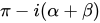
so that the sum is again .
From the cosine calculated by (4) or (5) the sine can be derived by means of the formula
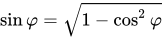
where for the case we can confine ourselves to the value

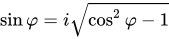
with the positive sign.
It deserves special notice that two conjugate radius-vectors of the indicatrix and the conjugate indicatrix are perpendicular to each other and that a deformation of the field-figure does not change the angle between two intersecting lines determined according to our definitions.
§ 8. Before proceeding further we must now indicate the natural units (§ 5) for two-, three-, or four-dimensional extensions in the field-figure. Like the unit of length, these are defined for each point separately, so that the numerical value of a finite extension is found by dividing it into infinitely small parts.
A two-dimensional extension cuts the conjugate indicatrix in an ellipse, or the indicatrix itself and the conjugate indicatrix in two conjugate hyperbolae. In both cases we derive our unit from the area of a parallelogram described on conjugate radius-vectors.
A three-dimensional extension cuts the conjugate indicatrix in an ellipsoid, or the indicatrix and its conjugate in two conjugate hyperboloids. Now our unit will be derived from the volume of a parallelepiped described on three conjugate radius-vectors.
In a similar way the magnitude of four-dimensional extensions will be determined by comparison with a parallelepiped the edges of which are four conjugate radius-vectors of the indicatrix and the conjugate indicatrix.
It must here be kept in mind that, according to well known theorems, the area of the parallelogram and the volume of the parallelepipeds in question are independent of the special choice of the conjugate radius-vectors.
We shall further specify the units in such a way (comp. § 5) that the numerical magnitude of a parallelogram or a parallelepiped described on conjugate radius-vectors is found by multiplying the numbers by which the edges are expressed in natural measure.
From what has been said it follows that the area of the parallelogram described on two line-elements is given by the product of the lengths of these elements and the sine of the enclosed angle. Similarly the area of an infinitely small triangle is determined by half the product of two sides and the sine of the angle between them.
We need hardly add that the numerical value of any two-, three- or four-dimensional domain expressed in natural measure is not changed by a deformation of the field-figure.
§ 9. Let, at any point of the field-figure, 1, 2, 3, 4 be four arbitrarily chosen conjugate radius-vectors of the indicatrix. Two of these determine an infinitely small part of a two-dimensional extension. We may prolong this part to finite distances from by drawing from this point geodetic lines whose initial directions lie in the plane . In this way we obtain six two-dimensional extensions (1,2), (2,3), (3,1), (1,4), (2,4) and (3,4). Let us now consider in one of these e. g. () an infinitesimal triangle near the point , the sides of which are geodetic lines (viz. geodetic lines in ()). If in calculating the angles of this triangle we go to quantities of the second order with respect to the sides and to the distances from , the sum of the angles proves to have no longer the value (comp. § 7). The "excess" is proportional to the area of the triangle, independently of the length of the sides, of their ratios and of the position of the triangle in the extension (). For the three extensions (1,2) (2,3), (3,1), which do not intersect the indicatrix itself but the conjugate indicatrix, this proposition follows from a well-known theorem of Gauss in the theory of curvature of surfaces; for the other three (1,4), (2,4), (3,4), which cut the indicatrix itself, the proof can be given by direct calculation. The considerations necessary for this, and some other calculations with which we shall be concerned further on will be communicated in a later paper.


In considering the three last-mentioned extensions I have confined myself to triangles with real sides (§ 7, b).
The quotient

is now for each extension a definite number, which we may consider as a measure of the curvature of the two-dimensional extension (); the sum of the six numbers may be called the curvature of the field-figure at the point in question. This quantity is the same that has been introduced by Hilbert; this results from the calculation of its value, which at the same time shows to be independent of the special choice of the directions 1, 2, 3, 4 introduced in the beginning of this §.


The numbers all real and have a meaning that can be indicated without the introduction of coordinates; moreover their sum is not changed by a deformation of the field-figure.
If now is an element of the four-dimensional extension of the field-figure, expressed in natural measure, the part of the principal function belonging to the gravitation field is

| (6) |
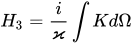
where the integration is extended to the domain considered (§ 6) while is the gravitation constant. too is not changed by a deformation of the field-figure.


The factor has been introduced in order to obtain a real value for , the element being represented in natural measure by a negative imaginary number (§ 8).

§ 10. What we have to say of the electromagnetic field must be preceded by some considerations belonging to what may be called the "vector theory" of the field-figure.
A line-element , taken in a definite, direction (indicated by the order of the letters), may be called a vector. Such vectors can be compounded or decomposed by means of parallelograms or parallelepipeds. Especially, when coordinates have been chosen, a vector may be resolved into four components which have the directions of the coordinates, viz. such directions that a shift along the first e.g. changes , while remain constant. The four components in question are determined by the differentials corresponding to . We shall say that by these they are expressed in "-measure". Their values in natural measure are found by multiplying by certain factors. If we keep in mind that the radius-vectors of the e conjugate indicatrix and the indicatrix in the directions of the axes are expressed in " measure" by



and in natural units by

we find for the reducing factors
| (7) |

In the language of vector-analysis the vector obtained by the composition of two or more vectors is also called the sum of these vectors.
We shall also speak of finite vectors, i.e. of directed quantities which can be represented on an infinitely reduced scale by line-elements in the field-figure. If is the constant "reduction factor" chosen for this purpose, a vector will be represented by a line-element , the direction of which is also ascribed to . It will now be evident that two finite vectors, as well as two infinitely small ones, determine an infinitesimal two dimensional extension and that finite vectors can be compounded and resolved by means of parallelograms and parallelepipeds. Also that we may speak of the "magnitude" of such figures, that e.g. the rule given in § 8 applies to the parallelogram described on two vectors.


The components of a vector in the directions of the coordinates expressed in -measure will be called . This means that are equal to the differentials corresponding to the infinitely small vector .


If we want to know the components of in natural units we must multiply by the factors (7).

§ 11. Two vectors and starting from a point of the field-figure and lying in a plane , determine what we shall call a rotation in that plane. We ascribe to it the direction indicated by the order and a value given by the parallelogram described on and and expressed in natural measure[11]. This involves that the same rotation may be represented in many different ways by two vectors in the plane .


For the rotation we shall also use the symbol .
![{\displaystyle [\mathrm {A\cdot B]} }](https://wikimedia.org/api/rest_v1/media/math/render/svg/f29c2337c99435dfb7e852a107a462704c0a6a17)
By the vector product of three vectors at a point of the field-figure and not lying in one plane we shall understand a vector the direction of which is conjugate with each of the three vectors (and therefore with the three-dimensional extension ), the direction of corresponding to those of and in a way presently to be indicated, while the magnitude of , expressed in natural measure, is equal to that of the parallelepiped described on , and and expressed in the same measure. This definition involves that the value is ascribed to the vector product of three vectors lying in one and the same plane.
![{\displaystyle [\mathrm {A\cdot B\cdot C]} }](https://wikimedia.org/api/rest_v1/media/math/render/svg/4b947cb5f806578247a8c8ca027ebd9bf141d687)


A further statement about the direction of is necessary because two opposite directions are conjugate with . For one set of three directions we shall choose arbitrarily which of its two conjugate directions will be said to correspond to it. If this is the direction , then the direction corresponding to will be determined by the rule that , passes into by a gradual passage of the first three vectors from into , this latter passage being effected in such a way that during the change the vectors never come to lie in one plane.


The vector product takes the opposite direction when one of the vectors is reversed as well as when two of them are interchanged. We must therefore always attend to the order of the symbols in .
The vector product possesses the distributive property with respect to each of the three vectors, so that e.g. if and are vectors,


![{\displaystyle \left[\left(\mathrm {A} _{1}+\mathrm {A} _{2}\right)\cdot \mathrm {B\cdot C} \right]=\mathrm {\left[A_{1}\cdot B\cdot C\right]+\left[A_{2}\cdot B\cdot C\right]} }](https://wikimedia.org/api/rest_v1/media/math/render/svg/e5c66c3e4d0ca2358ee750c91b4299166ab11a5c)
From this we can infer that depends only on and the rotation determined by and . For this reason we write for the vector product also ; in calculating it we are free to replace the rotation by any two vectors by means of which it can be represented.
![{\displaystyle [\mathrm {R\cdot C]} }](https://wikimedia.org/api/rest_v1/media/math/render/svg/ef5529561a9fc955876d00fd46c28b2f5210bcc8)
If , and are rotations in the same plane, such that the value and direction of are found by adding and algebraically, we have, in virtue of the distributive property


![{\displaystyle [\mathrm {R_{1}\cdot C]} +[\mathrm {R_{2}\cdot C]} =[\mathrm {R\cdot C]} }](https://wikimedia.org/api/rest_v1/media/math/render/svg/dd9ad25395ad4e2eb73e6ddd824d368df27e8469)
Let us consider e.g. the three-dimensional extension , which cuts the conjugate indicatrix in the ellipsoid


If we agree that in -measure spaces in this extension will be represented by positive numbers and that a parallelepiped with the positive edges will have the volume , we find for that of the parallelepiped on three conjugate radius-vectors



where it has been taken into consideration that is negative.

The volume of the same parallelepiped being expressed in natural measure by — (§ 8), we have to multiply by

| (8) |

if we want to pass from the expression in -measure to that in natural measure.
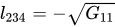
For the extension , i.e. the corresponding factor is


| (9) |
§ 13. In the theory of electromagnetic phenomena we are concerned in the first place with the electric charge and the convection current. So far as these quantities belong to a definite element of the field-figure they may be combined into

where is a vector which we may call the current vector. When it is resolved into four components having the directions of the axes, the first three components determine the convection current, while the fourth component gives the density of the electric charge.

As to the electric and the magnetic force, these two taken together can be represented at each point of the field-figure by two rotations
and


in definite, mutually conjugate two-dimensional extensions. These quantities are closely connected with the current vector, for after having introduced coordinates we have for each closed surface the vector equation
| (10) |
![{\displaystyle \int \left\{\left[\mathrm {R} _{e}\cdot \mathrm {N} \right]+\left[\mathrm {R} _{h}\cdot \mathrm {N} \right]\right\}_{x}d\sigma =i\int \{\mathrm {q} \}_{x}d\Omega }](https://wikimedia.org/api/rest_v1/media/math/render/svg/c0cd820ae56671134f44895e7974aa0e138b0fdd)
where the second integral has to be taken over the domain enclosed by . On the left hand side represents a three-dimensional surface-element expressed in natural units and a vector of the magnitude 1 in natural measure conjugate with or perpendicular to that element (§ 7) and directed towards the outside of the domain . The index shows that the vector must be expressed in -measure. At each point of the surface we must resolve the vector along the four directions of the coordinates, express each component in -measure (§10) and finally, after multiplication by , we must add algebraically all -components; similarly all -components and so on.


![{\displaystyle \left[\mathrm {R} _{e}\cdot \mathrm {N} \right]+\left[\mathrm {R} _{h}\cdot \mathrm {N} \right]}](https://wikimedia.org/api/rest_v1/media/math/render/svg/8f59fe97d9452024cd22465dec1fa172cfc22025)

It must be expressly remarked that if an equation like (10) in which we are concerned with the composition of vectors at different points of the field-figure, shall have a definite meaning we must know which components are to be considered as having the same direction, so that they can be added. This has been determined by the introduction of coordinates.
On the right hand side of the equation the index means that the vector must be expressed in -measure and the factor had to be introduced because is imaginary.
One can prove that equation (10) is equivalent to the differential equations which in Einstein's theory serve for the same purpose and further that when the equation holds for one choice of coordinates it will also be true for any other choice.
§ 14. The proof for these assertions must be deferred to the second part of this communication. For the present we shall only add that the part of the principal function referring to the electromagnetic field is given by
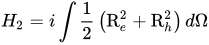
where and are, expressed in natural units, the two rotations that are characteristic of the field. Like the two other parts of the principal function, is not changed by a deformation of the field-figure. In this statement it is to be understood that the parallelograms by which and are represented take part in the deformation.

Some remarks on the way in which, starting from the principal function, we may obtain the fundamental equations of the theory must also be deferred. I shall conclude now by remarking that, as an immediate consequence of Hamilton's principle, the world-line of a material point which is acted on only by a given gravitation field, will be a geodetic line, and that the equations which determine the gravitation field caused by material and electromagnetic systems will be found by the consideration of infinitely small variations of the indicatrices, by which the numerical values of all quantities that are measured by means of these surfaces will be changed.
II.
(Communicated in the meeting of March 25, 1916).
§ 15. In the first part of this communication the connexion between the electric and the magnetic force on one hand and the charge and the convection current on the other was expressed by the equation
| (10) |
which has been discussed in § 13. It will now be shown that this formula is equivalent to the differential equations by which the connexion in question is expressed in the theory of Einstein. For this purpose some further geometrical considerations must first be developed. They refer to the special case that the quantities , have the same values at every point of the field-figure.
If this condition is fulfilled, considerations which generally may be applied to infinitesimal extensions only are valid for finite extensions too.
§ 16. The factor required, in the measurement of four-dimensional domains, for the passage from -units to natural units has now the same value at every point of the field-figure. Similarly, when any one-, two- or three-dimensional extension in the field-figure that is determined by linear equations ("linear extensions") is considered, the factor by means of which the said passage may be effected for parts of that extension, will be the same for all those parts. Moreover the factor in question will be the same for two "parallel" extensions of this kind, i.e. for two extensions the determining equations of which can be written in such a way that the coefficients of are the same in them.
It is obvious that linear one-dimensional extensions can be called "straight lines", also it will be clear what is to be understood by a "prism" (or "cylinder"). This latter is bounded by two mutually parallel linear three-dimensional extensions and and by a lateral surface which may be extended indefinitely to both sides and in which mutually parallel straight lines ("generating lines") can be drawn.


We need not dwell upon the elementary properties of the prism.
§ 17. A vector may now be represented by a straight line of finite length; the quantities , which have been introduced in § 10, are the changes of the coordinates caused by a displacement along that line. The magnitude of the vector, expressed in natural units, will be denoted by . It is given by a formula similar to (1), viz. by

| (11) |

A vector may be regarded as being the same everywhere in the field-figure, if have constant values. In the same way a rotation (§ 11) may be said to be the same everywhere, if it can be represented by two vectors of this kind.
If from a point two vectors and issue, denoted by , and , resp., the angle between them (comp. (5)) is defined by


| (12) |

We remark here that are real, positive or negative quantities and that and are expressed in the way indicated in § 5 ("absolute" values). It is to be understood that does not change when the signs of are reversed at the same time.

If is the value of the vector and if the angle between this vector and is denoted by (), it follows further from (11) and (12) that



In the special case of a right angle we have

an equation expressing the connexion between a vector and its "projection" on a line . The angle () is the angle between the vector and its projection, both reckoned from the same point .

§ 18. Let us now return to the prism mentioned in § 16. From a point of the boundary of the "upper face", we can draw a line perpendicular to and . Let be the point, where it cuts thus last, plane, the "base", and the point where this plane is encountered by the generating line through . If then , we have



| (13) |

The strokes over the letters indicate the absolute values of the distances and .


It can be shown (§ 8) that, all quantities being expressed in natural units, the "volume" of the prism is found by taking the product of the numerical values of the base and the "height" .
Let now linear three-dimensional extensions perpendicular to be made to pass through and . From these extensions the lateral boundary of the prism cuts the parts and and these parts, together with the lateral surface, enclose a new prism , the volume of which is equal to that of . As now the volume of is given by the product of and , we have with regard to (13)


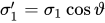
If now we remember that, if a vector perpendicular to is projected on the generating line, the ratio between the projection and the vector itself (viz. between their absolute values) is given by and that a connexion similar to that which was found above between a normal section of the prism and , also exists between and any other oblique section, we easily find the following theorem:

Let and be two arbitrarily chosen linear three-dimensional sections of the prism, and two vectors, perpendicular to and resp. and of the same length, and the absolute values of the projections of and on a generating line. Then we have


| (14) |

§ 19. After these preliminaries we can show that the left hand side of (10) is equal to 0, if the numbers are constants and if moreover both the rotation and the rotation are everywhere the same. For the two parts of the integral the proof may be given in the same way, so that it suffices to consider the expression
| (15) |
![{\displaystyle \int \left[\mathrm {R} _{e}\cdot \mathrm {N} \right]_{x}d\sigma }](https://wikimedia.org/api/rest_v1/media/math/render/svg/c68d92512bdea1dfd353c1df1a06f7f6a5c8cd0d)
![{\displaystyle \left[\mathrm {R} _{e}\cdot \mathrm {N} \right]_{x}}](https://wikimedia.org/api/rest_v1/media/math/render/svg/98ceed9c06362d380bb551d507619352a22f57dd)
is a homogeneous linear function of . Under the special assumptions specified at the beginning of this § these are every where, the same functions. Let us thus consider a definite component of (15) e.g. that which corresponds to the direction of the coordinate . We can represent it by an expression of the form

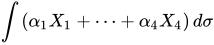
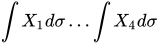
where are constants. It will therefore be sufficient to prove that the four integrals

| (16) |
vanish.
In order to calculate we consider an infinitely small prism, the edges of which have the direction . This prism cuts from the boundary surface two elements and . Proceeding along a generating line in the direction of the positive we shall enter the extension bounded by through one of these elements and leave it through the other. Now the vectors perpendicular to , which occur in (15) and which we shall denote by and for the two elements, have the same value.[12] If, therefore, and are the absolute values of the projections of and on a line in the direction , we have according to (14)


| (17) |

Let first the four directions of coordinates be perpendicular to one another. Then the components of the vector obtained by projecting on the above mentioned line are and similarly those of the projection of . But as, proceeding in the direction of we enter through one element and leave it through the other, while and are both directed outward, and , must have opposite signs. So we have

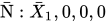



and because of (17) we may now conclude that the elements and in the first of the integrals (16) annul each other. It will be clear now that the whole integral vanishes and that similar considerations may be applied to the other three.


So we have proved that under the special assumptions made the left hand side of (10) will vanish in the special case that the directions of the coordinates are perpendicular to each other. This conclusion likewise holds for an other set of coordinates if only the assumption made at the beginning of this § is fulfilled. This is obvious, as we can pass from mutually perpendicular coordinates to arbitrarily chosen other ones which fulfil this latter condition by linear transformation formulae with constant coefficients. The - and the -components of the vector


are then connected by homogeneous linear formulae with coefficients which have the same value at all points of the surface . Hence if, as has been shown above, the four -components of the vector
![{\displaystyle \int \left\{\left[\mathrm {R} _{e}\cdot \mathrm {N} \right]+\left[\mathrm {R} _{h}\cdot \mathrm {N} \right]\right\}d\sigma }](https://wikimedia.org/api/rest_v1/media/math/render/svg/5b5de3d8188d14014dce2360124fc5ec6c66f7c5)
vanish, the four -components are now seen to do so likewise.[13]
§ 20. The above considerations were intended to prepare a corollary which will be of use in the treatment of the integral on the left hand side of (10), if we now leave the special assumptions made above and suppose the quantities to be functions of the coordinates while also the rotations and may change from point to point.
This corollary may be formulated as follows: If all dimensions of the limiting surface are infinitely small of the first order, the integral
![{\displaystyle \int \left\{\left[\mathrm {R} _{e}\cdot \mathrm {N} \right]+\left[\mathrm {R} _{h}\cdot \mathrm {N} \right]\right\}_{x}d\sigma }](https://wikimedia.org/api/rest_v1/media/math/render/svg/bcda143df49a23613d7c8ede0630b63e313479c9)
will be of the fourth order.
In order to make this clear let us suppose that in the calculation of the integral we confine ourselves to quantities of the third order. The surface being already of that order we may then omit all infinitesimal values in the quantities by which is multiplied; we may therefore neglect the infinitesimal changes of the quantities over the extension considered, and also those of and . By this we just come to the case considered in § 19. Thus it is evident, that as regards quantities of the third order the first part of (10) is 0. From this it follows that in reality it is at least of the fourth order.
§ 21. Let us now return to the general case that the extension to which equation (10) refers, has finite dimensions. If by a surface this extension is divided into two extensions and , the quantities on the two sides in (10) each consist of two parts referring to these extensions. For the right hand side this is immediately clear and as to the quantity on the left hand side, it follows from the consideration that the contributions of a to the integrals over the boundaries of and are equal with opposite signs. In the two cases namely we must take for equal but opposite vectors.


Also, if the extension is divided into an arbitrary number of parts, each term in (10) will be the sum of a number of integrals, each relating to one of these parts.
By surfaces with the equations we can divide the extension into elements which we shall denote by . As a rule there will be left near the surface certain infinitely small extensions of a different form. From the preceding § it is evident that, in the calculation of the integrals, these latter extensions may be neglected and that only the extensions have to be considered. From this we can conclude that equation (10) is valid for any finite extension, as soon at it holds for each of the elements .

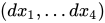
§ 22. We shall now show what equation (10) becomes for one element . Besides the infinitesimal quantities , occurring in the equation

of the indicatrix we introduce four other quantities , which we define by

| (18) |

or
| (19) |
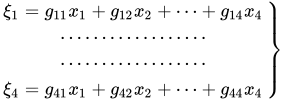
with the equalities .

To each of these quantities corresponds a definite direction, viz. that in which we have to proceed in order to make the considered quantity change in positive sense while the other three remain constant. If we denote these directions by and in the same way the directions of the coordinates by 1, 2, 3, 4, it is evident that is conjugate with 2, 3 and 4, with 3, 1 and 4, and so on; inversely 1 with ; 2 with , and so on. From what has been said above about the algebraic signs of it follows further that, if directions opposite to 1, etc. are denoted by — 1, etc., the directions — 1 and will point to the same side of an extension . The same may be said of the directions —2 and or —3 and with respect to extensions , or , while with respect to an extension , the directions 4 and point to the same side.





Finally, we shall fix (§11) as far as is necessary, which direction corresponds to three others. For that purpose we shall imagine the directions of coordinates to pass into mutually conjugate directions, which will also be called </math>, by gradual changes, in such a way that never three of them come to lie in one plane. We shall agree that after this change —4 corresponds to 1, 2, 3.


Let be the numbers 1, 2, 3, 4 in an order obtained from the natural one by an even number of permutations. Then the rule of § 11 teaches us that the direction corresponds to . It is clear that this would be the ease with , if were obtained from 1, 2, 3, 4 by an odd number of permutations. If further it is kept in mind that, always in the new case, the directions coincide with —1, —2, —3, 4, we come to the conclusion that the directions 1, 2, 3 and 4 correspond to the sets and respectively. The rule of gradual change (§11) involves that this holds also for the original case, in which 1, 2, 3, 4 were not yet mutually conjugate.




This is all that has to be said about the relations between the different directions. It must only be kept in mind, that whenever two of the first three directions are interchanged, the fourth must be reversed.
§ 23. In the neighbourhood of a point of the field-figure we may introduce as coordinates instead of the quantities defined by (19). Line-elements or finite vectors can be resolved in the directions of these coordinates, i.e. in the directions . Their components and the magnitudes of different extensions can now be expressed in -nits in the same way as formerly in -units. So the volume of a three-dimensional parallelepiped with the positive edges is represented by the product .


Solving from (19) we obtain expressions of the form
| (20) |
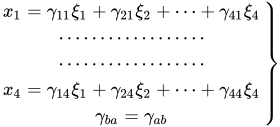
If we use the coordinates the coefficients play the same part as the coefficients when the coordinates are used. According to (18) and (20) we have namely


so that the equation of the indicatrix may be written

§ 24. Let the rotations and of which we spoke in § 13 be defined by the vectors and respectively, the resultants of the vectors , etc. in the directions . Then, according to the properties of the vector product that were discussed in § 11,


![{\displaystyle {\begin{array}{ll}\left[\mathrm {R} _{e}\cdot \mathrm {N} \right]&=\left[\mathrm {\left(A_{1^{*}}^{I}+\dots +A_{4^{*}}^{I}\right)\cdot \left(A_{1^{*}}^{II}+\dots +A_{4^{*}}^{II}\right)\cdot N} \right]\\&=\sum ({\overline {ab}})\left\{\left[\mathrm {A} _{a^{*}}^{I},\ \mathrm {A} _{b^{*}}^{II}\cdot \mathrm {N} \right]-\left[\mathrm {A} _{a^{*}}^{II},\ \mathrm {A} _{b^{*}}^{I}\cdot \mathrm {N} \right]\right\}\end{array}}}](https://wikimedia.org/api/rest_v1/media/math/render/svg/67f7ea3f8a0069f1560ddd8e4cd8e61781c44066)
where the stroke over indicates that each combination of two different numbers contributes one term to the sum. For the vector product we have a similar equation. Now two or more rotations in one and the same plane, e.g. in the plane , may be replaced by one rotation, which can be represented by means of two vectors with arbitrarily chosen directions in that plane, e.g. the directions and . We may therefore introduce two vectors and directed along and resp., so that

![{\displaystyle \left[\mathrm {R} _{h}\cdot \mathrm {N} \right]}](https://wikimedia.org/api/rest_v1/media/math/render/svg/041ad84e3905d089039e633c84876e2b446f669a)


| (21) |
![{\displaystyle \left[\mathrm {B} _{a^{*}}\cdot \mathrm {B} _{b^{*}}\right]=\left[\mathrm {A} _{a^{*}}^{I}\cdot \mathrm {A} _{b^{*}}^{II}\right]-\left[\mathrm {A} _{a^{*}}^{II}\cdot \mathrm {A} _{b^{*}}^{I}\right]+\left[\mathrm {A} _{a^{*}}^{III}\cdot \mathrm {A} _{b^{*}}^{IV}\right]-\left[\mathrm {A} _{a^{*}}^{IV}\cdot \mathrm {A} _{b^{*}}^{III}\right]}](https://wikimedia.org/api/rest_v1/media/math/render/svg/f0927ceede0e3e743cfd09c30d79a5d04c2ee054)
Then we must substitute in (10)
| (22) |
![{\displaystyle \left[\mathrm {R} _{e}\cdot \mathrm {N} \right]+\left[\mathrm {R} _{h}\cdot \mathrm {N} \right]=\sum ({\overline {ab}})\left[\mathrm {B} _{a^{*}}\cdot \mathrm {B} _{b^{*}}\cdot \mathrm {N} \right]}](https://wikimedia.org/api/rest_v1/media/math/render/svg/072ffa6a4457663f40045b16dbcc7b34d5914ae2)
Here it must be remarked that the magnitude and the sense of one of the vectors may be chosen arbitrarily; when this has been done, the other vector is perfectly determined.
In the following calculations the vector has one of the directions . As this is also the case with the vectors and , the vector product occurring in (22) can easily be expressed in -units. After that we may pass to natural units and finally, as is necessary for the substitution in (10), to -units.
In order to pass from -units to natural units we have to multiply a vector in the direction by a certain coefficient , and a part of the extension by a coefficient . These coefficients correspond to (§ 10) and (§ 12). The factors e.g. can be expressed by means of the minors of the determinant of the quantities . If this is worked out and if the equations



are taken into consideration, we obtain the following corollary, which we shall soon use:
Let and also be the numbers 1, 2, 3, 4 in any order, being not the same as , then we have, if none of the two numbers and is 4,


| (23) |
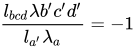
and if one of the two is 4
| (24) |
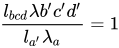
§ 25. We shall now suppose (comp. § 24) that in -units the vector has the value +1, and we shall write for the value that must then be given to . If the -components of the vectors etc. are denoted by etc., we find from (21)


| (25) |

This formula involves that
| (26) |

It may be remarked that is the value that must be given to the vector if is taken to be 1.

The quantities may be said to represent the rotations .
![{\displaystyle \left[\mathrm {B} _{a^{*}}\cdot \mathrm {B} _{b^{*}}\right]}](https://wikimedia.org/api/rest_v1/media/math/render/svg/13268be7f5a7241b8c63a41bd7048836725801d8)
At the end of our calculations we shall introduce instead of the quantities t defined by

| (27) |

In the first of these equations are supposed to be the numbers 1, 2, 3, 4, in an order obtained from 1, 2, 3, 4 by an even number of permutations.

§ 26. We have now to calculate the left hand side of equation (10) for the case that is the surface of an element . For this purpose we shall each time take together two opposite sides, calculating for each pair the contributions due to the different terms on the right hand side of (22), or as we may say to the different rotations . It is convenient now to denote by the numbers 1, 2, 3 either in this order or in any other derived from it by a cyclic permutation, while the -components of the vector we are calculating and which stands on the left hand side of (10) will be represented by .
a. Let us first consider that one of the sides which faces towards the side of the positive . The vector drawn outward has the direction and in -units the magnitude . As the direction corresponds to , the rotation gives with a vector product represented by a vector in the direction . The magnitude of this vector is in -units



and in natural units

This must be multiplied by , the magnitude of the side under consideration in natural units, and finally by to express the vector product in -units. Because of (24) we may write for the result



The opposite side gives a similar result with the opposite sign ( having for that side the direction ), so that together the sides contribute the term


to the component . For shortness sake we have put here


Finally we may take, .
b. Secondly we consider a side facing towards the positive . The vector has now the direction . We consider the vector products of this vector with the rotations , and , which vector products have the directions and 4. A calculation exactly similar to the one we performed just now gives the contributions to . For these we thus find the products of by 



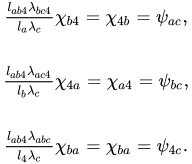
Taking also into consideration the opposite side we find for the contributions

This may be applied to each of the three pairs of sides not yet mentioned under ; we have only to take for successively 1, 2, 3.
Summing up what has been said in this § we may say: the components of the vector on the left hand side of (10) are
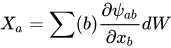
§ 27. For the components of the vector occurring on the right hand side of (10) we may write

if is the component of the vector in the direction expressed in -units, while represents the magnitude of the element in natural units. This magnitude is


so that by putting
| (28) |
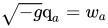
we find for equation (10)
| (29) |
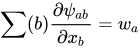
The four relations contained in this equation have the same form as those expressed by formula (25) in my paper of last year[14]. We shall now show that the two sets of equations correspond in all respects. For this purpose it will be shown that the transformation formulae formerly deduced for and follow from the way in which these quantities have been now defined. The notations from the former paper will again be used and we shall suppose the transformation determinant to be positive.


§ 28. Between the differentials of the original coordinates and the new coordinates which we are going to introduce we have the relations

| (30) |

and formulae of the same form (comp. § 10) may be written down for the components of a vector expressed in -measure. As the quantities constitute a vector and as
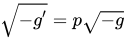
we have according to (28)[15]
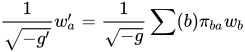
or
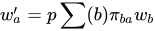
Further we have for the infinitely small quantities [16] defined by (19)

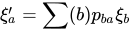
and in agreement with this for the components of a vector expressed in -units
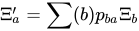
so that we find from (25)[17]

Interchanging here and , we obtain

and
| (31) |

The quantity between brackets on the right hand side is a second order minor of the determinant and as is well known this minor is related to a similar minor of the determinant of the coefficients . If corresponds to in the way mentioned in § 25, and in the same way to , we have



so that (31) becomes

According to (27) this becomes

for which we may write

Interchanging and in the second of the two parts into which the sum on the right hand side can be decomposed, and taking into consideration that

as is evident from (26) and (27), we find[18]

§ 29. Finally it can be proved that if equation (10) holds for one system of coordinates , it will also be true for every other system , so that
| (32) |
![{\displaystyle \int \left\{\left[\mathrm {R} _{e}\cdot \mathrm {N} \right]+\left[\mathrm {R} _{h}\cdot \mathrm {N} \right]\right\}_{x'}d\sigma =i\int \{\mathrm {q} \}_{x'}d\Omega }](https://wikimedia.org/api/rest_v1/media/math/render/svg/fca5b9eb990d9380d9b72cefbb15132a36366b5f)
To show this we shall first assume that the extension , which is understood to be the same in the two cases, is the element .
For the four equations taken together in (10) we may then write
| (33) |

and in the same way for the four equations (32)
| (34) |

We have now to deduce these last equations from (33). In doing so we must keep in mind that are the -components and the -components of one definite vector and that the same may be said of and .


Hence, at a definite point (comp. (30))
| (35) |
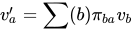
We shall particularly denote by the values of these quantities belonging to the angle from which the edges issue in positive directions. To the right hand sides of the equations (34) we may apply transformation (35) with these values of , -being infinitely small of the fourth order and it being allowed to confine ourselves to quantities of this order.

On the left hand sides of (34), however, we must take into consideration, the surface being of the third order, that the values of change from point to point. Let be the changes which undergo when we pass from to any other point of the surface. Then we must write for the value of the coefficient at this last point

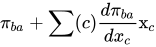
We thus have

It will be shown presently that the last term vanishes. This being proved, it is clear that the relations (34) follow from (33); indeed, multiplying equations (33) by respectively and adding them we find

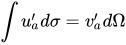
§ 30. The proof for
| (36) |

rests on the relations
| (37) |
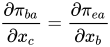
which follow from
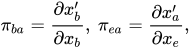
The integral which occurs in (36) differs from
| (38) |

by the infinitely small factor under the sign of integration
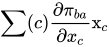
Now we have calculated in § 26 integrals like (38) by taking together each time two opposite sides, one of which passes through while the second is obtained from the first by a shift in the direction of one of the coordinates e. g. of over the distance . We had then to keep in mind that for the two sides the values of , which have opposite signs, are a little different; and it was precisely this difference that was of importance. In the calculation of the integral


| (39) |
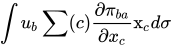
however it may be neglected. Hence, when we express the components in terms of the quantities , we may give to these latter the values which they have at the point .
Let us consider two sides situated at the ends of the edges and whose magnitude we may therefore express in -units if are the numbers which are left of 1, 2, 3, 4 when the number is omitted. For the part contributed to (38) by the side we found in § 26


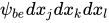
We now find for the part of (39) due to the two sides
![{\displaystyle \psi {}_{be}\sum (c){\frac {\partial \pi {}_{ba}}{\partial x_{c}}}\left[\int \limits _{2}\mathrm {x} _{c}d\sigma -\int \limits _{1}\mathrm {x} _{c}d\sigma \right]}](https://wikimedia.org/api/rest_v1/media/math/render/svg/ed4bf9266b40e563a9b8de89b625a9a6ec294b06)
where the first integral relates to and the second to . It is clear that but one value of , viz. has to be considered. As everywhere in and everywhere in it is further evident that the above expression becomes


This is one part contributed to the expression (36). A second part, the origin of which will be immediately understood, is found by interchanging and . With a view to (37) and because of


we have for each term of (36) another by which it is cancelled. This is what had to be proved.
§ 31. Now that we have shown that equation (32) holds for each element we may conclude by the considerations of § 21 that this is equally true for any arbitrarily chosen magnitude and shape of the extension . In particular the equation may be applied to an element and by considerations exactly similar to those presented in § 26 we see that in the new coordinates as well as in the original ones we have equations of the form (29).

Whatever be our choice of the coordinates the part of the principal function indicated in § 14 can therefore be derived for a given current vector .
In a sequel to this paper some conclusions that may be drawn from Hamilton's principle will be considered. III.
(Communicated in the meeting of April 1916.)[19]
§ 32. In the two preceding papers[20] we have tried so far as possible to present the fundamental principles of the new gravitation theory in a simple form.
We shall now show how Einstein's differential equations for the gravitation field can be derived from Hamilton's principle. In this connexion we shall also have to consider the energy, the stresses, momenta and energy-currents in that field.
We shall again introduce the quantities formerly used and we shall also use the "inverse" system of quantities for which we shall now write . It is found useful to introduce besides these the quantities

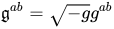
Differential coefficients of all these variables with respect to the coordinates will be represented by the indices belonging to these latter, e.g.
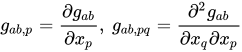
We shall use Christoffel's symbols
![{\displaystyle \left[{\begin{array}{c}ab\\c\end{array}}\right]={\frac {1}{2}}\left(g_{ac,b}+g_{bc,a}-g_{ab,c}\right)}](https://wikimedia.org/api/rest_v1/media/math/render/svg/9765fc4eadb1e74908c536b73312b7a5236b84f4)
and Riemann's symbol
![{\displaystyle {\begin{array}{l}(ik,lm)={\frac {1}{2}}\left(g_{im,lk}+g_{kl,im}-g_{il,km}-g_{km,il}\right)+\\\\\qquad +\sum (ab)g^{ab}\left\{\left[{\begin{array}{c}im\\a\end{array}}\right]\left[{\begin{array}{c}kl\\b\end{array}}\right]-\left[{\begin{array}{c}il\\a\end{array}}\right]\left[{\begin{array}{c}km\\b\end{array}}\right]\right\}\end{array}}}](https://wikimedia.org/api/rest_v1/media/math/render/svg/73a6cafabaf55ac03f38cfafc3136deb90b3357a)
Further we put
| (40) |

| (41) |


where

In the integral , the element of the field-figure, is expressed in -units. The integration has to be extended over the domain within a certain closed surface ; is a positive constant.

§ 33. When we pass from the system of coordinates to another, the value of proves to remain unaltered; it is a scalar quantity. This may be verified by first proving that the quantities form a covariant tensor of the fourth order[21]. Next, being a contravariant tensor of the second order[22], we can deduce from (40) that is a covariant tensor of the same order[23]. According to (41) is then a scalar. The same is true[24] for .


We remark that [25] and . We shall suppose to be written in such a way that its form is not altered by interchanging and or and . If originally this condition is not fulfilled it is easy to pass to a "symmetrical" form of this kind.



It is clear that may also be expressed in the quantities and their first and second derivatives and in the same way in the and first and second derivatives of these quantities.

If the necessary substitutions are executed with due care, these new forms of will also be symmetrical.
§ 34. We shall first express the quantity in the 's and their derivatives and we shall determine the variation it undergoes by arbitrarily chosen variations , these latter being continuous functions of the coordinates. We have evidently


By means of the equations
and
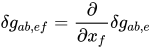
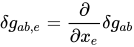
this may be decomposed into two parts
| (42) |

namely
| (43) |

| (44) |
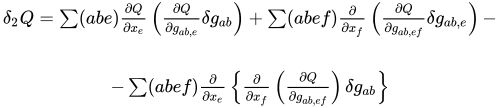
The last equation shows that
| (45) |
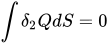
if the variations and their first derivatives vanish at the boundary of the domain of integration.
§ 35. Equations of the same form may also be found if is expressed in one of the two other ways mentioned in § 33. If e.g. we work with the quantities we shall find


where and are directly found from (43) and (44) by replacing , , , and etc. by , etc. If the variations chosen in the two cases correspond to each other we shall have of course


Moreover we can show that the equalities

exist separately.[26]
The decomposition of into two parts is therefore the same, whether we use or .


It is further of importance that when the system of coordinates is changed, not only is an invariant, but that this is also the case with and separately.[27]


We have therefore
| (46) |
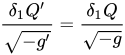
§ 36. For the calculation of we shall suppose to be expressed in the quantities and their derivatives. Therefore (comp. (43))

| (47) |

if we put

Now we can show that the quantities are exactly the quantities defined by (40). To this effect we may use the following considerations.

We know that is a contravariant tensor of the second order. From this we can deduce that is also such a tensor.

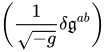
Writing for it we find according to (46) and (47) that

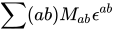
is a scalar for every choice of .

This involves that is a covariant tensor of the second order and as the same is true for we must prove the equation


only for one special choice of coordinates.
§ 37. Now this choice can be made in such a way that at the point of the field-figure , , for and that moreover all first derivatives vanish. If then the values at a point near are developed in series of ascending powers of the differences of coordinates the terms directly following the constant ones will be of the second order. It is with these terms that we are concerned in the calculation both of and of for the point . As in the results the coefficients of these terms occur to the first power only, it is sufficient to show that each of the above mentioned terms separately contributes the same value to and to .




From these considerations we may conclude that
| (48) |

Expressions containing instead of either the variations or might be derived from this by using the relations between the different variations. Of these we shall only mention the formula


| (49) |

§ 38. In connexion with what precedes we here insert a consideration the purpose of which will be evident later on. Let the infinitely small quantity be an arbitrarily chosen continuous function of the coordinates and let the variations be defined by the condition that at some point the quantities have after the change the values which existed before the change at the point , to which is shifted when is diminished by , while the three other coordinates are left constant. Then we have

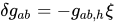
and similar formulae for the variations .
If for and the expressions (48) and (44) are taken, the equation

| (50) |

is an identity for every choice of the variations.
It will likewise be so in the special case considered and we shall also come to an identity if in (50) the terms with the derivatives of are omitted while those with itself are preserved.
When this is done reduces to

and, taking into consideration (44) and (48), we find after division by
| (51) |
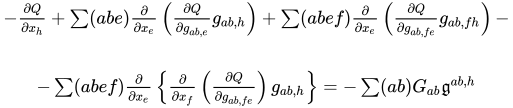
In the second term of (44) we have interchanged here the indices and .

If for shortness' sake we put, for

| (52) |

and for

| (53) |

we may write
| (54) |

The set of quantities will be called the complex and the set of the four quantities which stand on the left hand side of (54) in the cases , the divergency of the complex.[28] It will be denoted by and each of the four quantities separately by .


The equation therefore becomes
| (55) |

| (56) |

§ 39. We shall now consider a second complex , the components of which are defined by

| (57) |

Taking also the divergency of this complex we find that the difference

has just the value which we can deduce from (56) for the corresponding difference

It is thus seen that

and that we have therefore
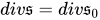
| (58) |
for all systems of coordinates as soon as this is the case for one system.
Now a direct calculation starting from (52), (53) and (57) teaches us that the terms with the highest derivatives of the quantities , (viz. those of the third order) are the same in and . Further it is evident that in the system of coordinates introduced in § 37 these terms with the third derivatives are the only ones. This proves the general validity of equation (58). It is especially to be noticed that if and are determined by (52), (53) and (57) and if the function defined in § 32 is taken for , the relation is an identity.

§ 40. We shall now derive the differential equations for the gravitation field, first for the case of an electromagnetic system.[29] For the part of the principal function belonging to it we write

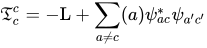
where is defined by (35) (1915). From we can derive the stresses, the momenta, the energy-current and the energy of the electromagnetic system; for this purpose we must use the equations (45) and (46) (1915) or in Einstein's notation, which we shall follow here,[30]

| (59) |
and for

| (60) |
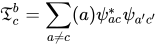
The set of quantities might be called the stress-energy-complex (comp. § 38). As for a change of the system of coordinates the transformation formulae for are similar to those by which tensors are defined, we can also speak of the stress-energy-tensor. We have namely



§ 41. The equations for the gravitation field are now obtained (comp. §§ 13 and 14, 1915) from the condition that
| (61) |

for all variations which vanish at the boundary of the field of integration together with their first derivatives. The index in the first term indicates that in the variation of the quantities must be kept constant.

If we suppose to be expressed in the quantities and if (42), (45) and (48) are taken into consideration, we find from (61) that at each point of the field-figure
| (62) |

If now in the first term we put
| (63) |
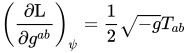
and if for the value (49) is substituted, this term becomes


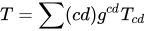
or if in the latter summation is interchanged with and if the quantity

| (64) |
is introduced,
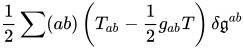
Finally, putting equal to zero the coefficient of each we find from (62) the differential equation required
| (65) |
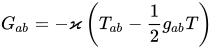
This is of the same form as Einstein's field equations, but to see that the formulae really correspond to each other it remains to show that the quantities and defined by (63), f59) and (60) are connected by Einstein's formulae

| (66) |

We must have therefore
| (67) |

and for
| (68) |

§ 42. This can be tested in the following way. The function (comp. § 9, 1915) is a homogeneous quadratic function of the 's and when differentiated with respect to these variables it gives the quantities . It may therefore also be regarded as a homogeneous quadratic function of the . From (35), (29) and (32)[31], 1915 we find therefore

| (69) |

Now we can also differentiate with respect to the 's, while not the 's but the quantities are kept constant, and we have e.g.
| (70) |
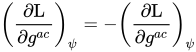
According to (69) one part of the latter differential coefficient is obtained by differentiating the factor only and the other part by keeping this factor constant.

For the calculation of the first of these parts we can use the relation
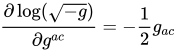
and for the second part we find
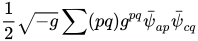
If (32) 1915 is used (67) and (68) finally become
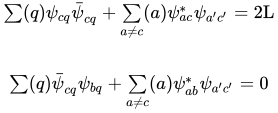
These equations are really fulfilled. This is evident from , , and , besides, the meaning of (§ 11, 1915) and equation (35) 1915 must be taken into consideration.


§ 43. In nearly the same way we can treat the gravitation field of a system of incoherent material points; here the quantities and (§§ 4 and 5, 1915) play a similar part as and in what precedes. To consider a more general case we can suppose "molecular forces" to act between the material points (which we assume to be equal to each other); in such a way that in ordinary mechanics we should ascribe to the system a potential energy depending on the density only. Conforming to this we shall add to the Lagrangian function (§ 4, 1915) a term which is some function of the density of the matter at the point of the field-figure, such as that density is when by a transformation the matter at that point has been brought to rest. This can also be expressed as follows. Let be an infinitely small three-dimensional extension expressed in natural units, which at the point is perpendicular to the world-line passing through that point, and the number of points where intersects world-lines. The contribution of an element of the field-figure to the principal function will then be found by multiplying the magnitude of that element expressed in natural units by a function of . Further calculation teaches us that the term to be added to must have the form


| (71) |
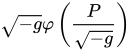

The equations for the gravitation field again take the form (65). is defined by an equation of the form (63), where on the left hand side we must differentiate while the 's are kept constant. Relation (66) can again be verified without difficulty.
We shall not, however, dwell upon this, as the following considerations are more general and apply e.g. also to systems of material points that are anisotropic as regards the configuration and the molecular actions.
§ 44. At any point of the field-figure the Lagrangian function will evidently be determined by the course and the mutual situation of the world-lines of the material points in the neighbourhood of . This leads to the assumption that for constant 's the variation is a homogeneous linear function of the virtual displacements of the material points and of the differential coefficients


these last quantities evidently determining the deformation of an infinitesimal part of the figure formed by the world-lines[32].
The calculation becomes most simple if we put
| (72) |

and for constant 's
| (73) |

Considerations corresponding exactly to those mentioned in §§ 4 — 6, 1915, now lead to the equations of motion and to the following expressions for the components of the stress-energy-tensor
| (74) |

and for
| (75) |
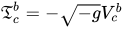
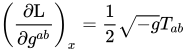
in the differentiation on the left hand side the coordinates of the material points are kept constant. To show that and satisfy equation (66) we must now show that

and for

If here the value (72) is substituted for and if (70) is taken into account, these equations say that for all values of and we must have
| (76) |
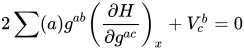
Now this relation immediately follows from a condition, to which must be subjected at any rate, viz. that is a scalar quantity. This involves that in a definite case we must find for always the same value whatever be the choice of coordinates.

§ 45. Let us suppose that instead of only one coordinate a new one has been introduced, which differs infinitely little from , with the restriction that if

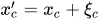
the term depends on the coordinate only and is zero at the point in question of the field-figure. The quantities then take other values and in the new system of coordinates the world-lines of the material points will have a slightly changed course.


By each of these circumstances separately would change, but all together must leave it unaltered. As to the first change we remark that, according to the transformation formula for , the variation vanishes when the two indices are different from , while
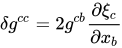
and for

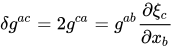
The change of due to these variations is
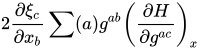


By putting equal to zero the sum of this expression and the preceding one we obtain (76).
§ 46. We have thus deduced for some cases the equations of the gravitation field from the variation theorem. Probably this can also be done for thermodynamic systems, if the Lagrangian function is properly chosen in connexion with the thermodynamic functions, entropy and free energy. But as soon as we are concerned with irreversible phenomena, when e.g. the energy-current consists in a conduction of heat, the variation principle cannot be applied. We shall then be obliged to take Einstein's field-equations as our point of departure, unless, considering the motions of the individual atoms or molecules, we succeed in treating these by means of the generalized principle of Hamilton.
§ 47. Finally we shall consider the stresses, the energy etc. which belong to the gravitation field itself. The results will be the same for all the systems treated above, but we shall confine ourselves to the case of §§ 44 and 45. We suppose certain external forces to act on the material points, though we shall see that strictly speaking this is not allowed.

For any displacements of the matter and variations of the gravitation field we first have the equation which summarizes what we found above
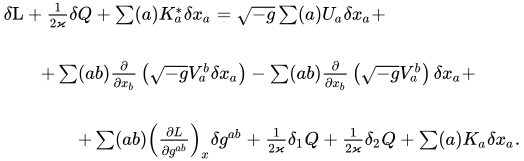
In virtue of the equations of motion of the matter, the terms with cancel each other on the right hand side and similarly, on account of the equations of the gravitation field, the terms with and . Thus we can write[33]
| (77) |

Let us now suppose that only the coordinate undergoes an infinitely small change, which has the same value at all points of the field-figure. Let at the same time the system of values be shifted everywhere in the direction of over the distance . The left hand side of the equation then becomes and we have on the right hand side



After dividing the equation by we may thus, according to (74) and (75), write
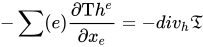
By the same division we obtain from the expression occurring on the left hand side of (51), which we have represented by

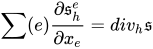
where the complex is defined by (52) and (53). If therefore we introduce a new complex which differs from only by the factor , so that


| (78) |

we find
| (79) |

The form of this equation leads us to consider as the stress-energy-complex of the gravitation field, just as is the stress-energy-tensor for the matter. We need not further explain that for the case the four equations contained in (79) express the conservation of momentum and of energy for the total system, matter and gravitation field taken together.

§ 48. To learn something about the nature of the stress-energy-complex we shall consider the stationary gravitation field caused by a quantity of matter without motion and distributed symmetrically around a point . In this problem it is convenient to introduce for the three space coordinates , ( will represent the time) "polar" coordinates. By we shall therefore denote a quantity which is a measure for the "distance" to the centre. As to and , we shall put , , after first having introduced polar coordinates (in such a way that the rectangular coordinates are , , ). It can be proved that, because of the symmetry about the centre, for , while we may put for the quantities


| (80) |

where are certain functions of . Ditferentiations of these functions will be represented by accents. We now find that of the complex only the components , and are different from zero. The expressions found for them may be further simplified by properly choosing . If the distance to the centre is measured by the time the light requires to be propagated from to the point in question, we have . One then finds


| (81) |
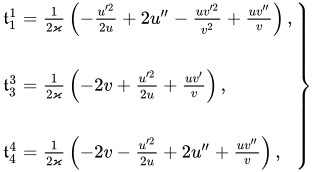
§ 49. We must assume that in the gravitation fields really existing the quantities have values differing very little from those which belong to a field without gravitation. In this latter we should have

and thus we put now

where the quantities and which depend on are infinitely small, say of the first order, and their derivatives too. Neglecting quantities of the second order we find from (81)


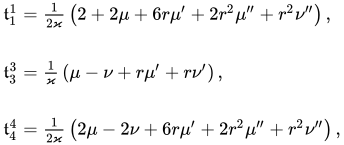
For our degree of approximation we may suppose that of the quantities only differs from 0. If we put

| (82) |

a quantity which depends on and which we shall assume to be zero outside a certain sphere, we find from the field equations
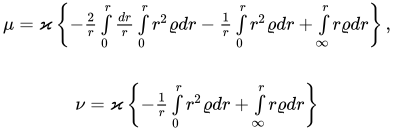
We thus obtain
| (83) |
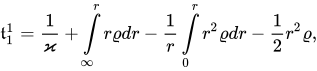
| (84) |
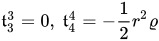
§ 50. If first we leave aside the first term of , which would also exist if no attracting matter were present, it is remarkable that the gravitation constant does not occur in the stress nor in the energy ; the same would have been found if we had used other coordinates. This constitutes an important difference between Einstein's theory and other theories in which attracting or repulsing forces are reduced to "field actions". The pulsating spheres of Bjerknes e.g. are subjected to forces which, for a given motion, are proportional to the density of the fluid in which they are imbedded; and the changes of pressure and the energy in that fluid are likewise proportional to this density. In this case we shall therefore ascribe to the stress-energy-complex values proportional to the intensity of the actions which we want to explain. In Einstein's theory such a proportionality does not exist. The value of is of the same order of magnitude as in the matter. To our degree of approximation we find namely from (82) .


§ 51. If we had not worked with polar coordinates but with rectangular coordinates we should have had to put for the field without gravitation , , for . Then we should have found zero for all the components of the complex. In the system of coordinates used above we found for the field without gravitation ; this is due to the complex being no tensor. If it were, the quantities would be zero in every system of coordinates if they had that value in one system.


It is also remarkable that in real eases the first term in (83) can be much larger than the following ones. If we consider e. g. a point outside the attracting sphere, we can prove that the ratio of the first term to the third is of the same order as the ratio of the square of the velocity of light to the square of the velocity with which a material point can describe a circular orbit passing through .
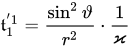
The following must also be noticed. In the system of polar coordinates used above there will exist in the field without gravitation the stress . If a stress of this magnitude were produced by means of actions which give rise to a stress-energy-tensor, the passage to rectangular coordinates would give us a stress which becomes infinite at the point . In those coordinates we should namely have
§ 52. Evidently it would be more satisfactory if we could ascribe a stress-energy-tensor to the gravitation field. Now this can really be done. Indeed, the quantities determined by (57) form a tensor and according to (58), (79) may be replaced by

| (85) |

if is defined by a relation similar to (78), viz.

| (86) |
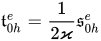
Equation (85) shows that, just as well as , we may consider the quantities as the stresses etc. in the gravitation field. This way of interpretation is very simple. With a view to (41) we can namely derive from the equations for the gravitation field (65)


and
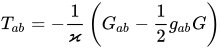
Further we find from (66)

and from (57) and (86)
| (87) |

At every point of the field-figure the components of the stress-energy-tensor of the gravitation field would therefore be equal to the corresponding quantities for the matter or the electro-magnetic system with the opposite sign. It is obvious that by this the condition of the conservation of momentum and energy for the whole system would be immediately fulfilled. It was in fact this circumstance that made me think of the tensor . The way in which was introduced in §§ 38 and 39 has only been chosen in order to lay stress on (58) being an identity, so that equation (85) is but another form of (79).

At first sight the relations (87) and the conception to which they have led, may look somewhat startling. According to it we should have to imagine that behind the directly observable world with its stresses, energy etc. there is hidden the gravitation field with stresses, energy etc. that are everywhere equal and opposite to the former; evidently this is in agreement with the interchange of momentum and energy which accompanies the action of gravitation. On the way of a light-beam e.g. there would be everywhere in the gravitation field an energy current equal and opposite to the one existing in the beam. If we remember that this hidden energy-current can be fully described mathematically by the quantities and that only the interchange just mentioned makes it perceptible to us, this mode of viewing the phenomena does not seem unacceptable. At all events we are forcibly led to it if we want to preserve the advantage of a stress-energy-tensor also for the gravitation field. It can namely be shown that a tensor which is transformed in the same way as the tensor defined by (57) and (86) and which in every system of coordinates has the same divergency as the latter, must coincide with .
Finally we may remark that (78), (86), (58), (87) give

so that we have, both from (79) and from (85), .
The question is this, that, so long as the gravitation field is considered as given, we may introduce "external" forces, but that in the equations for the gravitation field itself we must also take into consideration the stress-energy-tensor of the system by which those forces are exerted. IV.
(Communicated in the meeting of October 28, 1916).
§ 53. The expressions for the stress-energy-components of the gravitation field found in the preceding paper call for some further remarks. If by we denote a quantity having the value 1 for and being 0 for , those expressions can be written in the form (comp. equations (52) and (78))

| (88) |

They contain the first and second derivatives of the quantities . Einstein on the contrary has given values for the stress-energy-components which contain the first derivatives only and which therefore are in many respects much more fit for application.
It will now be shown how we can also find formulae without second derivatives, if we start from (88).
§ 54. For this purpose we shall consider the complex defined by

| (89) |

and we shall seek its divergency.
We have

or
| (90) |
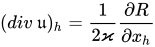
if we put
| (91) |

Now can be divided into two parts, the first of which contains differential coefficients of the quantities of the first order only, while the second is a homogeneous linear function of the second derivatives of those quantities. This latter involves that, if we replace (91) by



the second and the third term annul each other. Thus
| (92) |

If now we define a complex by the equation

| (93) |
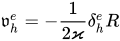
we have
| (94) |
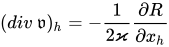
If finally we put

we infer from (90) and (94)
| (95) |

and from (88), (89), (93) and (92)
| (96) |
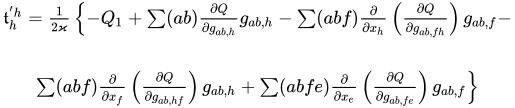
and for
| (97) |
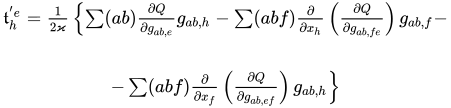
Formula (95) shows that the quantities can be taken just as well as the expressions (88) for the stress-energy-components and we see from (96) and (97) that these new expressions contain only the first derivatives of the coefficients ; they are homogeneous quadratic functions of these differential coefficients.

This becomes clear when we remember that is a function of this kind and that only contributes something to the second term of (96) and the first of (97); further that the derivatives of occurring in the following terms contain only the quantities and not their derivatives.

where for the sake of simplicity it has been assumed that . Further we have

![{\displaystyle \Gamma _{ab}^{c}=-\left\{{\begin{array}{c}ab\\c\end{array}}\right\}=-\sum (e)g^{ce}\left[{\begin{array}{c}ab\\e\end{array}}\right]}](https://wikimedia.org/api/rest_v1/media/math/render/svg/6aed57ec9bd1c28f6831bd91201d47a0d525d5f0)
If now our formulae (96) and (97) are likewise simplified by the assumption (so that becomes equal to ), we may expect that will become identical with . This is really so in the case for ; by which it seems very probable that the agreement will exist in general.


In the preceding paper it was shown already that the stress-energy-components do not form a "tensor", but what was called a "complex". The same may be said of the quantities defined by (96) and (97) and of the expressions given by Einstein. If we want a stress-energy-tensor, there are only left the quantities defined by (86) and (57), the values of which are always equal and opposite to the corresponding stress-energy-components for the matter or the electromagnetic field.


It must be noticed that the four equations
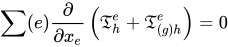
always express the same relations, whether we choose or as stress-energy-components of the gravitation field. If however in a definite case we want to use the equations in order to calculate how the momentum and the energy of the matter and the electromagnetic field change by the gravitational actions, it is best to use or , just because these quantities are homogeneous quadratic functions of the derivatives .


Experience namely teaches us that the gravitation fields occurring in nature may be regarded as feeble, in this sense that the values of the 's are little different from those which might be assumed if no gravitation field existed. For these latter values, which will be called the "normal" ones, we may write in orthogonal coordinates
| (98) |

In a first approximation, which most times will be sufficient, the deviations of the values of the 's from these normal ones may be taken proportional to the gravitation constant . This factor also appears in the differential coefficients ; hence, according to the character of the functions mentioned above (and on account of the factor in (96) and (97)) these functions become proportional to , so that in a feeble gravitation field they have low values.

§ 56. Because of the complicated form of equations (96) and (97), we shall confine ourselves to the calculation for some cases of , i.e. of the energy per unit of volume. This calculation is considerably simplified if we consider stationary fields only. Then all differential coefficients with respect to vanish, so that we have according to (96)

| (99) |

We shall work out the calculation, first for a field without gravitation and secondly for the case of an attracting spherical body in which the matter is distributed symmetrically round the centre.
If there is no gravitation field we may take for the quantities the "normal" values. For the case of orthogonal coordinates these are given by (98). When we want to use the polar coordinates introduced into § 48 we have the corresponding formulae
| (100) |
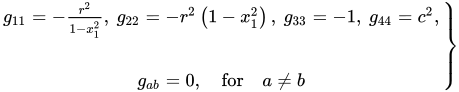
If, using polar coordinates, we have to do with an attracting sphere and if we take its centre as origin, we may put
| (101) |

where are functions of . The 's which belong to an orthogonal system of coordinates may be expressed in the same functions.
These 's are
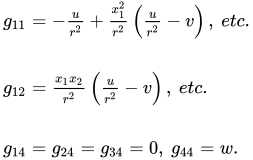
The "etc." means that for we have similar expressions as for and for similar ones as for .


§ 57. In order to deduce the differential equations determining we may arbitrarily use rectangular or polar coordinates; the latter however are here to be preferred. If differentiations with respect to are indicated by accents, we have according to (40) and (101)
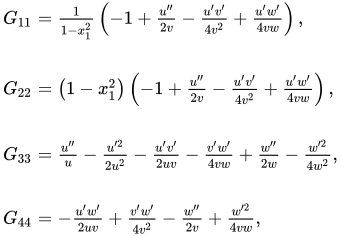
for

So we have found the left hand sides of the field equations (65). Before considering these equations more closely we shall introduce the simplification that the 's, are very little different from the normal values (100). For these latter we have
| (102) |

and therefore we now put
| (103) |

The quantities , which depend on r, will be regarded as infinitely small of the first order and in the field equations we shall neglect quantities of second and higher orders.

Then we may write for etc.

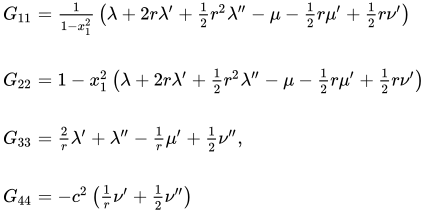
On the right hand-sides of the field equations (65) we may take for the normal value; moreover we shall take for and the values which hold for a system of incoherent material points. We may do so if we assume no other internal stresses but those caused by the mutual attractions; these stresses may be neglected in the present approximation.

As we supposed the attracting matter to be at rest we have according to (10), (16) and (15) (1915) , , , , .
In the notations we are now using we have further, according to (23) (1915), 




so that of the stress-energy-components of the matter only one is different from zero, namely

Further (66) involves that, also of the quantities , only one, namely , is not equal to zero. As we may put we have namely

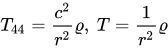
Finally we are led to the three differential equations
| (104) |

| (105) |

| (106) |
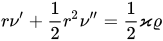
It may be remarked that , represents the "mass" present in the element of volume . Because of the meaning of (§ 48) the mass in the shell between spheres with radii and is found when is integrated with respect to between the limits —1 and +1 and with respect to between 0 and . As depends on only, this latter mass becomes , so that is connected with the "density" in the ordinary sense of the word, which will be called , by the equation


The differential equations also hold outside the sphere if is put equal to zero. We can first imagine to change gradually to near the surface and then treat the abrupt change as a limiting case.
In all the preceding considerations we have tacitly supposed the second derivatives of the quantities to have everywhere finite values. Therefore and will be continuous at the surface, even in the case of an abrupt change.

§ 58. Equation (106) gives
| (107) |
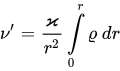
where the integration constant is determined by the consideration that for all the quantities and their derivatives must be finite, so that for the product must be zero. As it is natural to suppose that at an infinite distance vanishes, we find further


| (108) |
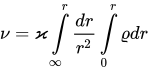
The quantities and on the contrary are not completely determined by the differential equations. If namely equations (105) and (106) are added to (104) after having been multiplied by and respectively, we find


| (109) |

and it is clear that (104) and (105) are satisfied as soon as this is the case with this condition (109) and with (106). So we have only to attend to (108) and (109). The indefiniteness remaining in and is inevitable on account of the covariancy of the field equations. It does not give rise to any difficulties.
Equation (107) teaches us that near the centre

if is the density at the centre, whereas from (108) we find a finite value for itself. This confirms what has been said above about the values at the centre. We shall assume that at that point and their derivatives have likewise finite values. Moreover we suppose (and this agrees with (109)) that and are continuous at the surface of the sphere.


If is the radius of the sphere we find from (108) for an external point
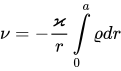
Without contradicting (109) we may assume that at a great distance from the centre and are likewise proportional to , so that and decrease proportionally to .


§ 59. We can now continue the calculation of (§ 56). Substituting (101) in (99) and using polar coordinates we find

whence by substituting (102) we derive for a field without gravitation

This equation shows that, working with polar coordinates, we should have to ascribe a certain negative value of the energy to a field without gravitation, in such a way (comp. § 57) that the energy in the shell between the spheres described round the origin with radii and becomes

The density of the energy in the ordinary sense of the word would be inversely proportional to , so that it would become infinite at the centre.

It is hardly necessary to remark that, using rectangular coordinates we find a value zero for the same case of a field without gravitation. The normal values of are then constants and their derivatives vanish.
§ 60. Using rectangular coordinates we shall now indicate the form of for the field of a spherical body, with the approximation specified in § 57. Thus we put
| (110) |
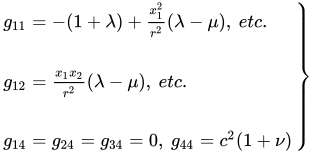
By (109) and (110) we find[34]
| (111) |
![{\displaystyle {\mathfrak {t}}_{4}^{'4}={\frac {c}{2\varkappa }}\left\{\nu '^{2}+{\frac {1}{r}}(\lambda -\mu )\left[{\frac {1}{r}}(\lambda -\mu )+2(\lambda '-\mu ')\right]\right\}}](https://wikimedia.org/api/rest_v1/media/math/render/svg/a6897fc8f48dbcc60c2ad974f60dce8106ef0a92)
Thus we see (comp. § 58) that at a distance from the attracting sphere decreases proportionally to . Further it is to be noticed that on account of the indefiniteness pointed out in § 58, there remains some uncertainty as to the distribution of the energy over the space, but that nevertheless the total energy of the gravitation field

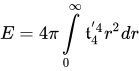
has a definite value.
Indeed, by the integration the last terra of (111) vanishes. After multiplication by this term becomes namely
![{\displaystyle (\lambda -\mu )^{2}+2r(\lambda -\mu )(\lambda '-\mu ')={\frac {d}{dr}}\left[r(\lambda -\mu )^{2}\right]}](https://wikimedia.org/api/rest_v1/media/math/render/svg/193d1adf821b8bb6f1cdbeb64c91111aa5523270)
The integral of this expression is 0 because (comp. §§ 57 and 58) is continuous at the surface of the sphere and vanishes both for and for .


We have thus
| (112) |
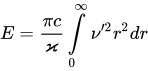
where the value (107) can be substituted for . If e.g. the density is everywhere the same all over the sphere, we have at an internal point

and at an external point
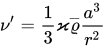
From this we find
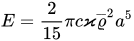
§ 61. The general equation (99) found for can be transformed in a simple way. We have namely
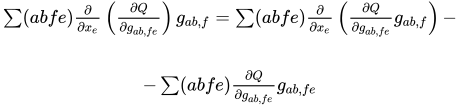
and we may write (§ 54) for the last term. Hence

| (113) |

where we must give the values 1, 2, 3 to and .
The gravitation energy lying within a closed surface consists therefore of two parts, the first of which is
| (114) |
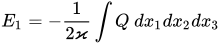
while the second can be represented by surface integrals. If namely are the direction constants of the normal drawn outward

| (115) |

In the case of the infinitely feeble gravitation field represented by (§ 57) both expressions and contain quantities of the first order, but it can easily be verified that these cancel each other in the sum, so that, as we knew already, the total energy is of the second order.


From and the equations of § 32 we find namely
| (116) |

so that we can write

The factor is of the first order. Thus, if we confine ourselves to that order, we may take for all the other quantities these normal values. Many of these are zero and we find

| (117) |

Here we must take ; , while we remark that for the expression between brackets vanishes. For the integral becomes do, which after summation with respect to gives


| (118) |

representing the normal to the surface. If and differ from each other, while neither of them is equal to 4, we can deduce from (110) and (109)

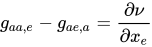

so that (117) becomes
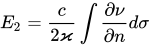
As now outside the sphere
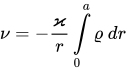
we have for every closed surface that does not surround the sphere , but for every surface that does

| (119) |
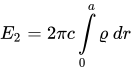
As to we remark that substituting (65) in (41) and taking into consideration (64) we find,
| (120) |

From this we conclude that is zero if there is no matter inside the surface . In order to determine in the opposite case, we remember that is independent of the choice of coordinates. To calculate this quantity we may therefore use the value of indicated in § 56, which is sufficient to calculate as far as the terms of the first order. We have therefore

and if, using further on rectangular coordinates, we take for the normal value ,

From this we find by substitution in (114) for the case of the closed surface a surrounding the sphere
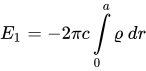
This equation together with (119) shows that in (113) when integrated over the whole space the terms of the first order really cancel each other. In order to calculate those of the second order and thus to derive the result (112) from (113), we should have to determine the quantity (comp. 120)), accurately to the order . The surface integrals in (115) too would have to be considered more closely. We shall not however dwell upon this.
§ 62. From the expression for given in (113) and the value

derived from it, it can be inferred that, though is no tensor, we yet may change a good deal in the system of coordinates in which the phenomena are described, without altering the value of the total energy. Let us suppose e.g. that is left unchanged but that, instead of the rectangular coordinates hitherto used, other quantities are introduced, which are some continuous function of , with the restriction that outside a certain closed surface surrounding the attracting matter at a sufficient distance. If we use these new coordinates, we shall have to introduce other quantities instead of however outside the closed surface the quantities and their derivatives do not change, the value of will approach the same limit as when we used the coordinates , if the surface for which it is calculated expands indefinitely. The value which we find for after the transformation of coordinates will also be the same as before. Indeed, if is an element of volume expressed in -units and the same element expressed in -units, while represents the new value of , we have




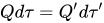
It is clear that the total energy will also remain unchanged if differ from at all points, provided only that these differences decrease so rapidly with increasing distance from the attracting body, that they have no influence on the limit of the expression (115).
The result which we have now found admits of another interpretation. In the mode of description which we first followed (using ), [35]) and are certain functions of ; in the new one , are certain other functions of . If now, without leaving the system of coordinates , we ascribe to the density and to the gravitation potentials values which depend on , in the same way as , depended on just now, we shall obtain a new system (consisting of the attracting body and the gravitation field) which is different from the original system because other functions of the coordinates occur in it, but which nevertheless no observation will be able to discern from it, the indefiniteness which is a necessary consequence of the covariancy of the field equations, again presenting itself.

What has been said shows that the total gravitation energy in this new system will have the same value as in the original one, as has been found already in § 60 with the restrictions then introduced.
§ 63. If were a tensor, we should have for all substitutions the transformation formulae given at the end of § 40. In reality this is not the case now, but from (96) and (97) we can still deduce that those formulae hold for linear substitutions. They may likewise be applied to the stress-energy-components of the matter or of an electromagnetic system. Hence, if represents the total stress-energy-components, i. e. quantities in which the corresponding components for the gravitation field, the matter and the electromagnetic field are taken together, we have for any linear transformation

| (121) |

We shall apply this to the case of a relativity transformation, which can be represented by the equations
| (122) |

with the relation
| (123) |

In doing so we shall assume that the system, when described in the rectangular coordinates and with respect to the time , is in a stationary state and at rest.
Then we derive from (97)[36]

which means that in the system there are neither momenta nor energy currents in the gravitation field.

We may assume the same for the matter, so that we have for the total stress-energy-components in the system

Let us now consider especially the components and in the system For these we find from (121) and (122)


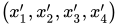
| (124) |

| (125) |

It is thus seen in the first place that between the momentum in the direction of and the energy-current in that direction there exists the relation


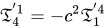
well known from the theory of relativity.
Further we have for the total energy in the system
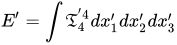
where the integration has to be performed for a definite value of the time . On account of (122) we may write for this

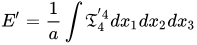
where we have to keep in view a definite value of the time .
If the value (125) is substituted here and if we take into consideration that, the state being stationary in the system ,
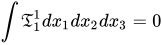
we have

if is the energy ascribed to the system in the coordinates . By integration of the first of the expressions (124) we find in the same way for the total momentum in the direction of


§ 64. Equations (122) show that in the coordinates the system has a velocity of translation in the direction of . If this velocity is denoted by , we have according to (123)


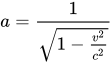
If therefore we put

we find
| (126) |
When the system moves as a whole we may therefore ascribe to it an energy and a momentum which depend on the velocity of translation in the way known from the theory of relativity. The quantity , to which the energy of the gravitation field also contributes a certain part, may be called the "mass" of the system. From what has been said in § 62 it follows that within certain limits it depends on the way in which the system and the gravitation field are described.

It must be remarked however that, if for the gravitation field we had chosen the stress-energy-tensor (§ 52), the total energy of the system even when in motion would be zero. The same would be true of the total momentum and we should have to put .

At first sight it may seem strange that we may arbitrarily ascribe to the moving system the momentum determined by (126) or a momentum 0; one might be inclined to think that, when a definite system of coordinates has been chosen, the momentum must have a definite value, which might be determined by an experiment in which the system is brought to rest by "external" forces. We must remember however (comp. § 52) that in the theory of gravitation we may introduce no "external" forces without considering also the material system in which they originate. This system together with the system with which we were originally concerned, will form an entity, in which there is a gravitation field, part of which is due to (and a part also to the simultaneous existence of and ). There is no doubt that we may apply the above considerations to the total system () without being led into contradiction with any observation.

- ↑ A. Einstein, Zur allgemeinen Relativitätstheorie, Berliner Sitzungsberichte 1915, pp. 778 799; Die Feldgleichungen der Gravitation, ibid. 1915, p. 844.
- ↑ D. Hilbert, Die Grundlagen der Physik I, Göttinger Nachrichten, Math.-phys. Klasse, Nov. 1915.
- ↑ It will be known that in the theory of relativity Minkowski was the first who used this geometric representation in an extension of four dimensions. The name "world-line" has been borrowed from him.
- ↑ For the sake of simplicity we shall imagine the two motions not to be disturbed by this coincidence, so that e.g. two material points penetrate each other or pass each other at an extremely small distance without any mutual influence.
- ↑ In a correspondence I had with him.
- ↑ In other terms, that the data procured by astronomical observations can be extended arbitrarily and unboundedly.
- ↑ A "surface" determined by one equation between the coordinates is a three-dimensional extension. It will cause no confusion if sometimes we apply the name of "plane" to certain two-dimensional extensions, if we speak e.g. of the "plane" determined by two line-elements.
- ↑ This corresponds to the negative value which (1) gives for .
- ↑ For a radius-vector on the asymptotic cone we may take either of these values; this makes no difference, as the numerical value of a line-element in the direction of such a radius-vector becomes 0 in both cases.
- ↑ This agrees with the value of the Lagrangian function, which is to be found e.g. in my paper on "Hamilton's principle in Einstein's theory of gravitation." These Proceedings 19 (1916). p. 751.
- ↑ If, according to circumstances, different signs arc given to , the angle whose sine occurs in the formula for the area of a parallelogram must be understood to be positive in one case and negative in the other.
- ↑ From § 10 it follows that if the length of a vector that is represented by a line (§ 17) coincides with a radius-vector of the conjugate indicatrix, it is always represented by an imaginary number. We may however obtain a vector which in natural units is represented by a real number e.g. by 1 (§ 13) if we multiply the vector by an imaginary factor, which means that its components and also those of a vector product in which it occurs are multiplied by that factor.
- ↑ In the above considerations difficulties might arise if the vector lay on the asymptotic cone of the indicatrix, our definition of a vector of the value 1 would then fail (comp. note 2, p. 1345). With a view to this we can choose the form of the extension (§ 13) in such a way that this case does not occur, a restriction leading to a boundary with sharp edges.
- ↑ Zittingsverslag Akad. Amsterdam, 23 (1915), p. 1073; translated in Proceedings Amsterdam, 19 (1910), p. 751. Further on this last paper will be cited by l. c.
- ↑ Comp. § 7, l. c.
- ↑ For the infinitesimal quantities occurring in (19) we have namely (comp. (30))
and taking into consideration (19) and (20), i e.
and formula (7) l. c, we may write (comp. note 2, p. 758, l. c.)
- ↑ Put . Then we have
and similar formulae for the other three parts of (25).
- ↑ Comp. (28) l. c.
- ↑ Published September 1916, a revision having been found desirable.
- ↑ See Proceedings Vol. XIX, p. 1341 and 1354.
- ↑ Namely:
The symbol denotes the complex of all the quantities .
- ↑ Namely:
- ↑ On account of the relation
- ↑ Similarly:
- ↑ This means that the transformation formulae for these quantities have the form
See for the notations used here and for some others to be used later on my communication in Zittingsverslag Akad Amsterdam 23 (1915), p. 1073 (translated in Proceedings Amsterdam 19 (1916), p. 751). In referring to the equations and the articles of this paper I shall add the indication 1915.
- ↑ Suppose that at the boundary of the domain of integration and . Then we have also and , so that
and from
we infer
As this must hold for every choice of the variations (by which choice the variations are determined too) we must have at each point of the field-figure
- ↑ This may be made clear by a reasoning similar to that used in the preceding note. We again suppose and to be zero at the boundary of the domain of integration. Then and vanish too at the boundary, so that
From
we may therefore conclude that
As this must hold for arbitrarily chosen variations we have the equation
- ↑ Einstein uses the word "divergency" in a somewhat different sense. It seemed desirable however to have a name for the left hand side of (54) and it was difficult to find a better one.
- ↑ This has also been done by de Donder, Zittingsverslag Akad. Amsterdam, 35 (1916), p. 153.
- ↑ The notations and (see (27), (29) and § 11, 1915), will however be preserved though they do not correspond to those of Einstein. As to formulae (59) and (60) it is to be understood that if and are two of the numbers 1, 2, 3, 4, and denote the other two in such a way that the order is obtained from 1 2 3 4 by an even number of permutations of two ciphers.
If are replaced by and if for the stresses the usual notations , etc., are used (so that e.g. for a surface element perpendicular to the axis of is the first component of the force per unit of surface which the part of the system situated on the positive side of exerts on the opposite part) then , etc. Further are the components of the momentum per unit of volume and the components of the energy-current. Finally is the energy per unit of volume. - ↑ The quantities in that equation are the same as those which are now denoted by .
- ↑ In the cases considered in § 43, can indeed be represented in this way.
- ↑ To make the notation agree with that of § 38 has been replaced by .
- ↑ Of the laborious calculation it may be remarked here only that it is convenient to write the values (110) in the form
where and are infinitesimal functions of . We then find
which reduces to (111) if the relations between and , viz.and the equality involved in (109) are taken into consideration.
- ↑ By we mean here what was denoted by in § 56.
- ↑ We have , while all the other quantities gab are independent of . Thus we can say that the quantities and are equal to zero when among their indices the number 4 occurs an odd number of times. The same may be said of , , (according to (116)), and also of products of two or more of such quantities. As in the last two terms of (97) the indices and occur twice, these terms will vanish when only one of the indices and has the value 4.
As to the first term of (97) we remark that, according to the formulae of § 32, each of the indices and occurs only once in the differential coefficient of with respect to , while other indices are repeated. As to the number of times which and the other indices occur we can therefore say the same of the first term of (97) as of the other terms. The first term also is therefore zero, if no more than one of the two indices and has the value 4.
That vanishes for is seen immediately.

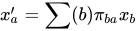







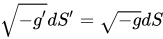





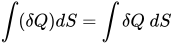
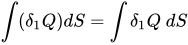

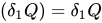



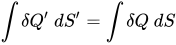
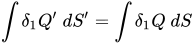




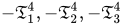

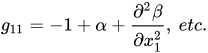
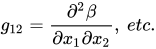

![{\displaystyle {\begin{array}{l}{\mathfrak {t}}_{4}^{'4}={\frac {c}{2\varkappa }}\left\{-{\frac {1}{2}}\sum (a)\left({\frac {\partial \alpha }{\partial x_{a}}}\right)^{2}+\sum (a){\frac {\partial \nu }{\partial x_{a}}}{\frac {\partial \alpha }{\partial x_{a}}}+\right.\\\\\qquad \left.+{\frac {1}{4}}\sum (aik)\left[{\frac {\partial ^{3}\beta }{\partial x_{a}\partial x_{i}^{2}}}{\frac {\partial ^{3}\beta }{\partial x_{a}\partial x_{k}^{2}}}-\left({\frac {\partial ^{3}\beta }{\partial x_{a}\partial x_{i}\partial x_{k}}}\right)^{2}\right]\right\}\\\\\qquad \qquad (a,i,k=1,2,3)\end{array}}}](https://wikimedia.org/api/rest_v1/media/math/render/svg/fc0c1b647eb57f81283195f8ac2edf1c7267fb95)







This work is in the public domain in the United States because it was published before January 1, 1929.
The longest-living author of this work died in 1928, so this work is in the public domain in countries and areas where the copyright term is the author's life plus 95 years or less. This work may be in the public domain in countries and areas with longer native copyright terms that apply the rule of the shorter term to foreign works.

Public domainPublic domainfalsefalse