answer, therefore, given at b, in the following example, to the subject at a, is, as Pietro Aron justly teaches, an answer in appearance only, and none at all in reality.
| a. Subject, in the Hexachord of C. | b. Pretended Answer, in the Hexachord of G. |
 |
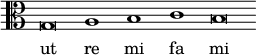 |
As an instance of the strict method of treatment, it would be difficult to find a more instructive example than the opening of Palestrina's Missa brevis, in the Thirteenth Mode transposed, where the Solmisation of the answer, in the Hexachord of F, is identical with that of the subject in the Natural Hexachord.

etc.
Now, this answer, though the only true one possible, could never have been deduced by the laws 'of modern Tonal Fugue: for, since the subject begins on the second degree of the scale by no means an unusual arrangement in the Thirteenth and Fourteenth Modes the customary reference to the Tonic and Dominant would not only have failed to throw auy light upon the question, but would even have tended to obscure it, by suggesting D as a not impossible response to the initial G.
It would be easy to multiply examples: but we trust enough has been said to prove that those who would rightly understand the magnificent Real Fugues of Palestrina and Anerio, will not waste the time they devote to the study of Guido's Hexachords. To us, familiar with a clearer system, their machinery may seem unnecessarily cumbrous. We may wonder, that, with the Octave within his reach, the great Benedictine should have gone so far out of the way, in his search for the means of passing from one group of sounds to another. But, we must remember that he was patiently groping, in the dark, for an as yet undiscovered truth. We look down upon his Hexachords from the perfection of the Octave. He looked up to them from the shortcomings of the Tetrachord. In order fully to appreciate the value of his contribution to musical science, we must try to imagine ourselves in his place. Whatever may be the defects of his system, it is immeasurably superior to any that preceded it: and, so long as the Modes continued in general use, it fulfilled its purpose perfectly.
HEYTHER[1] or HEATHER, William, Mus. Doc., born at Harmondsworth, Middlesex, was a lay vicar of Westminster Abbey, and on March 27, 1615, sworn a gentleman of the Chapel Royal. He was the intimate friend of Camden; they occupied the same house in Westminster, and when, in 1609, Camden was attacked by a pestilential disease, he retired to Heyther's house at Chislehurst to be cured, and there he died in 1623, having appointed Heyther his executor. When Camden founded the history lecture at Oxford in 1622, he made his friend Heyther the bearer to the University of the deed of endowment. The University on that occasion complimented Heyther by creating him Doctor of Music, May 18, 1622. (As to the improbable story of Gibbons having composed his exercise for him, see Gibbons, Orlando.) In 1626–7 Heyther founded the music lecture at Oxford, and endowed it with £17 6s. 8d. per ann. The deed bears date Feb. 2, of 2 Charles I. Richard Nicholson, Mus. Bac., organist of Magdalen College, was the first professor. Dr. Heyther died in July 1627, and was buried Aug. 1 in the south aisle of .the choir of Westminster Abbey. He gave £100 to St. Margaret's Hospital in Tothill Fields, commonly known as the Green Coat School. There is a portrait of him in his doctor's robes in the Music School, Oxford, which is engraved by Hawkins (chap. 120).
HIDDEN FIFTHS AND OCTAVES (Lat. Quintæ coopertæ, sen absconditæ; Germ. Verdeckte Quinten). Hidden Fifths, or Octaves, are held to be produced, whenever two parts proceed, in similar motion, towards a single Fifth, or Octave, to which one of them at least progresses by a leap, as in the following example:

Progressions such as these are prohibited, because, were the leaps filled up by the intervals of the Diatonic Scale, the hidden 'consecutives' [see Consecutive] would at once be converted into real ones, thus:
 | A musical score should appear at this position in the text. See Help:Sheet music for formatting instructions |
It may be urged, that, as the leaps are not intended to be filled up, the forbidden sequence
- ↑ His own spelling. In his will it is Heather.
