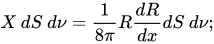
Let us next consider the resultant force due to the action of the electrified systems on these small electrified surfaces.
The potential within the surface is constant and equal to , and without the surface it is constant and equal to . In the shell between these surfaces it is continuous from to .
Hence the resultant force is zero except within the shell.
The electrified surface of the shell itself will be acted on by forces which are the arithmetical means of the forces just within and just without the surface, that is, in this case, since the resultant force outside is zero, the force acting on the superficial electrification is one-half of the resultant force just within the surface.
Hence, if be the total moving force resolved parallel to , due to the electrical action on both the electrified surfaces of the element ,
where the suffixes denote that the derivatives of are to be taken at and respectively.
Let be the direction-cosines of , the normal to the equipotential surface, then making
and since , we may write the value of
But
and
therefore
or, if we write
then
or the force in any direction on the element arising from the action of the electrified system on the two electrified surfaces of the element is equal to half the rate of increase of in that direction multiplied by the volume of the element.