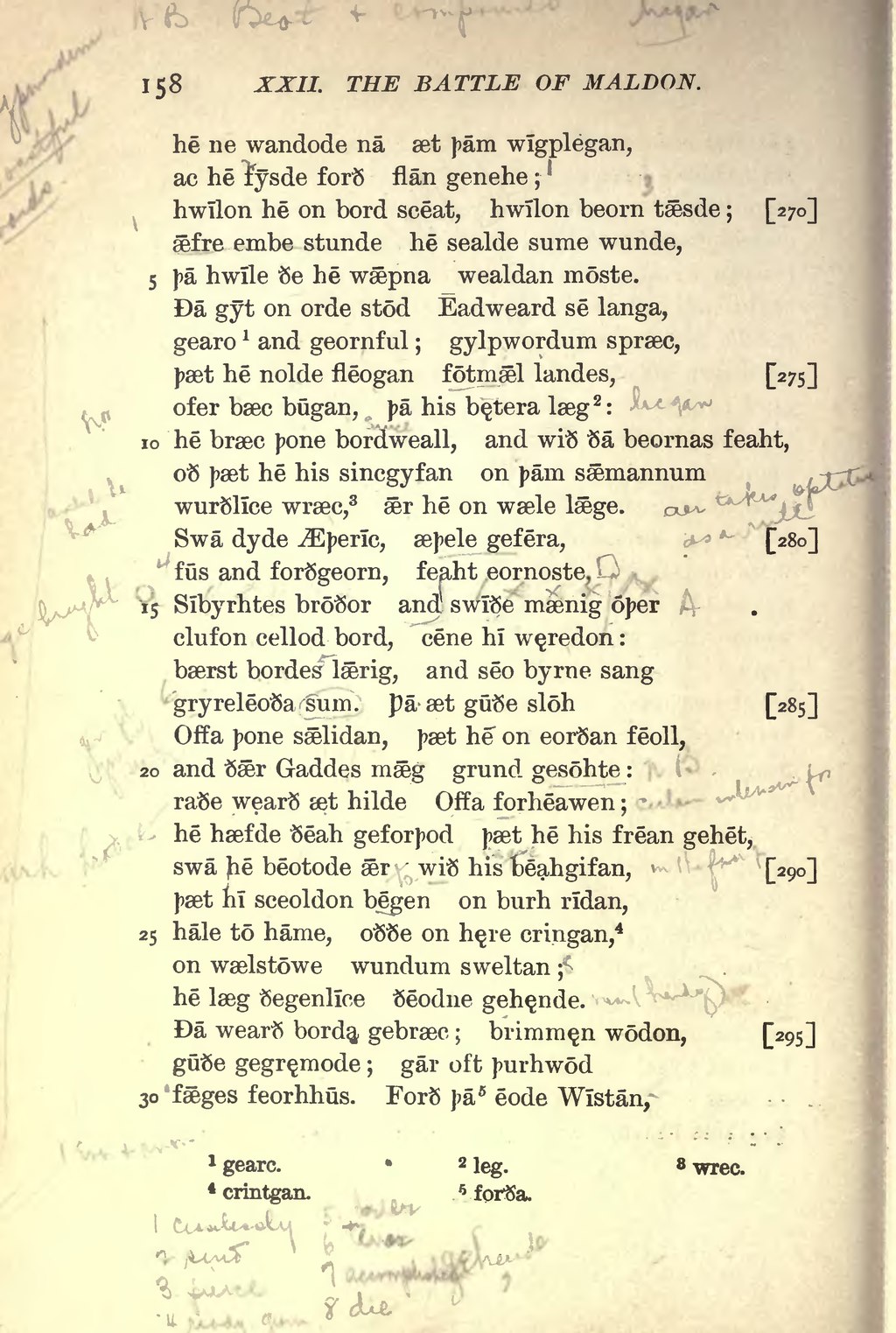
he ne wandode na 83t fam wigplegan,
ac he lysde for5 flan genehe ;
hwilon he on bord sceat, hwilon beorn tsesde ;
gefre embe stunde he sealde sume wunde,
5 fa hwile Se he wgepna wealdan moste.
Da gyt on orde stod Eadweard se langa,
gearo[1] and geornf ul ; gylpwordum sprsec,
fset he nolde fleogan fotmsel landes,
ofer bsec bugan, fa his b^tera lAg[2]:
10 he brsec fone bofctweall, and wi$ 8a beornas feaht,
o$ fset he his sincgyfan on fain seemannum
wurftlice wrsec,[3] ser he on wsele Isege.
Swa dyde ^Eferlc, sefele gefera,
' ' f us and forSgeorn, feaht .eornoste,
Q Sibyrhtes bro^or and: switSe msenig ofer
clufon celled bord, cene hi w^redon :
- bserst bordes Iserig, and seo byrne sang
'gryreleo'Sa'Sum. pa- set guSe sloh
Offa fone sselidan, fset he on eort5an feoll,
20 and fiser Gaddes rnseg grund gesohte :
ra^e wearS &st hilde Offa forheawen; u
he hsefde Seah geforfod fset he his frean gehet,
swa he beotode ser wi^ his teahgif an, >
fset nl sceoldon begen on burh ridan,
25 hale to hame, o^Se on h^re cringan,[4]
on wselstowe wundum sweltan f>
he Iseg Segenllce Seodne geh^nde.
Da weart5 borda^ gebrsec ; brimm^n wodon,
gu^e gegr^mode ; gar oft f urhwod
feorhhus. ForS fa[5] code Wistan,