Therefore, by (40), §102 , the curvature
K
=
0
{\displaystyle K=0}
(42), §103 , and (50), §117 , we see that in general
α
,
β
,
R
{\displaystyle \alpha ,\beta ,R}
P with its tangent to move along the curve to P' , at the point of inflection Q the curvature is zero, the rotation of the tangent is momentarily arrested, and as the direction of rotation changes, the center of curvature moves out indefinitely and the radius of curvature becomes infinite.
Illustrative Example 1.
y
2
=
4
p
x
{\displaystyle y^{2}=4px}
a ) to any point on the curve; (b ) to the vertex.
Solution.
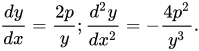
d
y
d
x
=
2
p
y
;
d
2
y
d
x
2
=
−
4
p
2
y
3
.
{\displaystyle {\frac {dy}{dx}}={\frac {2p}{y}};{\frac {d^{2}y}{dx^{2}}}=-{\frac {4p^{2}}{y^{3}}}.}
(a) Substituting in (E ),§116 ,
α
=
x
+
y
2
+
4
p
2
y
2
⋅
2
p
y
⋅
y
3
4
p
2
=
3
x
+
2
p
.
{\displaystyle \alpha =x+{\frac {y^{2}+4p^{2}}{y^{2}}}\cdot {\frac {2p}{y}}\cdot {\frac {y^{3}}{4p^{2}}}=3x+2p.}
β
=
y
−
y
2
+
4
p
2
y
2
⋅
y
3
4
p
2
=
−
y
3
4
p
2
.
{\displaystyle \beta =y-{\frac {y^{2}+4p^{2}}{y^{2}}}\cdot {\frac {y^{3}}{4p^{2}}}=-{\frac {y^{3}}{4p^{2}}}.}
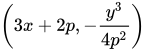
Therefore
(
3
x
+
2
p
,
−
y
3
4
p
2
)
{\displaystyle \left(3x+2p,-{\frac {y^{3}}{4p^{2}}}\right)}
(b)
(
2
p
,
0
)
{\displaystyle (2p,0)}
(
0
,
0
)
{\displaystyle (0,0)}
118. Center of curvature the limiting position of the intersection of normals at neighboring points.
(A )
y
=
f
(
x
)
.
{\displaystyle y\ =\ f(x).}
The equations of the normals to the curve at two neighboring points
P
0
{\displaystyle P_{0}}
P
1
{\displaystyle P_{1}}
[1]
(
x
0
−
X
)
+
(
y
0
−
Y
)
d
y
0
d
x
0
=
0
,
{\displaystyle (x_{0}-X)+(y_{0}-Y){\frac {dy_{0}}{dx_{0}}}=0,}
(
x
1
−
X
)
+
(
y
1
−
Y
)
d
y
1
d
x
1
=
0.
{\displaystyle (x_{1}-X)+(y_{1}-Y){\frac {dy_{1}}{dx_{1}}}=0.}
If the normals intersect at
C
′
(
α
′
,
β
′
)
{\displaystyle C'(\alpha ',\beta ')}
(B )
{
(
x
0
−
α
′
)
+
(
y
0
−
β
)
d
y
0
d
x
0
=
0
,
(
x
1
−
α
′
)
+
(
y
1
−
β
′
)
d
y
1
d
x
1
=
0.
{\displaystyle {\begin{cases}\left(x_{0}-\alpha '\right)+\left(y_{0}-\beta \right){\frac {dy_{0}}{dx_{0}}}=0,\\\left(x_{1}-\alpha '\right)+\left(y_{1}-\beta '\right){\frac {dy_{1}}{dx_{1}}}=0.\end{cases}}}
↑ From (2), §65 ,
X
{\displaystyle X}
Y
{\displaystyle Y}