instruments that the writer, while attending the Seventh International Geographic Congress at Berlin, 1899, as a delegate from the National Geographic Society, was made a member of the Provisional Committee of the International Seismological Association, just organized by the congress.
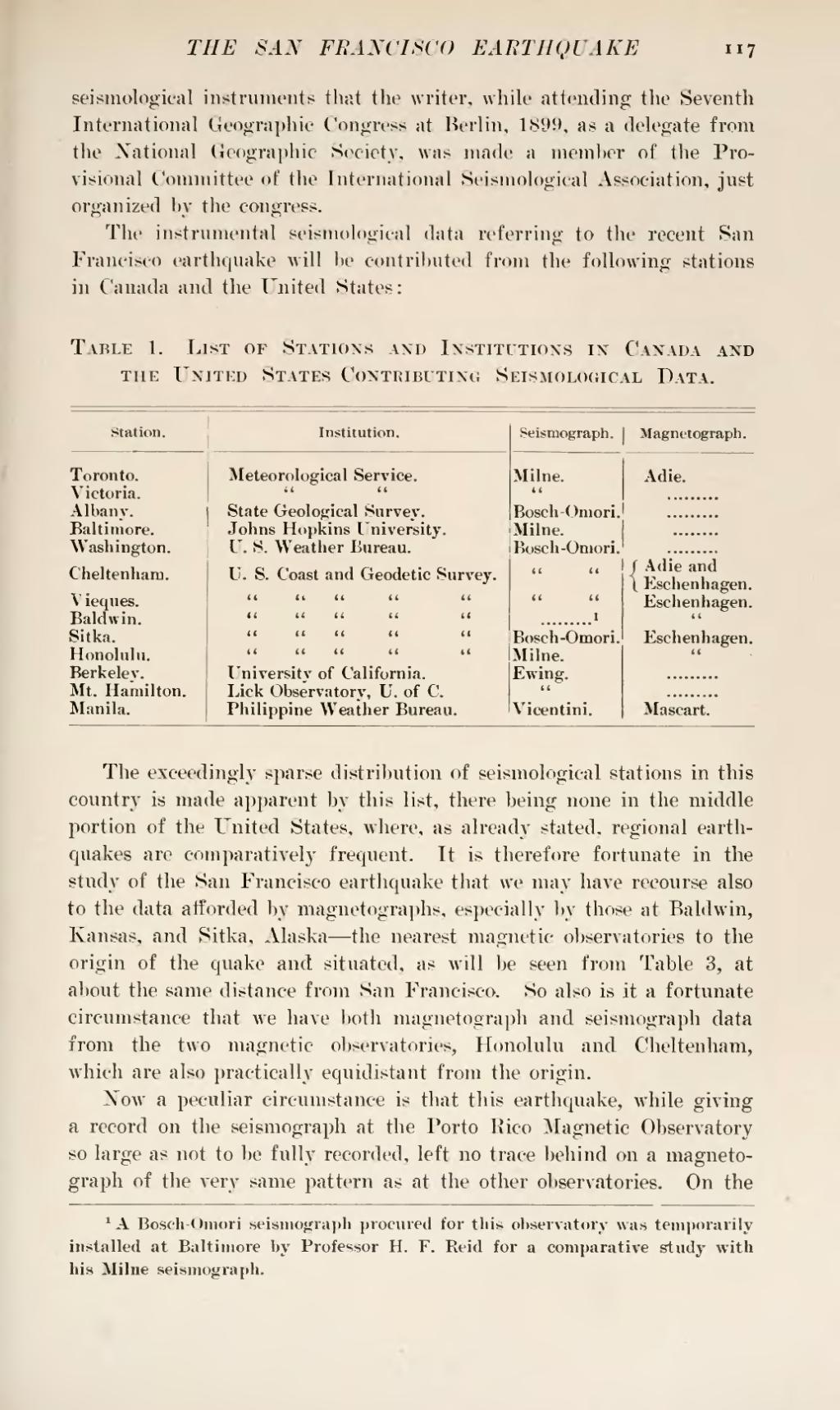
The instrumental seismological data referring to the recent San Francisco earthquake will be contributed from the following stations in Canada and the United States:
Table 1. List of Stations and Institutions in Canada and the United States Contributing Seismological Data.[1]

The exceedingly sparse distribution of seismological stations in this country is made apparent by this list, there being none in the middle portion of the United States, where, as already stated, regional earthquakes are comparatively frequent. It is therefore fortunate in the study of the San Francisco earthquake that we may have recourse also to the data afforded by magnetographs, especially by those at Baldwin, Kansas, and Sitka, Alaska—the nearest magnetic observatories to the origin of the quake and situated, as will be seen from Table 3, at about the same distance from San Francisco. So also is it a fortunate circumstance that we have both magnetograph and seismograph data from the two magnetic observatories, Honolulu and Cheltenham, which are also practically equidistant from the origin.
Now a peculiar circumstance is that this earthquake, while giving a record on the seismograph at the Porto Rico Magnetic Observatory so large as not to be fully recorded, left no trace behind on a magnetograph of the very same pattern as at the other observatories. On the
- ↑ A Bosch-Omori seismograph procured for this observatory was temporarily installed at Baltimore by Professor H. F. Reid for a comparative study with his Milne seismograph.