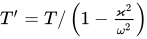
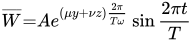
Herein, we make the substitution according to (10), than we have
This gives for x = ϰt:
14')
thus we have an illuminating plane (moving parallel to the X-axes), which oscillates with a wave-length (only different of the second order of T). The propagated oscillation can be written:
14)
Thus we get, within the propagated wave, a reduced period of oscillation in the relation of .
Is the observer is in motion as well, then:
This formula gives the principle of Doppler for plane waves. But it is in no way universal, but essentially presupposes a plane wave with constant amplitude throughout.
2) The same plane is to be set in oscillation by the law:
- as it similar occurs when a wave with initially constant amplitude travels through a prism of an absorbing substance - then for the propagated wave it is given: