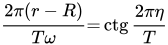
If we substitute according to (10), it is, if is set:
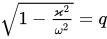
This gives for x = ϰt, if we write , :
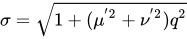
thus we have an oscillating and at the same time propagating plane; however, the propagated displacement reads:
15)
where we now have .
We notice that different laws as the Doppler principle are given, even if we limit ourselves to the first approximation, and ϰ²ω² is neglected compared to 1.
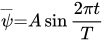
3) If the illuminating surface is a very small[AU 1] sphere of radius R, which oscillates according to the law for the rotation angle
around the X-axis, then, at the distance from the center of the sphere, the propagated rotations ψ are given by[1][AU 2]
↑This will be made more precise, so that the radius should be small compared to the wave-length. Yet the formulas (16) and (17) don't require this assumption:
↑There one also finds the laws for the emission of a linearly oscillating sphere, which allows the same way of use.
![{\displaystyle (W){=}Ae^{\frac {2\pi (\mu y+\nu z)q}{T\omega }}\sin {\frac {2\pi }{T}}\left[t\left(1+{\frac {\varkappa \sigma }{\omega }}\right)-x\left({\frac {\sigma }{\omega }}+{\frac {\varkappa }{\omega ^{2}}}\right)\right].}](https://wikimedia.org/api/rest_v1/media/math/render/svg/65ad7b81018aeea2b7fe8a3bba2a0a5a740b5d94)




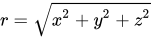
![{\displaystyle \psi ={\frac {R^{3}A}{r^{3}}}\left[\sin {\frac {2\pi }{T}}\left(t-{\frac {r-R}{\omega }}\right)+{\frac {2\pi (r-R)}{T\omega }}\cos {\frac {2\pi }{T}}\left(t-{\frac {r-R}{\omega }}\right)\right]}](https://wikimedia.org/api/rest_v1/media/math/render/svg/0795da3aa4a313b89f84d3e2517d8a99c9ac0260)