Sandra Fluke testimony entered in Congressional Record by Senator Barbara Boxer

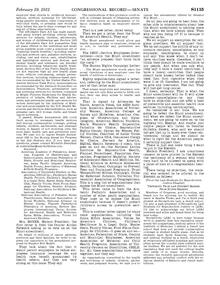
Sandra Fluke testimony entered in Congressional Record by Senator Barbara Boxer
HON. BARBARA BOXER
OF CALIFORNIA
IN THE UNITED STATES SENATE
February 29, 2012
Madam President, I ask unanimous consent to have printed in the
Record the testimony of a woman who tried very hard to be allowed to
speak with a panel of men at a congressional hearing.
There being no objection, the material was ordered to be printed in the Record, as follows:
[From the Law Students for Reproductive Justice Chapter]
Testimony From Law Student Barred From House Hearing
      Members of Congress, good morning, and thank you for
    allowing me to testify. My name is Sandra Fluke, and I'm a
    third year student at Georgetown Law, a Jesuit school. I'm
    also a past president of Georgetown Law Students for
    Reproductive Justice or LSRJ. I'd like to acknowledge my
    fellow LSRJ members and allies and thank them for being here
    today.
      Georgetown LSRJ is here today because we're so grateful
    that this regulation implements the nonpartisan, medical
    advice of the Institute of Medicine. I attend a Jesuit law
    school that does not provide contraception coverage in
    student health plans. Just as we students have faced
    financial, emotional, and medical burdens as a result,
    employees at religiously affiliated hospitals and
    universities across the country have suffered similar
    burdens. We are all grateful for the new regulation that will
    meet the critical health care needs of so many women.
    Simultaneously, the recently announced adjustment addresses
    any potential conflict with the religious identity of
    Catholic and Jesuit institutions.
      As I have watched national media coverage of this debate,
    it has been heartbreaking to see women's health treated as a
    political football. When I turn off the TV and look around my
    campus, I instead see the faces of the women affected, and I
    have heard more and more of their stories. You see,
    Georgetown does not cover contraceptives in its student
    insurance, although it does cover contraceptives for faculty
    and staff. On a daily basis, I hear from yet another woman
    who has suffered financial, emotional, and medical burdens
    because of this lack of contraceptive coverage. And so, I am
    here to share their voices and ask that you hear them.
      Without insurance coverage, contraception can cost a woman
    over $3,000 during law school. For a lot of students who,
    like me, are on public interest scholarships, that's
    practically an entire summer's salary. Forty percent of
    female students at Georgetown Law report struggling
    financially as a result of this policy. One told us of how
    embarrassed and powerless she felt when she was standing at
    the pharmacy counter, learning for the first time that
    contraception wasn't covered, and had to walk away because
    she couldn't afford it. Students like her have no choice but
    to go without contraception. Just on Tuesday, a married
    female student told me she had to stop using contraception
    because she couldn't afford it any longer.
      You might respond that contraception is accessible in lots
    of other ways. Unfortunately, that's not true. Women's health
    clinics provide vital medical services, but as the Guttmacher
    Institute has documented, clinics are unable to meet the
    crushing demand for these services. Clinics are closing and
    women are being forced to go without. How can Congress
    consider allowing even more employers and institutions to
    refuse contraceptive coverage and then respond that the non-
    profit clinics should step up to take care of the resulting
    medical crisis, particularly when so many legislators are
    attempting to defund those very same clinics?
      These denials of contraceptive coverage impact real people.
    In the worst cases, women who need this medication for other
    medical reasons suffer dire consequences. A friend of mine,
    for example, has polycystic ovarian syndrome and has to take
    prescription birth control to stop cysts from growing on her
    ovaries. Her prescription is technically covered by
    Georgetown insurance because it's not intended to prevent
    pregnancy. At many schools, it wouldn't be, and under Senator
    Blunt's amendment, Senator Rubio's bill, or Representative
    Fortenberry's bill, there's no requirement that an exception
    be made for such medical needs. When they do exist, these
    exceptions don't accomplish their well-intended goals because
    when you let university administrators or other employers,
    rather than women and their doctors, dictate whose medical
    needs are good enough and whose aren't, a woman's health
    takes a back seat to a bureaucracy focused on policing her
    body.
      In sixty-five percent of cases, our female students were
    interrogated by insurance representatives and university
    medical staff about why they need these prescriptions and
    whether they're lying about their symptoms. For my friend,
    and 20% of women in her situation, she never got the
    insurance company to cover her prescription, despite
    verification of her illness from her doctor. Her claim was
    denied repeatedly on the assumption that she really wanted
    the birth control to prevent pregnancy. She's gay, so clearly
    polycystic ovarian syndrome was a much more urgent concern
    than accidental pregnancy. After months of paying over $100
    out of pocket, she just couldn't afford her medication
    anymore and had to stop taking it. I learned about all of
    this when I walked out of a test and got a message from her
    that in the middle of her final exam period she'd been in the
    emergency room all night in excruciating pain. She wrote,
    "It was so painful, I woke up thinking I'd been shot."
    Without her taking the birth control, a massive cyst the size
    of a tennis ball had grown on her ovary. She had to have
    surgery to remove her entire ovary. She's not here this
    morning. She's in a doctor's office right now. Since last
    year's surgery, she's been experiencing night sweats, weight
    gain, and other symptoms of early menopause as a result of
    the removal of her ovary. She's 32 years old. As she put it:
    "If my body is indeed in early menopause, no fertility
    specialist in the world will be able to help me have my
    own children. I will have no chance at giving my mother
    her desperately desired grandbabies, simply because the
    insurance policy that I paid for totally unsubsidized by
    my school wouldn't cover my prescription for birth control
    when I needed it." Now, in addition to facing the health
    complications that come with having menopause at an early
    age--increased risk of cancer, heart disease,
    osteoporosis, she may never be able to be a mom.
      Perhaps you think my friend's tragic story is rare. It's
    not. One student told us doctors believe she has
    endometriosis, but it can't be proven without surgery, so the
    insurance hasn't been willing to cover her medication. Last
    week, a friend of mine told me that she also has polycystic ovarian syndrome.
      She's struggling to pay for her medication
    and is terrified to not have access to it. Due to the
    barriers erected by Georgetown's policy, she hasn't been
    reimbursed for her medication since last August. I sincerely
    pray that we don't have to wait until she loses an ovary or
    is diagnosed with cancer before her needs and the needs of
    all of these women are taken seriously.
      This is the message that not requiring coverage of
    contraception sends. A woman's reproductive healthcare isn't
    a necessity, isn't a priority. One student told us that she
    knew birth control wasn't covered, and she assumed that's how
    Georgetown's insurance handled all of women's sexual
    healthcare, so when she was raped, she didn't go to the
    doctor even to be examined or tested for sexually transmitted
    infections because she thought insurance wasn't going to
    cover something like that, something that was related to a
    woman's reproductive health. As one student put it, "this
    policy communicates to female students that our school
    doesn't understand our needs." These are not feelings that
    male fellow students experience. And they're not burdens that
    male students must shoulder.
      In the media lately, conservative Catholic organizations
    have been asking: what did we expect when we enrolled at a
    Catholic school? We can only answer that we expected women to
    be treated equally, to not have our school create untenable
    burdens that impede our academic success. We expected that
    our schools would live up to the Jesuit creed of cura
    personalis, to care for the whole person, by meeting all of
    our medical needs. We expected that when we told our
    universities of the problems this policy created for
    students, they would help us. We expected that when 94% of
    students opposed the policy, the university would respect our
    choices regarding insurance students pay for completely
    unsubsidized by the university, especially when the
    university already provides contraceptive coverage to faculty
    and staff. We did not expect that women would be told in the
    national media that if we wanted comprehensive insurance that
    met our needs, not just those of men, we should have gone to
    school elsewhere, even if that meant a less prestigious
    university. We refuse to pick between a quality education and
    our health, and we resent that, in the 21st century, anyone
    thinks it's acceptable to ask us to make this choice simply
    because we are women.
      Many of the students whose stories I've shared are Catholic
    women, so ours is not a war against the church. It is a
    struggle for access to the healthcare we need. The President
    of the Association of Jesuit Colleges has shared that Jesuit
    colleges and universities appreciate the modification to the
    rule announced last week. Religious concerns are addressed
    and women get the healthcare they need. That is something we
    can all agree on. Thank you.
Mrs. BOXER. Madam President, this is a panel of men who were called by House Republican Chairman Issa to testify about women's health--not one woman there, but they were the experts. They denied this woman the chance to speak. If she had been allowed to speak, this is what she wanted to say:
She had a friend who went to the doctor, and the friend had a cyst on her ovary. The doctor said: You have to take birth control. That is going to help. Those pills are going to help reduce the size of that cyst.
She couldn't afford the birth control pills and her employer wouldn't cover them, so she couldn't take them. She is a student. She wrote her friend saying that the cyst "was so painful, I woke up thinking I'd been shot."
I will quote part of the friend's testimony relaying what her friend told her.
      Without taking the birth control, a massive cyst the size
    of a tennis ball had grown on her ovary. She had to have
    surgery to remove her entire ovary. She's not here this
    morning. She's in a doctor's office right now. Since last
    year's surgery, she has been experiencing night sweats,
    weight gain, and other symptoms of early menopause as a
    result of the removal of her ovary. She's 32 years old. As
    she put it, "If my body is indeed in early menopause, no
    fertility specialist in the world will be able to help me
    have my own children. I will have no chance of giving my
    mother her desperately desired grandbabies, simply because
    the insurance policy that I paid for totally unsubsidized by
    my school wouldn't cover my prescription for birth control
    when I needed it."
And so her friend says:
      Now, in addition to facing the health complications that
    come with having menopause at an early age--increased risk of
    cancer, heart disease, osteoporosis--she may never be able to
    be a mom.
So when we talk about the Blunt amendment, we are not talking about
some obtuse issue, we are not talking about some philosophical issue.
What we are talking about when we talk about the Blunt amendment is a
young woman, a student at law school who couldn't afford to pay for the
birth control pills which would have saved her fertility, which would
have saved her horrific pain--a painful operation where she lost her
ovary simply because she couldn't have access to her birth control
pills.
This is not about some argument that doesn't have real consequences for our people. The Presiding Officer's constituents and my constituents deserve to have access to preventive care. They deserve to have access to essential health care. The Blunt amendment will take that away from them. It will take that away from them. And all on a highway bill. All on a highway bill.
So let's keep the Blunt amendment away from this highway bill. This highway bill is a product of strong bipartisanship, as the Presiding Officer has told the Senate. Let's keep it clean. Let's keep out these extraneous amendments that will roll back environmental laws that are cleaning up the air, that will keep the arsenic and the mercury out of the air and the lead out of the air. Let's not roll back these laws on a highway bill. Let's get the highway bill done. When we have other arguments about other issues, let's put those issues on a relevant bill.
This is the time now for us to pull together, not pull apart. The Nation needs us to work together. It is an election year, and it is a difficult time. There is a lot of name-calling going on out there on the campaign trail, but we are still here, last I checked, and we are supposed to be doing our work for the American people. We have a chance to do it on this highway bill. Let's defeat the Blunt amendment in the morning.
I thank my friends for coming over to the floor and speaking so eloquently today against this dangerous, precedent-setting Blunt amendment that will turn back the clock on women's health and on our families' health.
I yield the floor, and I suggest the absence of a quorum. ____________________

This work is in the public domain in the United States because it is a work of the United States federal government (see 17 U.S.C. 105).

Public domainPublic domainfalsefalse