rectangle, are y0 and z − ½dz. The corresponding value of G is
|
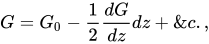 | (8) |
and the part of the value of p which arises from the side A is approximately
|
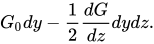 | (9) |
| Similarly, for B, |
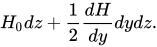 | |
| For C, |
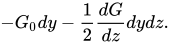 | |
| For D, |
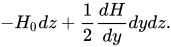 | |
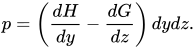
Adding these four quantities, we find the value of p for the rectangle
|
 | (10) |
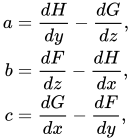
If we now assume three new quantities, a, b, c, such that
|
 | (A) |
and consider these as the constituents of a new vector
 ,
then, by Theorem IV, Art. 24, we may express the line-integral of
,
then, by Theorem IV, Art. 24, we may express the line-integral of
 ,
round any circuit in the form of the surface-integral of
,
over a surface bounded by the circuit, thus
,
round any circuit in the form of the surface-integral of
,
over a surface bounded by the circuit, thus
|
 | (11) |
| or |
 | (12) |
where ε is the angle between
and ds, and η that between
and the normal to dS, whose direction-cosines are l, m, n, and
 ,
,
 denote the numerical values of
and
denote the numerical values of
and
Comparing this result with equation (3), it is evident that the quantity I in that equation is equal to
 ,
or the resolved part of
normal to dS.
,
or the resolved part of
normal to dS.
592.] We have already seen (Arts.
490,
541) that, according to Faraday s theory, the phenomena of electromagnetic force and
