A Treatise on Electricity and Magnetism/Part II/Chapter VIII
CHAPTER VIII.
RESISTANCE AND CONDUCTIVITY IN THREE DIMENSIONS.
On the most General Relations between Current and Electromotive Force.
297.] Let the components of the current at any point be

Let the components of the electromotive force be
The electromotive force at any point is the resultant force on a unit of positive electricity placed at that point. It may arise (1) from electrostatic action, in which case if is the potential,

| (1) |

or (2) from electromagnetic induction, the laws of which we shall afterwards examine; or (3) from thermoelectric or electrochemical action at the point itself, tending to produce a current in a given direction.
We shall in general suppose that represent the components of the actual electromotive force at the point, whatever be the origin of the force, but we shall occasionally examine the result of supposing it entirely due to variation of potential.
By Ohm's Law the current is proportional to the electromotive force. Hence must be linear functions of We may therefore assume as the equations of Resistance,
| (2) |
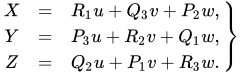
We may call the coefficients the coefficients of longitudinal resistance in the directions of the axes of coordinates.
The coefficients and may be called the coefficients of transverse resistance. They indicate the electromotive force in one direction required to produce a current in a different direction.


If we were at liberty to assume that a solid body may be treated as a system of linear conductors, then, from the reciprocal property (Art. 281) of any two conductors of a linear system, we might shew that the electromotive force along required to produce a unit current parallel to must be equal to the electromotive force along required to produce a unit current parallel to This would shew that and similarly we should find and When these conditions are satisfied the system of coefficients is said to be Symmetrical. When they are not satisfied it is called a Skew system.


We have great reason to believe that in every actual case the system is symmetrical, but we shall examine some of the consequences of admitting the possibility of a skew system.
298.] The quantities may be expressed as linear functions of by a system of equations, which we may call Equations of Conductivity,
| (3) |
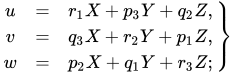
we may call the coefficients the coefficients of Longitudinal conductivity, and and those of Transverse conductivity.


The coefficients of resistance are inverse to those of conductivity. This relation may be defined as follows:
Let be the determinant of the coefficients of resistance, and that of the coefficients of conductivity, then![{\displaystyle [PQR]}](https://wikimedia.org/api/rest_v1/media/math/render/svg/d915f5adaf1949c3ef0e3cbfe636b12e1f7212bb)
![{\displaystyle [pqr]}](https://wikimedia.org/api/rest_v1/media/math/render/svg/7db64c30081117e221292645b6251f55266dd102)
| (4) |
![{\displaystyle [PQR]=P_{1}P_{2}P_{3}+Q_{1}Q_{2}Q_{3}+R_{1}R_{2}R_{3}-P_{1}Q_{1}R_{1}-P_{2}Q_{2}R_{2}-P_{3}Q_{3}R_{3},}](https://wikimedia.org/api/rest_v1/media/math/render/svg/447067e1a8d27faf283c88ac3b454d92710416dc)
| (5) |
![{\displaystyle [pqr]=p_{1}p_{2}p_{3}+q_{1}q_{2}q_{3}+r_{1}r_{2}r_{3}-p_{1}q_{1}r_{1}-p_{2}q_{2}r_{2}-p_{3}q_{3}r_{3},}](https://wikimedia.org/api/rest_v1/media/math/render/svg/b0568dcfeba718cd5ff6ea650069f24577d06e84)
| (6) |
![{\displaystyle [PQR][pqr]=1,}](https://wikimedia.org/api/rest_v1/media/math/render/svg/e8021001ac9c59be2b91b6787918abd668e3169c)
| (7) |
![{\displaystyle {\begin{matrix}[PQR]p_{1}=(P_{2}P_{3}-Q_{1}R_{1}),&[pqr]P_{1}=(p_{2}p_{3}-q_{1}r_{1}),\\\mathrm {\&c.} &\mathrm {\&c.} \end{matrix}}}](https://wikimedia.org/api/rest_v1/media/math/render/svg/a5a9e270de6eac0652f41c53795c9a7c442b06e3)
The other equations may be formed by altering the symbols and the suffixes in cyclical order.


Rate of Generation of Heat.
299.] To find the work done by the current in unit of time in overcoming resistance, and so generating heat, we multiply the components of the current by the corresponding components of the electromotive force. We thus obtain the following expressions for the quantity of work expended in unit of time: 
| (8) |

| (9) |

| (10) |





It is only when the coefficients are equal respectively to that the two systems of axes coincide.
If with Thomson[1] we write

| and | (11) |

| (12) |
![{\displaystyle \left.{\begin{array}{rcl}[PQR]&=&R_{1}R_{2}R_{3}+2S_{1}S_{2}S_{3}-S_{1}^{2}R_{1}-S_{2}^{2}R_{2}-S_{3}^{2}R_{3}\\&&+2(S_{1}T_{2}T_{3}+S_{2}T_{3}T_{1}+S_{3}T_{1}T_{2})+R_{1}T_{1}^{2}+R_{2}T_{2}^{2}+R_{3}T_{3}^{2};\end{array}}\right\}}](https://wikimedia.org/api/rest_v1/media/math/render/svg/7f0646f6c50db19bbe2f1b1a3ba899cb8aa2326d)
| and | (13) |
![{\displaystyle {\begin{array}{rcl}[PQR]r_{1}&=&R_{2}R_{3}-S_{1}^{2}+T_{1}^{2},\\\left[PQR\right]s_{1}&=&T_{2}T_{3}+S_{2}S_{3}-R_{1}S_{1},\\\left[PQR\right]t_{1}&=&-R_{1}T_{1}+S_{2}T_{3}+S_{3}T_{2}.\end{array}}}](https://wikimedia.org/api/rest_v1/media/math/render/svg/a4f22792525fa12463cb06f9eda30aa5daa530bb)

If therefore we cause to disappear, will not also disappear unless the coefficients are zero.


Condition of Stability.
300.] Since the equilibrium of electricity is stable, the work spent in maintaining the current must always be positive. The conditions that must be positive are that the three coefficients and the three expressions
| (14) |
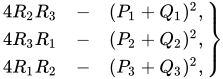
must all be positive.
Equation of Continuity in a Homogeneous Medium.
301.] If we express the components of the electromotive force as the derivatives of the potential the equation of continuity
| (15) |
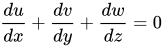
| (16) |

If the medium is not homogeneous there will be terms arising from the variation of the coefficients of conductivity in passing from one point to another.
This equation corresponds to Laplace's equation in an isotropic medium.
302.] If we put| (17) |
![{\displaystyle [rs]=r_{1}r_{2}r_{3}+2s_{1}s_{2}s_{3}-r_{1}s_{1}^{2}-r_{2}s_{2}^{2}-r_{3}s_{3}^{2},}](https://wikimedia.org/api/rest_v1/media/math/render/svg/131611acba1c9d0654c8919b2ad83a80b5231c92)
| and | (18) |
![{\displaystyle [AB]=A_{1}A_{2}A_{3}+2B_{1}B_{2}B_{3}-A_{1}B_{1}^{2}-A_{2}B_{2}^{2}-A_{3}B_{3}^{2},}](https://wikimedia.org/api/rest_v1/media/math/render/svg/e96bd8debc4f1ab4b523a32effb1a3132a18eaa4)
| where | (19) |
![{\displaystyle \left.{\begin{array}{rcl}[rs]A_{1}&=&r_{2}r_{2}-s_{1}^{2},\\{}[rs]B_{1}&=&s_{2}s_{3}-r_{1}s_{1},\\--&-&---\end{array}}\right\}}](https://wikimedia.org/api/rest_v1/media/math/render/svg/794be808fb11e11c5c2b96a9d3f89804721eafe9)


| (20) |
![{\displaystyle A_{1}x^{2}+A_{2}y^{2}+A_{3}z^{2}+2B_{1}yz+2B_{2}zx+2B_{3}xxy=[AB]\rho ^{2},}](https://wikimedia.org/api/rest_v1/media/math/render/svg/bf4400b9a13c8621fc317456d7e6904c6f9d6647)
| (21) |

is a solution of the equation.
In the case in which the coefficients are zero, the coefficients and become identical with and When exists this is not the case.


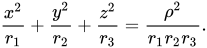
In the case therefore of electricity flowing out from a centre in an infinite homogeneous, but not isotropic, medium, the equipotential surfaces are ellipsoids, for each of which is constant. The axes of these ellipsoids are in the directions of the principal axes of conductivity, and these do not coincide with the principal axes of resistance unless the system is symmetrical.
By a transformation of this equation we may take for the axes of the principal axes of conductivity. The coefficients of the forms and will then be reduced to zero, and each coefficient of the form will be the reciprocal of the corresponding coefficient of the form The expression for will be


| (22)) |
303.] The theory of the complete system of equations of resistance and of conductivity is that of linear functions of three variables, and it is exemplified in the theory of Strains[2], and in other parts of physics. The most appropriate method of treating it is that by which Hamilton and Tait treat a linear and vector function of a vector. We shall not, however, expressly introduce Quaternion notation.
The coefficients may be regarded as the rectangular components of a vector the absolute magnitude and direction of which are fixed in the body, and independent of the direction of the axes of reference. The same is true of which are the components of another vector


The vectors and do not in general coincide in direction.
Let us now take the axis of so as to coincide with the vector and transform the equations of resistance accordingly. They will then have the form
| (23) |
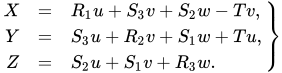
It appears from these equations that we may consider the electromotive force as the resultant of two forces, one of them depending only on the coefficients and and the other depending on alone. The part depending on and is related to the current in the same way that the perpendicular on the tangent plane of an ellipsoid is related to the radius vector. The other part, depending on is equal to the product of into the resolved part of the current perpendicular to the axis of , and its direction is perpendicular to and to the current, being always in the direction in which the resolved part of the current would lie if turned 90° in the positive direction round


Considering the current and as vectors, the part of the electromotive force due to is the vector part of the product,

The coefficient may be called the Rotatory coefficient. We have reason to believe that it does not exist in any known substance. It should be found, if anywhere, in magnets, which have a polarization in one direction, probably due to a rotational phenomenon in the substance.
304.] Let us next consider the general characteristic equation of
| (24) |

where the coefficients of conductivity may have any positive values, continuous or discontinuous, at any point of space, and vanishes at infinity.
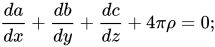
Also, let be three functions of satisfying the condition


| (25) |
| and let | (26) |
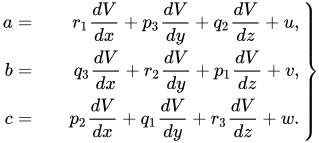
| (27) |

be extended over spaces bounded as in the enunciation of Art. 97, where the coefficients are the coefficients of resistance.

Then will have a unique minimum value when are such that are each everywhere zero, and the characteristic equation (24) will therefore, as shewn in Art. 98, have one and only one solution.
In this case represents the mechanical equivalent of the heat generated by the current in the system in unit of time, and we have to prove that there is one way, and one only, of making this heat a minimum, and that the distribution of currents in that case is that which arises from the solution of the characteristic equation of the potential
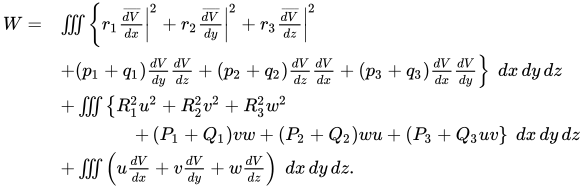
The quantity may be written in terms of equations (25) and (26), 

| (28) |
| Since | (29) |
the third term of vanishes within the limits.
The second term, being the rate of conversion of electrical energy into heat, is also essentially positive. Its minimum value is zero, and this is attained only when and are everywhere zero.


The value of is in this case reduced to the first term, and is then a minimum and a unique minimum.
305.] As this proposition is of great importance in the theory of electricity, it may be useful to present the following proof of the most general case in a form free from analytical operations.
Let us consider the propagation of electricity through a conductor of any form, homogeneous or heterogeneous.
Then we know that
(1) If we draw a line along the path and in the direction of the electric current, the line must pass from places of high potential to places of low potential.
(2) If the potential at every point of the system be altered in a given uniform ratio, the currents will be altered in the same ratio, according to Ohm's Law.
(3) If a certain distribution of potential gives rise to a certain distribution of currents, and a second distribution of potential gives rise to a second distribution of currents, then a third distribution in which the potential is the sum or difference of those in the first and second will give rise to a third distribution of currents, such that the total current passing through a given finite surface in the third case is the sum or difference of the currents passing through it in the first and second cases. For, by Ohm's Law, the additional current due to an alteration of potentials is independent of the original current due to the original distribution of potentials.
(4) If the potential is constant over the whole of a closed surface, and if there are no electrodes or intrinsic electromotive forces within it, then there will be no currents within the closed surface, and the potential at any point within it will be equal to that at the surface.
If there are currents within the closed surface they must either be closed curves, or they must begin and end either within the closed surface or at the surface itself.
But since the current must pass from places of high to places of low potential, it cannot flow in a closed curve.
Since there are no electrodes within the surface the current cannot begin or end within the closed surface, and since the potential at all points of the surface is the same, there can be no current along lines passing from one point of the surface to another.
Hence there are no currents within the surface, and therefore there can be no difference of potential, as such a difference would produce currents, and therefore the potential within the closed surface is everywhere the same as at the surface.
(5) If there is no electric current through any part of a closed surface, and no electrodes or intrinsic electromotive forces within the surface, there will be no currents within the surface, and the potential will be uniform.
We have seen that the currents cannot form closed curves, or begin or terminate within the surface, and since by the hypothesis they do not pass through the surface, there can be no currents, and therefore the potential is constant.
(6) If the potential is uniform over part of a closed surface, and if there is no current through the remainder of the surface, the potential within the surface will be uniform for the same reasons.
(7) If over part of the surface of a body the potential of every point is known, and if over the rest of the surface of the body the current passing through the surface at each point is known, then only one distribution of potentials at points within the body can exist.
For if there were two different values of the potential at any point within the body, let these be in the first case and in the second case, and let us imagine a third case in which the potential of every point of the body is the excess of potential in the first case over that in the second. Then on that part of the surface for which the potential is known the potential in the third case will be zero, and on that part of the surface through which the currents are known the currents in the third case will be zero, so that by (6) the potential everywhere within the surface will be zero, or there is no excess of over or the reverse. Hence there is only one possible distribution of potentials. This proposition is true whether the solid be bounded by one closed surface or by several.


On the Approximate Calculation of the Resistance of a Conductor of a given Form.
306.] The conductor here considered has its surface divided into three portions. Over one of these portions the potential is maintained at a constant value. Over a second portion the potential has a constant value different from the first. The whole of the remainder of the surface is impervious to electricity. We may suppose the conditions of the first and second portions to be fulfilled by applying to the conductor two electrodes of perfectly conducting material, and that of the remainder of the surface by coating it with perfectly non-conducting material.
Under these circumstances the current in every part of the conductor is simply proportional to the difference between the potentials of the electrodes. Calling this difference the electromotive force, the total current from the one electrode to the other is the product of the electromotive force by the conductivity of the conductor as a whole, and the resistance of the conductor is the reciprocal of the conductivity.
It is only when a conductor is approximately in the circumstances above defined that it can be said to have a definite resistance, or conductivity as a whole. A resistance coil, consisting of a thin wire terminating in large masses of copper, approximately satisfies these conditions, for the potential in the massive electrodes is nearly constant, and any differences of potential in different points of the same electrode may be neglected in comparison with the difference of the potentials of the two electrodes.
A very useful method of calculating the resistance of such conductors has been given, so far as I know, for the first time, by the Hon. J. W. Strutt, in a paper on the Theory of Resonance[3].
It is founded on the following considerations.
If the specific resistance of any portion of the conductor be changed, that of the remainder being unchanged, the resistance of the whole conductor will be increased if that of the portion is increased, and diminished if that of the portion be diminished.
This principle may be regarded as self-evident, but it may easily be shewn that the value of the expression for the resistance of a system of conductors between two points selected as electrodes, increases as the resistance of each member of the system increases.
It follows from this that if a surface of any form be described in the substance of the conductor, and if we further suppose this surface to be an infinitely thin sheet of a perfectly conducting substance, the resistance of the conductor as a whole will be diminished unless the surface is one of the equipotential surfaces in the natural state of the conductor, in which case no effect will be produced by making it a perfect conductor, as it is already in electrical equilibrium.
If therefore we draw within the conductor a series of surfaces, the first of which coincides with the first electrode, and the last with the second, while the intermediate surfaces are bounded by the non-conducting surface and do not intersect each other, and if we suppose each of these surfaces to be an infinitely thin sheet of perfectly conducting matter, we shall have obtained a system the resistance of which is certainly not greater than that of the original conductor, and is equal to it only when the surfaces we have chosen are the natural equipotential surfaces.
To calculate the resistance of the artificial system is an operation of much less difficulty than the original problem. For the resistance of the whole is the sum of the resistances of all the strata contained between the consecutive surfaces, and the resistance of each stratum can be found thus:
Let be an element of the surface of the stratum, the thickness of the stratum perpendicular to the element, the specific resistance, the difference of potential of the perfectly conducting surfaces, and the current through then


| (1) |
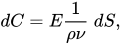
| (2) |
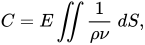
| (3) |
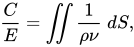
and the resistance of the stratum is the reciprocal of this quantity.
If the stratum be that bounded by the two surfaces for which the function has the values and respectively, then

| (4) |
![{\displaystyle {\frac {dF}{\nu }}=\nabla F=\left[\left({\frac {dF}{dx}}\right)^{2}+\left({\frac {dF}{dy}}\right)^{2}+\left({\frac {dF}{dz}}\right)^{2}\right]^{\frac {1}{2}},}](https://wikimedia.org/api/rest_v1/media/math/render/svg/b7727ae560b82641b4b0cd7409f8abe5a391527c)
| (5) |


| (6) |
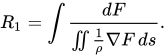
The resistance of the conductor in its natural state is greater than the value thus obtained, unless all the surfaces we have chosen are the natural equipotential surfaces. Also, since the true value of is the absolute maximum of the values of which can thus be obtained, a small deviation of the chosen surfaces from the true equipotential surfaces will produce an error of which is comparatively small.

This method of determining a lower limit of the value of the resistance is evidently perfectly general, and may be applied to conductors of any form, even when the specific resistance, varies in any manner within the conductor.
The most familiar example is the ordinary method of determining the resistance of a straight wire of variable section. In this case the surfaces chosen are planes perpendicular to the axis of the wire, the strata have parallel faces, and the resistance of a stratum of section and thickness is

| (7) |

| (8) |
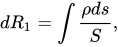


This method in the case of wires whose section varies slowly with the length gives a result very near the truth, but it is really only a lower limit, for the true resistance is always greater than this, except in the case where the section is perfectly uniform.
307.] To find the higher limit of the resistance, let us suppose a surface drawn in the conductor to be rendered impermeable to electricity. The effect of this must be to increase the resistance of the conductor unless the surface is one of the natural surfaces of flow. By means of two systems of surfaces we can form a set of tubes which will completely regulate the flow, and the effect, if there is any, of this system of impermeable surfaces must be to increase the resistance above its natural value.
The resistance of each of the tubes may be calculated by the method already given for a fine wire, and the resistance of the whole conductor is the reciprocal of the sum of the reciprocals of the resistances of all the tubes. The resistance thus found is greater than the natural resistance, except when the tubes follow the natural lines of flow.
In the case already considered, where the conductor is in the form of an elongated solid of revolution, let us measure along the axis, and let the radius of the section at any point be Let one set of impermeable surfaces be the planes through the axis for each of which is constant, and let the other set be surfaces of revolution for which


| (9) |

where is a numerical quantity between 0 and 1.

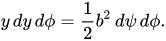
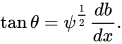
Let us consider a portion of one of the tubes bounded by the surfaces and and and
The section of the tube taken perpendicular to the axis is


| (10) |

| (11) |

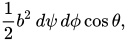
| (12) |

| Let | (13) |



To find the conductivity of the whole conductor, which is the sum of the conductivities of the separate tubes, we must integrate this expression between and and between
and The result is


| (14) |
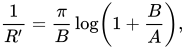
which may be less, but cannot be greater, than the true conductivity of the conductor.


| (15) |


| (16) |



| (17) |
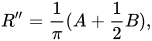
308.] We shall now apply the same method to find the correction which must be applied to the length of a cylindrical conductor of radius when its extremity is placed in metallic contact with a massive electrode, which we may suppose of a different metal.

For the lower limit of the resistance we shall suppose that an infinitely thin disk of perfectly conducting matter is placed between the end of the cylinder and the massive electrode, so as to bring the end of the cylinder to one and the same potential throughout. The potential within the cylinder will then be a function of its length only, and if we suppose the surface of the electrode where the cylinder meets it to be approximately plane, and all its dimensions to be large compared with the diameter of the cylinder, the distribution of potential will be that due to a conductor in the form of a disk placed in an infinite medium. See Arts. 152, 177.
If is the difference of the potential of the disk from that of the distant parts of the electrode, the current issuing from the surface of the disk into the electrode, and the specific resistance of the electrode,

| (18) |


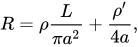
| (19) |
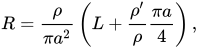
where the second term within brackets is a quantity which must be added to the length of the cylinder or wire in calculating its resistance, and this is certainly too small a correction.
To understand the nature of the outstanding error we may observe, that whereas we have supposed the flow in the wire up to the disk to be uniform throughout the section, the flow from the disk to the electrode is not uniform, but is at any point inversely proportional to the minimum chord through that point. In the actual case the flow through the disk will not be uniform, but it will not vary so much from point to point as in this supposed case. The potential of the disk in the actual case will not be uniform, but will diminish from the middle to the edge.
309.] We shall next determine a quantity greater than the true resistance by constraining the flow through the disk to be uniform at every point. We may suppose electromotive forces introduced for this purpose acting perpendicular to the surface of the disk.
The resistance within the wire will be the same as before, but in the electrode the rate of generation of heat will be the surface-integral of the product of the flow into the potential. The rate of flow at any point is and the potential is the same as that of an electrified surface whose surface-density is where

| (20) |

being the specific resistance.
We have therefore to determine the potential energy of the electrification of the disk with the uniform surface-density
The potential at the edge of a disk of uniform density is easily found to be The work done in adding a strip of breadth at the circumference of the disk is and the whole potential energy of the disk is the integral of this,



| (21) |


| (22) |
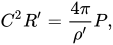


this correction being greater than the true value. The true correction to be added to the length is therefore where is a number lying between and or between 0.785 and 0.849.


