A Treatise on Electricity and Magnetism/Part IV/Chapter VII
CHAPTER VII.
THEORY OF ELECTRIC CIRCUITS.
578.1 We may now confine our attention to that part of the kinetic energy of the system which depends on squares and products of the strengths of the electric currents. We may call this the Electrokinetic Energy of the system. The part depending on the motion of the conductors belongs to ordinary dynamics, and we have shewn that the part depending on products of velocities and currents does not exist.
Let , , &c. denote the different conducting circuits. Let their form and relative position be expressed in terms of the variables , , &c., the number of which is equal to the number of degrees of freedom of the mechanical system. We shall call these the Geometrical Variables.


Let , denote the quantity of electricity which has crossed a given section of the conductor , since the beginning of the time t. The strength of the current will be denoted by , the fluxion of this quantity.


We shall call the actual current, and the integral current. There is one variable of this kind for each circuit in the system.
Let denote the electrokinetic energy of the system. It is a homogeneous function of the second degree with respect to the strengths of the currents, and is of the form

| (1) |

where the coefficients , , &c. are functions of the geometrical variables , , &c. The electrical variables , , &c., do not enter into the expression.


We may call , , &c., the electric moments of inertia of the circuits , , &c., and the electric product of inertia of the two circuits and . When we wish to avoid the language of the dynamical theory, we shall call the coefficient of self-induction of the circuit and the coefficient of mutual induction of the circuits and . is also called the potential of the circuit with respect to . These quantities depend only on the form and relative position of the circuits. We shall find that in the electromagnetic system of measurement they are quantities of the dimension of a line. See Art. 627.


By differentiating with respect to we obtain the quantity which, in the dynamical theory, may be called the momentum corresponding to . In the electric theory we shall call the electrokinetic momentum of the circuit . Its value is


The electrokinetic momentum of the circuit is therefore made up of the product of its own current into its coefficient of self-induction, together with the sum of the products of the currents
in the other circuits, each into the coefficient of mutual induction of and that other circuit.
On Electromotive Force.
579.] Let be the impressed electromotive force in the circuit , arising from some cause, such as a voltaic or thermoelectric battery, which would produce a current independently of magneto-electric induction.


Let be the resistance of the circuit, then, by Ohm's law, an electromotive force is required to overcome the resistance, leaving an electromotive force available for changing the momentum of the circuit. Calling this force , we have, by the general equations,


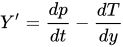
but since does not involve , the last term disappears.

Hence, the equation of electromotive force is
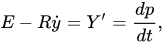
| or |
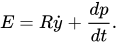
The impressed electromotive force is therefore the sum of two parts. The first,
,
is required to maintain the current
against the resistance . The second part is required to increase the electromagnetic momentum . This is the electromotive force which must be supplied from sources independent of magneto-electric induction. The electromotive force arising from magneto-electric induction alone is evidently
, or the rate of decrease of the electrokinetic momentum of the circuit.


Electromagnetic Force.
580.] Let X' be the impressed mechanical force arising from external causes, and tending to increase the variable x. By the general equations
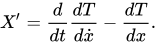
Since the expression for the electrokinetic energy does not contain the velocity
,
the first term of the second member disappears, and we find


Here X' is the external force required to balance the forces arising from electrical causes. It is usual to consider this force as the reaction against the electromagnetic force, which we shall call X,
and which is equal and opposite to X'.
| Hence |

or, the electromagnetic force tending to increase any variable is equal to the rate of increase of the electrokinetic energy per unit increase of that variable, the currents being maintained constant.
If the currents are maintained constant by a battery during a displacement in which a quantity, W, of work is done by electromotive force, the electrokinetic energy of the system will be at the same time increased by W. Hence the battery will be drawn upon for a double quantity of energy, or 2W, in addition to that which is spent in generating heat in the circuit. This was first pointed out by Sir W. Thomson[1]. Compare this result with the electrostatic property in Art. 93.
Case of Two Circuits.
581.] Let A1 be called the Primary Circuit, and A2 the Secondary Circuit. The electrokinetic energy of the system may be written

where L and N are the coefficients of self-induction of the primary and secondary circuits respectively, and M is the coefficient of their mutual induction.
Let us suppose that no electromotive force acts on the secondary circuit except that due to the induction of the primary current. We have then

Integrating this equation with respect to t, we have

where y2 is the integral current in the secondary circuit.
The method of measuring an integral current of short duration will be described in Art. 748, and it is easy in most cases to ensure that the duration of the secondary current shall be very short.
Let the values of the variable quantities in the equation at the end of the time t be accented, then, if y2 is the integral current, or the whole quantity of electricity which flows through a section of the secondary circuit during the time t,

If the secondary current arises entirely from induction, its initial value
must be zero if the primary current is constant, and the
conductors at rest before the beginning of the time t.

If the time t is sufficient to allow the secondary current to die away, , its final value, is also zero, so that the equation becomes


The integral current of the secondary circuit depends in this case on the initial and final values of
.

Induced Currents.
582.] Let us begin by supposing the primary circuit broken, or , and let a current be established in it when contact is made.


The equation which determines the secondary integral current is

When the circuits are placed side by side, and in the same direction, M is a positive quantity. Hence, when contact is made in the primary circuit, a negative current is induced in the secondary circuit.
When the contact is broken in the primary circuit, the primary current ceases, and the induced current is y2 where

The secondary current is in this case positive.
If the primary current is maintained constant, and the form or relative position of the circuits altered so that M becomes M', the integral secondary current is y2, where

In the case of two circuits placed side by side and in the same
direction M diminishes as the distance between the circuits in creases. Hence, the induced current is positive when this distance is increased and negative when it is diminished.
These are the elementary cases of induced currents described in Art. 530.
On Mechanical Action between the Two Circuits.
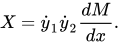
583.] Let x be any one of the geometrical variables on which the form and relative position of the circuits depend, the electromagnetic force tending to increase x is

If the motion of the system corresponding to the variation of x is such that each circuit moves as a rigid body, L and N will be independent of x, and the equation will be reduced to the form
Hence, if the primary and secondary currents are of the same
sign, the force X, which acts between the circuits, will tend to move them so as to increase M.
If the circuits are placed side by side, and the currents flow in the same direction, M will be increased by their being brought nearer together. Hence the force X is in this case an attraction.
584.] The whole of the phenomena of the mutual action of two circuits, whether the induction of currents or the mechanical force between them, depend on the quantity M, which we have called the coefficient of mutual induction. The method of calculating this quantity from the geometrical relations of the circuits is given in Art. 524, but in the investigations of the next chapter we shall not assume a knowledge of the mathematical form of this quantity. We shall consider it as deduced from experiments on induction, as, for instance, by observing the integral current when the secondary circuit is suddenly moved from a given position to an infinite distance, or to any position in which we know that M = 0.
- ↑ Nichol's Cyclopaedia of Physical Science, ed. 1860, Article, 'Magnetism, Dynamical Relations of'.