A Treatise on Electricity and Magnetism/Part IV/Chapter XVI
CHAPTER XVI.
ELECTROMAGNETIC OBSERVATIONS.
730.] So many of the measurements of electrical quantities depend on observations of the motion of a vibrating body that we shall devote some attention to the nature of this motion, and the best methods of observing it.
The small oscillations of a body about a position of stable equilibrium are, in general, similar to those of a point acted on by a force varying directly as the distance from a fixed point. In the case of the vibrating bodies in our experiments there is also a resistance to the motion, depending on a variety of causes, such as the viscosity of the air, and that of the suspension fibre. In many electrical instruments there is another cause of resistance, namely, the reflex action of currents induced in conducting circuits placed near vibrating magnets. These currents are induced by the motion of the magnet, and their action on the magnet is, by the law of Lenz, invariably opposed to its motion. This is in many cases the principal part of the resistance.
A metallic circuit, called a Damper, is sometimes placed near a magnet for the express purpose of damping or deadening its vibrations. We shall therefore speak of this kind of resistance as Damping.
In the case of slow vibrations, such as can be easily observed, the whole resistance, from whatever causes it may arise, appears to be proportional to the velocity. It is only when the velocity is much greater than in the ordinary vibrations of electromagnetic instruments that we have evidence of a resistance proportional to the square of the velocity.
We have therefore to investigate the motion of a body subject to an attraction varying as the distance, and to a resistance varying as the velocity.
731.] The following application, by Professor Tait[1], of the principle of the Hodograph, enables us to investigate this kind of motion in a very simple manner by means of the equiangular spiral.
Let it be required to find the acceleration of a particle which describes a logarithmic or equiangular spiral with uniform angular velocity about the pole.

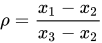
The property of this spiral is, that the tangent makes with the radius vector a constant angle .
If is the velocity at the point , then





Fig. 58.
Hence will be a point in the hodograph. But is turned through a constant angle , so that the hodograph described by is the same as the original spiral turned about its pole through an angle .


The acceleration of is represented in magnitude and direction by the velocity of multiplied by the same factor, .
Hence, if we perform on the same operation of turning it through an angle into the position , the acceleration of will be equal in magnitude and direction to

,


and .


The first of these components is a central force towards proportional to the distance.
The second is in a direction opposite to the velocity, and since
,

.


, and .


If in these expressions we make , the orbit becomes a circle, and we have , and .
Hence, if the law of attraction remains the same, , and


732.] If we now consider the motion of a point which is the projection of the moving point on the horizontal line , we shall find that its distance from and its velocity are the horizontal components of those of . Hence the acceleration of this point is also an attraction towards , equal to times its distance from , together with a retardation equal to times its velocity.


We have therefore a complete construction for the rectilinear motion of a point, subject to an attraction proportional to the distance from a fixed point, and to a resistance proportional to the velocity. The motion of such a point is simply the horizontal part of the motion of another point which moves with uniform angular velocity in a logarithmic spiral.
733.] The equation of the spiral is


If we draw making an angle with the vertical, then the tangents , , , &c. will be vertical, and , , , &c. will be the extremities of successive oscillations.


734.] The observations which are made on vibrating bodies are—
The quantities which we have to determine are—
To determine the Reading at the Position of Equilibrium from Three Consecutive Elongations.
735.] Let , , be the observed scale-readings, corresponding to the elongations , , , and let be the reading at the position of equilibrium, , and let be the value of ,


| , | |
| , | |
| . |



| , |
| whence . |

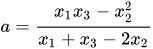
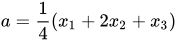
To determine the Logarithmic Decrement.

, , .


.

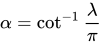


.
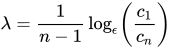


Since, however, in most cases time is valuable, it is best to take the second set of observations before the diminution of amplitude has proceeded so far.
737.] In certain cases we may have to determine the position of equilibrium from two consecutive elongations, the logarithmic decrement being known from a special experiment. We have then.
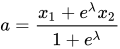
Time of Vibration,
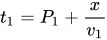
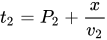
738.] Having determined the scale-reading of the point of equilibrium, a conspicuous mark is placed at that point of the scale, or as near it as possible, and the times of the passage of this mark are noted for several successive vibrations.
Let us suppose that the mark is at an unknown but very small distance on the positive side of the point of equilibrium, and that is the observed time of the first transit of the mark in the positive direction, and , , &c. the times of the following transits.
If be the time of vibration, and , , , &c. the times of transit of the true point of equilibrium,




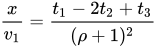




739.] The same method may be extended to a series of any number of vibrations. If the vibrations are so rapid that the time of every transit cannot be recorded, we may record the time of every third or every fifth transit, taking care that the directions of successive transits are opposite. If the vibrations continue regular for a long time, we need not observe during the whole time. We may begin by observing a sufficient number of transits to determine approximately the period of vibration, , and the time of the middle transit, , noting whether this transit is in the positive or the negative direction. We may then either go on counting the vibrations without recording the times of transit, or we may leave the apparatus unwatched. We then observe a second series of transits, and deduce the time of vibration and the time of middle transit , noting the direction of this transit.

If and the periods of vibration as deduced from the two sets of observations, are nearly equal, we may proceed to a more accurate determination of the period by combining the two series of observations.
Dividing by , the quotient ought to be very nearly an integer, even or odd according as the transits and are in the same or in opposite directions. If this is not the case, the series of observations is worthless, but if the result is very nearly a whole number , we divide by , and thus find the mean value of for the whole time of swinging.

740.] The time of vibration thus found is the actual mean time of vibration, and is subject to corrections if we wish to deduce from it the time of vibration in infinitely small arcs and without damping.
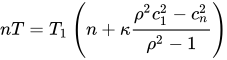
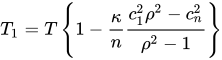
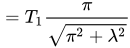
To reduce the observed time to the time in infinitely small arcs, we observe that the time of a vibration of amplitude is in general of the form



| . |

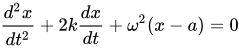

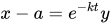
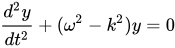
| | , when is less than ; | | (4) | |
| , when is equal to ; | (5) | |||
| and | , when is greater than . | (6) |



The value of may be obtained from that of by equation (2). When is less than , the motion consists of an infinite series of oscillations, of constant periodic time, but of continually decreasing amplitude. As increases, the periodic time becomes longer, and the diminution of amplitude becomes more rapid.

When (half the coefficient of resistance) becomes equal to or greater than , (the square root of the acceleration at unit distance from the point of equilibrium,) the motion ceases to be oscillatory, and during the whole motion the body can only once pass through the point of equilibrium, after which it reaches a position of greatest elongation, and then returns towards the point of equilibrium, continually approaching, but never reaching it.
Galvanometers in which the resistance is so great that the motion is of this kind are called dead beat galvanometers. They are useful in many experiments, but especially in telegraphic signalling, in which the existence of free vibrations would quite disguise the movements which are meant to be observed.
Whatever be the values of and , the value of , the scale-reading at the point of equilibrium, may be deduced from five scale-readings, , , , , , taken at equal intervals of time, by the formula



On the Observation of the Galvanometer.
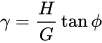
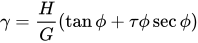
742.] To measure a constant current with the tangent galvanometer, the instrument is adjusted with the plane of its coils parallel to the magnetic meridian, and the zero reading is taken. The current is then made to pass through the coils, and the deflexion of the magnet corresponding to its new position of equilibrium is observed. Let this be denoted by .
Then, if is the horizontal magnetic force, the coefficient of the galvanometer, and the strength of the current,



Best Value of the Deflexion.
743.] In some galvanometers the number of windings of the coil through which the current flows can be altered at pleasure. In others a known fraction of the current can be diverted from the galvanometer by a conductor called a Shunt. In either case the value of , the effect of a unit-current on the magnet, is made to vary.
Let us determine the value of , for which a given error in the observation of the deflexion corresponds to the smallest error of the deduced value of the strength of the current.
Differentiating equation (1), we find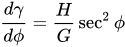
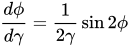
This is a maximum for a given value of when the deflexion is 45°. The value of should therefore be adjusted till is as nearly equal to as is possible; so that for strong currents it is better not to use too sensitive a galvanometer.

On the Best Method of applying the Current.
744.] When the observer is able, by means of a key, to make or break the connexions of the circuit at any instant, it is advisable to operate with the key in such a way as to make the magnet arrive at its position of equilibrium with the least possible velocity. The following method was devised by Gauss for this purpose.
Suppose that the magnet is in its position of equilibrium, and that there is no current. The observer now makes contact for a short time, so that the magnet is set in motion towards its new position of equilibrium. He then breaks contact. The force is now towards the original position of equilibrium, and the motion is retarded. If this is so managed that the magnet comes to rest exactly at the new position of equilibrium, and if the observer again makes contact at that instant and maintains the contact, the magnet will remain at rest in its new position.
If we neglect the effect of the resistances and also the inequality of the total force acting in the new and the old positions, then, since we wish the new force to generate as much kinetic energy during the time of its first action as the original force destroys while the circuit is broken, we must prolong the first action of the current till the magnet has moved over half the distance from the first position to the second. Then if the original force acts while the magnet moves over the other half of its course, it will exactly stop it. Now the time required to pass from a point of greatest elongation to a point half way to the position of equilibrium is one-sixth of a complete period, or one-third of a single vibration.
The operator, therefore, having previously ascertained the time of a single vibration, makes contact for one-third of that time, breaks contact for another third of the same time, and then makes contact again during the continuance of the experiment. The magnet is then either at rest, or its vibrations are so small that observations may be taken at once, without waiting for the motion to die away. For this purpose a metronome may be adjusted so as to beat three times for each single vibration of the magnet.
The rule is somewhat more complicated when the resistance is of sufficient magnitude to be taken into account, but in this case the vibrations die away so fast that it is unnecessary to apply any corrections to the rule.
When the magnet is to be restored to its original position, the circuit is broken for one-third of a vibration, made again for an equal time, and finally broken. This leaves the magnet at rest in its former position.
If the reversed reading is to be taken immediately after the direct one, the circuit is broken for the time of a single vibration and then reversed. This brings the magnet to rest in the reversed position.
Measurement by the First Swing.


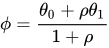
In this way the deflexion may be calculated without waiting for the magnet to come to rest in its position of equilibrium.
To make a Series of Observations.



Fig. 59.
Method of Multiplication.
747.] In certain cases, in which the deflexion of the galvanometer magnet is very small, it may be advisable to increase the visible effect by reversing the current at proper intervals, so as to set up a swinging motion of the magnet. For this purpose, after ascertaining the time, , of a single vibration of the magnet, the current is sent in the positive direction for a time , then in the reversed direction for an equal time, and so on. When the motion of the magnet has become visible, we may make the reversal of the current at the observed times of greatest elongation.
Let the magnet be at the positive elongation , and let the current be sent through the coil in the negative direction. The point of equilibrium is then , and the magnet will swing to a negative elongation , such that

| | , | |
| or | .\ |



| | , | ||
| or | ; |








The application of this method to exact measurement requires an accurate knowledge of , the ratio of one vibration of the magnet to the next under the influence of the resistances which it experiences. The uncertainties arising from the difficulty of avoiding irregularities in the value of generally outweigh the advantages of the large angular elongation. It is only where we wish to establish the existence of a very small current by causing it to produce a visible movement of the needle that this method is really valuable.
On the Measurement of Transient Currents.
748.] When a current lasts only during a very small fraction of the time of vibration of the galvanometer-magnet, the whole quantity of electricity transmitted by the current may be measured by the angular velocity communicated to the magnet during the passage of the current, and this may be determined from the elongation of the first vibration of the magnet.
If we neglect the resistance which damps the vibrations of the magnet, the investigation becomes very simple.
Let be the intensity of the current at any instant, and the quantity of electricity which it transmits, then





The magnet then swings freely and reaches an elongation . If there is no resistance, the work done against the magnetic force during this swing is .
The energy communicated to the magnet by the current is

| | | , | | | (4) | ||
| whence | |||||||
| by (3). | (5) |

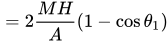

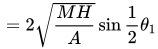

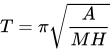
But if be the time of a single vibration of the magnet,
| | | , | | | (6) | |
| and we find | , | (7) |
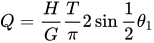
where is the horizontal magnetic force, the coefficient of the galvanometer, the time of a single vibration, and the first elongation of the magnet.
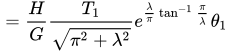
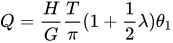
749.] In many actual experiments the elongation is a small angle, and it is then easy to take into account the effect of resistance, for we may treat the equation of motion as a linear equation.
Let the magnet be at rest at its position of equilibrium, let an angular velocity be communicated to it instantaneously, and let its first elongation be .

The equation of motion is
| | | , | | | (8) | |
| . | (9) |


When , , and .


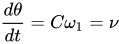
When ,
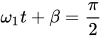
| | | . | | | (10) | ||
| Hence | . | (11) |

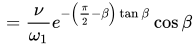
| Now | | | , | | | (12) | |
| , , | (13) |




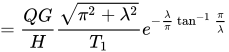
| Hence | | | , | | | (15) | |
| and | , | (16) |

Method of Recoil.
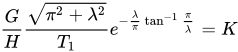
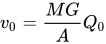
750.] The method given above supposes the magnet to be at rest in its position of equilibrium when the transient current is passed through the coil. If we wish to repeat the experiment we must wait till the magnet is again at rest. In certain cases, however, in which we are able to produce transient currents of equal intensity, and to do so at any desired instant, the following method, described by Weber[3], is the most convenient for making a continued series of observations.
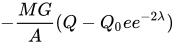
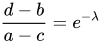
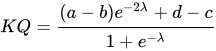
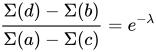
Suppose that we set the magnet swinging by means of a transient current whose value is . If, for brevity, we write










.


Fig. 60.
The motion of the magnet in the method of recoil is graphically represented in Fig. 60, where the abscissa represents the time, and the ordinate the deflexion of the magnet at that time. See Art. 760.
Method of Multiplication.
751.] If we make the transient current pass every time that the magnet passes through the zero point, and always so as to increase the velocity of the magnet, then, if , , &c. are the successive elongations,
| | | , | | (33) |
| . | (34) |



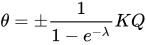
If is small, the value of the ultimate elongation may be large, but since this involves a long continued experiment, and a careful determination of , and since a small error in introduces a large error in the determination of , this method is rarely useful for numerical determination, and should be reserved for obtaining evidence of the existence or non-existence of currents too small to be observed directly.
In all experiments in which transient currents are made to act on the moving magnet of the galvanometer, it is essential that the whole current should pass while the distance of the magnet from the zero point remains a small fraction of the total elongation. The time of vibration should therefore be large compared with the time required to produce the current, and the operator should have his eye on the motion of the magnet, so as to regulate the instant of passage of the current by the instant of passage of the magnet through its point of equilibrium.
To estimate the error introduced by a failure of the operator to produce the current at the proper instant, we observe that the effect of a force in increasing the elongation varies as
