6. Variables and constants. A variable is a quantity to which an unlimited number of values can be assigned. Variables are denoted by the later letters of the alphabet. Thus, in the equation of a straight line,
,
and may be considered as the variable coördinates of a point moving along the line.
A quantity whose value remains unchanged is called a constant.
Numerical or absolute constants retain the same values in all problems, as , etc.
Arbitrary constants, or parameters, are constants to which any one of an unlimited set of numerical values may be assigned, and they are supposed to have these assigned values throughout the investigation. They are usually denoted by the earlier letters of the alphabet. Thus, for every pair of values arbitrarily assigned to
and , the equation
represents some particular straight line.
7. Interval of a variable. Very often we confine ourselves to a portion only of the number system. For example, we may restrict our variable so that it shall take on only such values as lie between and , where and may be included, or either or both excluded. We shall employ the symbol , being less than , to represent the numbers , and all the numbers between them, unless otherwise stated. This symbol is read the interval from to .
8. Continuous variation. A variable is said to vary continuously through an interval , when starts with the value and increases until it takes on the value in such a manner as to assume the value of every number between and in the order of their magnitudes. This may be illustrated geometrically as follows:
The origin being at , lay off on the straight line the points and corresponding to the numbers and . Also let the point correspond to a particular value of the variable . Evidently the interval is represented by the segment . Now as varies continuously from to inclusive, i.e. through the interval , the point generates the segment .
9. Functions.When two variables are so related that the value of the first variable depends on the value of the second variable, then the first variable is said to be a function of the second variable.
Nearly all scientific problems deal with quantities and relations of this sort, and in the experiences of everyday life we are continually meeting conditions illustrating the dependence of one quantity on another. For instance, the weight a man is able to lift depends on his strength, other things being equal. Similarly, the distance a boy can run may be considered as depending on the time. Or, we may say that the area of a square is a function of the length of a side, and the volume of a sphere is a function of its diameter.
10. Independent and dependent variables. The second variable, to which values may be assigned at pleasure within limits depending on the particular problem, is called the independent variable, or argument; and the first variable, whose value is determined as soon as the value of the independent variable is fixed, is called the dependent variable, or function.
Frequently, when we are considering two related variables, it is in our power to fix upon whichever we please as the independent variable; but having once made the choice, no change of independent variable is allowed without certain precautions and transformations.
One quantity (the dependent variable) may be a function of two or more other quantities (the independent variables, or arguments). For example, the cost of cloth is a function of both the quality and quantity; the area of a triangle is a function of the base and altitude; the volume of a rectangular parallelepiped is a function of its three dimensions.
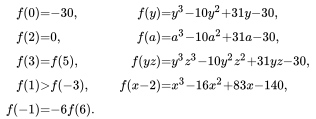
11. Notation of functions. The symbol is used to denote a function of , and is read of . In order to distinguish between different functions, the prefixed letter is changed, as , etc.
During any investigation the same functional symbol always indicates the same law of dependence of the function upon the variable. In the simpler cases this law takes the form of a series of analytical operations upon that variable. Hence, in such a case, the same functional symbol will indicate the same operations or series of operations, even though applied to different quantities. Thus, if
,
then
.
Also
,
,
,
,
,
, etc.
Similarly, denotes a function of and and is read of and .
If
,
then
,
and
.
Again, if
,
then
,
and
.
Evidently this system of notation may be extended indefinitely.
12. Values of the independent variable for which a function is defined. Consider the functions
of the independent variable . Denoting the dependent variable in each case by , we may write
.
In each case (the value of the function) is known, or, as we say, defined, for all values of . This is not by any means true of all functions, as the following examples illustrating the more common exceptions will show.
(1) .
Here the value of (i.e. the function) is defined for all values of except . When the divisor becomes zero and the value of cannot be computed from (1).[1] Any value might be assigned to the function for this value of the argument.
(2) .
In this case the function is defined only for positive values of . Negative values of give imaginary values for , and these must be excluded here, where we are confining ourselves to real numbers only.
(3)
Here is defined only for positive values of . For negative values of this function does not exist (see § 19).
(4) .
Since sines and cosines cannot become greater than nor less than , it follows that the above functions are defined for all values of ranging from to inclusive, but for no other values.


![{\displaystyle \scriptstyle {[a,b]}}](https://wikimedia.org/api/rest_v1/media/math/render/svg/251a7c88e24035b9515851922acb83c53b71a36c)





























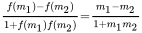



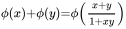



![{\displaystyle \scriptstyle {F(2\theta )={\frac {2F(\theta )}{1-[F(\theta )]^{2}}}}}](https://wikimedia.org/api/rest_v1/media/math/render/svg/15c2e1ba95f6175ea3af1c353a70dca6a09423c4)




