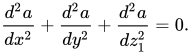
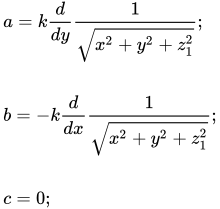
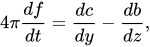
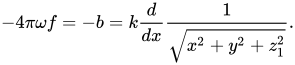
In the April number of the Philosophical Magazine Mr. Heaviside discusses the question of a moving electrified sphere, and while agreeing with the results I obtained some time ago as to the magnetic force produced by such a sphere when moving slowly, differs as to the numerical magnitude of the energy possessed by the sphere and the forces acting upon it when placed in a magnetic field. The latter quantities, however, do not depend merely upon the alterations caused by the motion of the sphere in the polarization of the dielectric surrounding the sphere, but also upon the boundary conditions we adopt and upon the view we take of the motion close to the sphere of the medium in which the electric displacements occur.
This will be seen in the course of the following investigation, in which I have endeavoured to take into account the motion of the medium in which the displacements occur. I find that, in order to close the circuits in this case, it is necessary to assume effects which, as far as I know, have not been noticed.
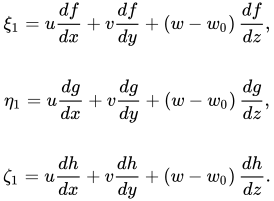
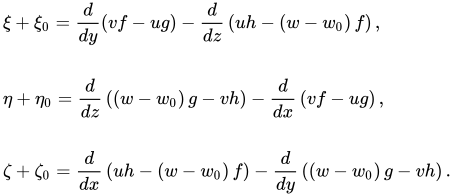
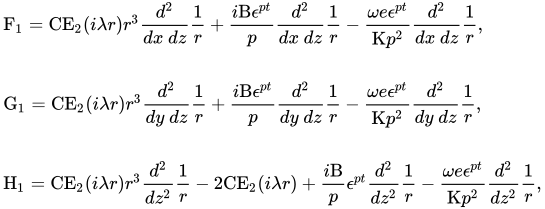
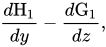
Let us consider the case when the electric field is that due to a charged sphere moving parallel to the axis of with the velocity , the components at of the velocity of the medium being ; then, if we supposed that the displacement displacement-currents are due entirely to variations in the electric displacement caused by the motion of the sphere and the medium, the components of these currents would be given by
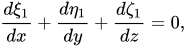
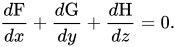
These values, however, do not satisfy the equation
unless the dielectric is moving uniformly; so that, if the circuits are to be closed, the motion of the medium must produce some other effect analogous to a current.
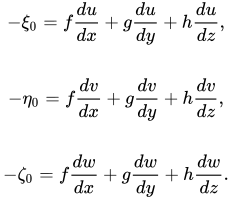
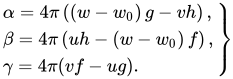
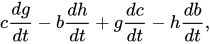
Since
we see that the currents will be closed if we add on to the components the components , where
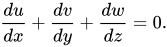
The medium is assumed to be incompressible, so that
Hence the components of the total effective currents are
If the motion of the medium is irrotational, these conditions will be satisfied if we suppose that the motion of the dielectric gives rise to magnetic forces whose components are given by the equations
(1)
If we suppose that the electric field is due to a number of charged spheres moving with velocities respectively, and producing electric displacements whose components are the component of the magnetic force parallel to will be
where are the resultant displacements.
Thus, since in the general case when the æther is in motion the assumption that the currents are merely due to the changes in the polarization caused by the æther moving from a place where the displacement has one value to another where it has a different one is insufficient if the circuits are closed, it is necessary to replace it by another; the assumption we shall adopt is that the motion of the polarized æther sets up magnetic forces whose components are given by equations (1).
When the æther is at rest this agrees with Maxwell's principle that the currents are equal to the rate of increase of the electric displacement. We should get these magnetic forces if, in the expression for the mean Lagrangian function of unit volume of the moving æther, there was the term
where are the components of the magnetic induction.
This term would show that there is an electromotive force parallel to equal to
and a mechanical force equal to
if the electrified bodies are at rest.
The first of these corresponds to the well-known expression for the electromotive force on a conductor moving in a magnetic field; the second is the mechanical force on a current in a magnetic field plus the term .
We can deduce an important consequence of the assumption, if we consider the case of the æther moving with uniform velocity between two parallel planes charged, the one with positive, the other with negative electricity.
If is the velocity of the æther, the electric displacement at right angles to the planes, the magnetic force between the planes will be parallel to , and equal to ; or if is the surface-density of the electrification on the planes , the magnetic force vanishes except between the planes, so that on crossing the positively electrified surface there is an increase in the magnetic force parallel to equal to . Thus the charged surface acts like a current sheet of intensity , but is the velocity of the plane relatively to the æther; so that a charged surface moving with velocity relatively to the æther must act like a current sheet of intensity .
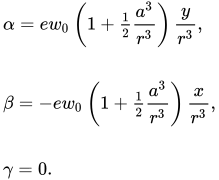
We will now proceed to apply these results to some special cases. Let us suppose that we have a charged sphere moving along the axis of with the velocity , and that it sets the æther around it in motion in the same way as an incompressible fluid is set in motion by a solid sphere of the same radius moving through it with the same velocity. If is the radius of the sphere,
hence by equations (1),
Thus the lines of magnetic force are circles with their centres along and their planes at right angles to the axis of .
At a distance from the centre large compared with the radius of the sphere the magnetic force is the same as that due to a current , but close to the sphere the relative motion of the sphere and æther causes it to be larger than this, and at the surface of the sphere it is the same as that due to a current .
The energy due to this distribution of currents is .
Another case which can be easily solved is that of a right circular cylinder rotating with an angular velocity , each unit length of the cylinder being charged with units of electricity. If is the radius of the cylinder,
and by equations (1).
Thus outside the rotating cylinder there is a magnetic force parallel to the axis of rotation.
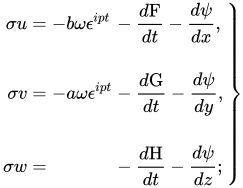
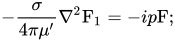
If we assume that the æther outside the sphere is at rest, we can find the solution of the case of a charged metal sphere executing harmonic oscillations. Suppose the sphere to be moving parallel to the axis of . the velocity at any time being represented by the real part of . Then if we take rectangular axes passing through the centre of the sphere and moving with it, the following equations are true inside the sphere if are the components of the current, those of magnetic induction, the electrostatic potential, the components of the rector potential, and the specific resistance of the metal.
(2)
and therefore
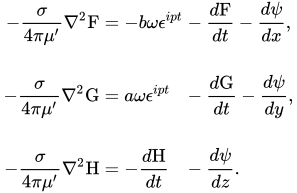
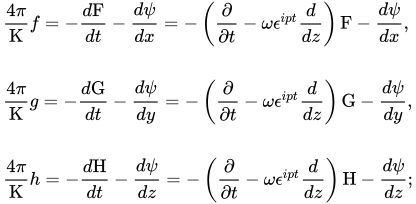
In the dielectric outside the sphere, if are the electric displacements, the specific inductive capacity, and if denote partial differentiation with respect to the time, the equations are
and therefore
(3)
with a similar equation for .
From the form of these equations we see that the solution will take the form
If we substitute these values in the above equations, we see that we may put all equal to zero.
If is the quantity of electricity on the sphere,
Equating the coefficients of to zero in equations (2) and (3) we have
inside the sphere,
with similar equations for and ; outside the sphere we have
(4)
with similar equations for and .
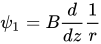
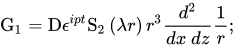
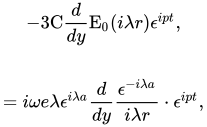
The form of equation (4) suggests that we should put
A particular integral of (4) is then
The complementary function is that solution of the differential equation
which, when considered as a function of the angular coordinates of a point, varies as ; this (see Proc. Math. Soc. vol. xv. p. 212) is
where
and
Thus, outside the sphere,
where , and is introduced into the expression for to make
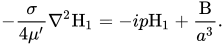
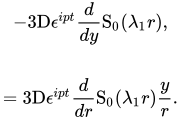
Inside the sphere the differential equations for and are of the form
if , the solution of this equation is
where
Similarly
the differential equation for is
So that
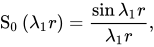
where
and is introduced to make
Since are continuous when , if is the radius of the sphere we have
(5)
Since, on the assumption discussed above, the electrification on the surface of the moving sphere is equivalent to a tangential current-sheet whose intensity is , we have as another surface-condition that the difference between the magnetic force outside and inside ; hence
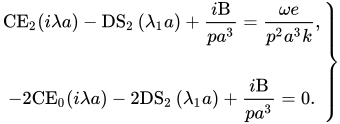
From (5) we have
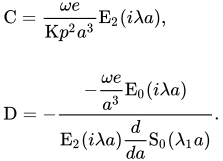
From these equations we have
(6)
(7)
where
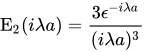
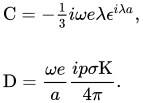
Let us first consider the case where and are both small. In this case is large compared with and , very small compared with ; hence we see that
Since approximately, and , we have
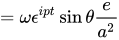
The magnetic force outside the sphere parallel to the axis of equals
or
taking the real part
Similarly the magnetic force parallel to the axis of
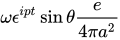
and the magnetic force parallel to vanishes. Thus the magnetic force is the same as that which would be produced by a current-element or , being the velocity of the sphere (see Proc. Math. Soc. xv. p. 214).
The magnetic force inside the sphere parallel to equals
Substituting the value for given by equation (7), this equals
or, taking the real part and writing for ,
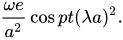
The component parallel to is
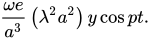
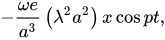
and the -component vanishes. Thus the maximum magnetic force inside the sphere is
If is very small, this is very small compared with the force outside the sphere. If the velocity is uniform, , and therefore , and the magnetic force inside the sphere vanishes. When there is no magnetic force inside the sphere its energy and the force acting upon it have the values assigned to them by Mr. Heaviside.
Let us next take the case where is small and large: in this case and have the same values as before, so that the magnetic force due to the moving sphere is the same.
We must now consider the case where and are both large; in this case we find from (6) and (7)
if and are both large.
Thus the magnetic force parallel to outside
and that parallel to
Thus, since is large, the magnetic force, though in the same direction as that due to a current , is very much smaller in magnitude, and fades away to zero as increases without limit.
The maximum magnetic force inside the sphere
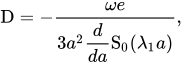
Thus in this case the magnetic force just inside the sphere is equal to , while that outside the sphere is very much smaller. This is a striking contrast to the previous cases, where the magnetic force inside the sphere is very small compared with that outside. Thus, in this case, when the time of the oscillation is small compared with that of the electrical oscillations the distribution of magnetic force is turned inside out. The magnetic force diminishes very rapidly as we recede from the surface of the sphere. In this case the total current parallel to the axis of inside the sphere is finite, for this by equation (2) equals
So that if the sphere is placed in a magnetic field the force acting upon it is the same as that on a current .
When the sphere is moving with a uniform velocity , equations (3) become
whence
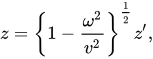
where is the velocity of propagation of electrodynamic action through the dielectric. If we put
this equation becomes
With similar equations for and , we see that a solution of these equations is
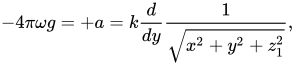
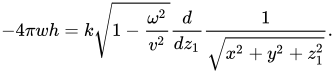
where is a constant. Since, if ,
and
we have
Similarly
and
so that
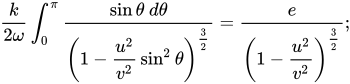
The displacement across any spherical surface must , so that
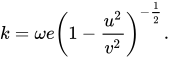
and therefore, if ,
Thus the lines of magnetic forces are circles round the axis of and the magnitude of the force equals
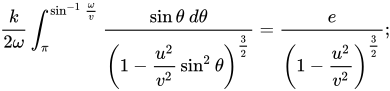
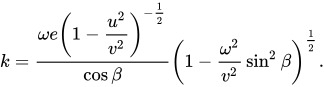
which is Mr. Heaviside's result. If , the integral becomes infinite, the displacement will be within a cone of semi-vertical angle ; we must therefore only integrate within this cone, and the equation to determine is,
or
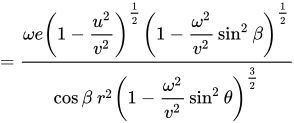
Thus the magnetic force
.
Since , this expression vanishes unless , when it becomes infinite, so that the magnetic force and the electric displacement seem confined to the surface of a cone of semi-vertical angle , the vertex pointing in the direction of motion.
This work is in the public domain in the United States because it was published before January 1, 1929.
The longest-living author of this work died in 1940, so this work is in the public domain in countries and areas where the copyright term is the author's life plus 83 years or less. This work may be in the public domain in countries and areas with longer native copyright terms that apply the rule of the shorter term to foreign works.