(5) At any point of an electrified surface at which the surface-density is , the first derivative of , taken with respect to the normal to the surface, changes its value abruptly at the surface, so that


|
, |
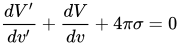
where and are the normals on either side of the surface, and and are the corresponding- potentials. We shall refer to this equation as the Superficial Characteristic equation.


(6) If denote the potential at a point whose distance from any fixed point in a finite electrical system is , then the product , when increases indefinitely, is ultimately equal to , the total charge in the finite system.


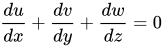
97.] Lemma. Let V be any continuous function of and let be functions of subject to the general solenoidal condition


|
, | (1) |
where these functions are continuous, and to the superficial solenoidal condition
|
, | (2) |

at any surface at which these functions become discontinuous, being the direction-cosines of the normal to the surface, and and the values of the functions on opposite sides of the surface, then the triple integral


|
| (3) |

vanishes when the integration is extended over a space bounded by surfaces at which either is constant, or
|
, | (4) |

being the direction-cosines of the surface.

Before proceeding to prove this theorem analytically we may observe, that if be taken to represent the components of the velocity of a homogeneous incompressible fluid of density unity, and if be taken to represent the potential at any point of space of forces acting on the fluid, then the general and superficial equations of continuity ((1) and (2)) indicate that every part of the space is, and continues to be, full of the fluid, and equation (4) is the condition to be fulfilled at a surface through which the fluid does not pass.
The integral represents the work done by the fluid against the forces acting on it in unit of time.

