The actual potential at any point due to the electricity at and on is


where denotes the distance between and .

At the surface and at all points on the negative side of , the potential is zero, therefore
| (1) |
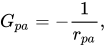
where the suffix indicates that a point on the surface is taken instead of .


Let denote the surface-density induced by at a point of the surface , then, since is the potential at due to the superficial distribution,


| (2) |
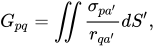
where is an element of the surface at , and the integration is to be extended over the whole surface .

But if unit of electricity had been placed at , we should have had by equation (1),
| (3) |

| (4) |
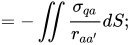
where is the density induced by on an element at , and is the distance between and . Substituting this value of in the expression for , we find


| (5) |

Since this expression is not altered by changing into and into ,we find that


| (6) |

a result which we have already shewn to be necessary in Art. 88, but which we now see to be deducible from the mathematical process by which Green’s function may be calculated.
If we assume any distribution of electricity whatever, and place in the field a point charged with unit of electricity, and if the surface of potential zero completely separates the point from the assumed distribution, then if we take this surface for the surface , and the point for , Green’s function, for any point on the same side of the surface as , will be the potential of the assumed distribution on the other side of the surface. In this way we may construct any number of cases in which Green’s function can be
