between and . All these coefficients will in general vary with the position of , and if is so arranged that the extremities of and are not near those of as long as the motion of is confined within certain limits, we may ascertain the form of these coefficients. If represents the deflexion of from towards , then the part of the surface of opposed to will diminish as increases. Hence if is kept at potential 1 while and are kept at potential , the charge on will be , where and are constants, and is the capacity of .
If and are symmetrical, the capacity of is .
The capacity of is not altered by the motion, for the only effect of the motion is to bring a different part of opposite to the interval between and . Hence .
The quantity of electricity induced on when is raised to potential unity is .
The coefficient of induction between and is .
The coefficient of induction between and is not altered by the motion of , but remains .
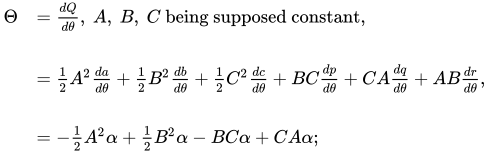
Hence the electrical energy of the system is
and if is the moment of the force tending to increase ,
or
Fig. 19.
In the present form of Thomson's Quadrant Electrometer the conductors and are in the form of a cylindrical box completely divided into four quadrants, separately insulated, but joined by wires so that two opposite quadrants are connected with and the two others with .
The conductor is suspended so as to be capable of turning about a vertical axis, and may consist of two opposite flat quadrantal arcs supported by their radii at their extremities. In the position of equilibrium these quadrants should be partly