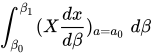
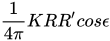
Page 26, l. 3 from bottom, dele 'As we have made no assumption', &c. down to l. 7 of p. 27, 'the expression may then be written', and substitute as follows:—
Let us now suppose that the curves for which is constant form a series of closed curves surrounding the point on the surface for which has its minimum value, , the last curve of the series, for which , coinciding with the original closed curve s.
Let us also suppose that the curves for which is constant form a series of lines drawn from the point at which to the closed curve s, the first , and the last, , being identical
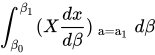
Integrating (8) by parts the first term with respect to a and
the second with respect to , the double integrals destroy each
other. The line integral,
,
is zero, because the curve , is reduced to a point at which
there is but one value of and of .
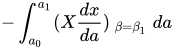
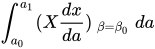
The two line integrals,
+ ,
destroy each other, because the point is identical with the
point .
The expressions (8) is therefore reduced to
(9)
Since the curve is identical with the closed curve s, we
may write this expression
p. 80, in equations (3), (4), (6), (e), (17), (18), (19), (20), (21), (22), for read .
p. 82, l. 3, for read .
p. 83, in equations (28), (29), (30). (31), forread
p. 83,„ in equation (29), insert - before the second member.
p. 105, 1. 2, for read .
p. 108, equation (1), forread.
p. 108,„equation„ (2), forread.
p. 108,„equation„ (3), for, read.
p. 108,„equation„ (4), for read.
p. 113, l. 4, forread.
p. 113,„ l. 5, for read .
p. 111, I. 5, forread.
p. 124, last line, forread.
p. 125, lines 3 and 4, transpose within and without; l. 16, forread; and l. 18, forread.
p. 128, lines 11, 10, 8 from bottom for read .
p. 149, l. 24, for equpotential read equipotential.