differentiating with respect to or , the arbitrary function of and will disappear. We shall therefore leave it out of account.


If we also write for , the single symbol , which represents a certain velocity, the equation between and becomes


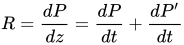
659.] Let us first suppose that there is no external magnetic system acting on the current sheet. We may therefore suppose . The case then becomes that of a system of electric currents in the sheet left to themselves, but acting on one another by their mutual induction, and at the same time losing their energy on account of the resistance of the sheet. The result is expressed by the equation

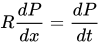
the solution of which is

Hence, the value of on any point on the positive side of the sheet whose coordinates are , , , and at a time , is equal to the value of at the point , , at the instant when .


If therefore a system of currents is excited in a uniform plane sheet of infinite extent and then left to itself, its magnetic effect at any point on the positive side of the sheet will be the same as if the system of currents had been maintained constant in the sheet, and the sheet moved in the direction of a normal from its negative side with the constant velocity . The diminution of the electromagnetic forces, which arises from a decay of the currents in the real case, is accurately represented by the diminution of the force on account of the increasing distance in the imaginary case.
660.] Integrating equation (21) with respect to , we obtain
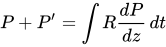
If we suppose that at first and are both zero, and that a magnet or electromagnet is suddenly magnetized or brought from an infinite distance, so as to change the value of suddenly from zero to , then, since the time-integral in the second member of (24) vanishes with the time, we must have at the first instant

at the surface of the sheet.
Hence, the system of currents excited in the sheet by the sudden
