Only the meaning of the vectors denoted by , is different. At it can be seen from (50) and (51), Lorentz's definition of these vectors still allows, to separate the contributions of aether and matter to electromagnetic energy and electromagnetic momentum; however, formulas apply to these contributions, which do not allow a simple interpretation any more.

§ 11. Consideration of the temporal change of and .


Up to now, we have considered the dielectric constant and the magnetic permeability as quantities, which have constant values for a given material point, or at least (see § 10) are varying in a specified way with velocity. The case, that these values depend on the state of deformation of the body, and thus on time, we haven't considered yet. Now, as to how are these considerations to be modified, when and are not equal to zero?


A) Theories of H. Hertz and E. Cohn.
If we employ formulas (23) of Hertz's theory, or formulas (26) of Cohn's theory, then we find in the case that and are depending on time, that instead of (18) the following relation takes place
| (54) |

where it is set
| (54a) |
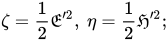
there it is assumed, that the earlier expressions (24) and (27) hold for the momentum density.
B) Theories of H. Minkowski and H. A. Lorentz.
The calculation becomes somewhat more complicated, when one employs the connecting equations (36) and (37) of Minkowski’s theory. The terms

are not only to be inserted in the right-hand side of (38), but also – when the terms which contain and are calculated – the variability of and is to be considered in (38c). Also a relation in the form of (54) is given, when the value of is not changed; though the


