Due to the identity which is easily to be verified
the relation is obtained
(5)
§ 3. The energy equation and the momentum equations.
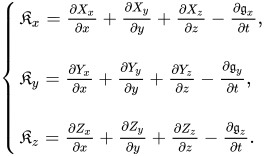
We understand under coordinates and the time, measured in a reference system in which the observer has a fixed location. The ponderomotive force measured by him, which is acting (due to the electromagnetic process) on the unit volume of moving matter, shall have the components:
(6)
The vector which arises here, is denoted by us as "electromagnetic momentum density" or shortly as "momentum density". The system of "fictitious electromagnetic stresses" consists of six quantities, namely the normal stresses , and the pairwise shear-stresses which are mutually equal:
(6a)
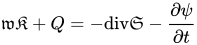
To the "momentum equations" (6), the energy equation is added:
(7)
Here, means the Joule-head, the electromagnetic energy density, the energy current.
While the momentum equations determine the momentum exerted by the electromagnetic field, the energy equation determines which energy-quantity per unit space and time is converted into a non-electromagnetic form (work and heat).
If one introduces into (6) and (7) the temporal derivative defined by (3) and (3a),
![{\displaystyle \left[{\frac {\partial '{\mathfrak {A}}}{\partial t}}{\mathfrak {B}}\right]+\left[{\mathfrak {A}}{\frac {\partial '{\mathfrak {B}}}{\partial t}}\right]={\frac {\delta }{\delta t}}[{\mathfrak {AB}}]+[{\mathfrak {AB}}]\mathrm {div} {\mathfrak {w}}-\left[{\mathfrak {A}},\ ({\mathfrak {B}}\nabla ){\mathfrak {w}}\right]+\left[{\mathfrak {B}},\ ({\mathfrak {A}}\nabla ){\mathfrak {w}}\right]}](https://wikimedia.org/api/rest_v1/media/math/render/svg/2acd1a2e41a1c30f3abe38cfa2974d649d7a45a5)
![{\displaystyle \left[{\mathfrak {A}},\ ({\mathfrak {B}}\nabla ){\mathfrak {w}}\right]-\left[{\mathfrak {B}},\ ({\mathfrak {A}}\nabla ){\mathfrak {w}}\right]=[{\mathfrak {AB}}]\mathrm {div} {\mathfrak {w}}-([{\mathfrak {AB}}]\nabla ){\mathfrak {w}}-\left[[{\mathfrak {AB}}]\mathrm {curl} {\mathfrak {w}}\right]}](https://wikimedia.org/api/rest_v1/media/math/render/svg/4690593a49b4ee81d9db6363f27c00af063646f9)
![{\displaystyle \left[{\frac {\partial '{\mathfrak {A}}}{\partial t}}{\mathfrak {B}}\right]+\left[{\mathfrak {A}}{\frac {\partial '{\mathfrak {B}}}{\partial t}}\right]={\frac {\delta }{\delta t}}[{\mathfrak {AB}}]+([{\mathfrak {AB}}]\nabla ){\mathfrak {w}}-\left[[{\mathfrak {AB}}]\mathrm {curl} {\mathfrak {w}}\right]}](https://wikimedia.org/api/rest_v1/media/math/render/svg/e15716711fa9af0fb08112d572d05f533e50bd86)