H. A. Bumstead—Lorentz-FitzGerald Hypothesis.
503
These are also the values of the electric and magnetic forces produced at points outside, by Lorentz's electron, or by any charged system in which, when at rest, the charge is distributed with spherical symmetry and which, when in motion, suffers the Lorentz-FitzGerald contraction.  is the force exerted by the moving charge
  upon a unit charge which is at rest at the point
  If the unit charge at
  is in motion with the velocity
  then the force exerted upon it, which we may call (), is

|
(3)
|
where  represents the vector product. Thus the force on a charge at rest at the point,
  is in the direction of
  but this is not true in general if it is in motion.
Let us consider first the special case when the two charges have the same velocity,  Let the two components of parallel and perpendicular to
  be
be  and
and  respectively. The force
  will be parallel to
  and in the opposite direction and its magnitude will be
  So that the corresponding components of () are

|
(4)
|
and

or since 

|
(5)
|
These are the components of the actual force on the moving charge at  if it is of opposite sign to the charge the force will have the direction given in fig. 2.
When  ,
,  and
and 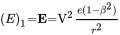 which is
  times the value of the electrostatic force when the charges are at rest: this corresponds to the gravitational case of p. 501 when the force was in the direction of motion. When
  ,
,  , and
, and  which also agrees with the corresponding case for gravitation.
If we apply this electromagnetic law of force to gravitation we are at first sight confronted with the difficulty that the magnitude of the force varies not only with the distance but
