| (10) |
![{\displaystyle \int \left\{\left[\mathrm {R} _{e}\cdot \mathrm {N} \right]+\left[\mathrm {R} _{h}\cdot \mathrm {N} \right]\right\}_{x}d\sigma =i\int \{\mathrm {q} \}_{x}d\Omega }](https://wikimedia.org/api/rest_v1/media/math/render/svg/c0cd820ae56671134f44895e7974aa0e138b0fdd)
where the second integral has to be taken over the domain enclosed by . On the left hand side represents a three-dimensional surface-element expressed in natural units and a vector of the magnitude 1 in natural measure conjugate with or perpendicular to that element (§ 7) and directed towards the outside of the domain . The index shows that the vector must be expressed in -measure. At each point of the surface we must resolve the vector along the four directions of the coordinates, express each component in -measure (§10) and finally, after multiplication by , we must add algebraically all -components; similarly all -components and so on.


![{\displaystyle \left[\mathrm {R} _{e}\cdot \mathrm {N} \right]+\left[\mathrm {R} _{h}\cdot \mathrm {N} \right]}](https://wikimedia.org/api/rest_v1/media/math/render/svg/8f59fe97d9452024cd22465dec1fa172cfc22025)


It must be expressly remarked that if an equation like (10) in which we are concerned with the composition of vectors at different points of the field-figure, shall have a definite meaning we must know which components are to be considered as having the same direction, so that they can be added. This has been determined by the introduction of coordinates.
On the right hand side of the equation the index means that the vector must be expressed in -measure and the factor had to be introduced because is imaginary.


One can prove that equation (10) is equivalent to the differential equations which in Einstein's theory serve for the same purpose and further that when the equation holds for one choice of coordinates it will also be true for any other choice.
§ 14. The proof for these assertions must be deferred to the second part of this communication. For the present we shall only add that the part of the principal function referring to the electromagnetic field is given by
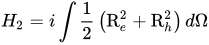
where and are, expressed in natural units, the two rotations that are characteristic of the field. Like the two other parts of the principal function, is not changed by a deformation of the field-figure. In this statement it is to be understood that the parallelograms by which and are represented take part in the deformation.


Some remarks on the way in which, starting from the principal function, we may obtain the fundamental equations of the theory
