In the following calculations the vector  has one of the directions
  . As this is also the case with the vectors
  and
and  , the vector product occurring in (22) can easily be expressed in
  -units. After that we may pass to natural units and finally, as is necessary for the substitution in (10), to
  -units.
In order to pass from -units to natural units we have to multiply a vector in the direction  by a certain coefficient
  , and a part of the extension
  by a coefficient
  . These coefficients correspond to
  (§ 10) and
  (§ 12). The factors e.g. can be expressed by means of the minors
  of the determinant
  of the quantities
  . If this is worked out and if the equations

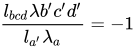
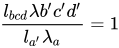
are taken into consideration, we obtain the following corollary, which we shall soon use:
Let  and also
  be the numbers 1, 2, 3, 4 in any order,
  being not the same as
  , then we have, if none of the two numbers
  and
and  is 4,
is 4,
|
(23)
|
and if one of the two is 4
|
(24)
|
§ 25. We shall now suppose (comp. § 24) that in -units the vector has the value +1, and we shall write  for the value that must then be given to . If the -components of the vectors
  etc. are denoted by
  etc., we find from (21)

|
(25)
|
This formula involves that

|
(26)
|
It may be remarked that  is the value that must be given to the vector if is taken to be 1.
The quantities may be said to represent the rotations ![{\displaystyle \left[\mathrm {B} _{a^{*}}\cdot \mathrm {B} _{b^{*}}\right]}](https://wikimedia.org/api/rest_v1/media/math/render/svg/13268be7f5a7241b8c63a41bd7048836725801d8) .
.
At the end of our calculations we shall introduce instead of the quantities t defined by

|
(27)
|
In the first of these equations  are supposed to be the numbers 1, 2, 3, 4, in an order obtained from 1, 2, 3, 4 by an even number of permutations.
