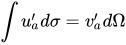
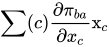
in positive directions. To the right hand sides of the equations (34) we may apply transformation (35) with these values of , -being infinitely small of the fourth order and it being allowed to confine ourselves to quantities of this order.
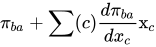
On the left hand sides of (34), however, we must take into consideration, the surface being of the third order, that the values of change from point to point. Let be the changes which undergo when we pass from to any other point of the surface. Then we must write for the value of the coefficient at this last point
We thus have
It will be shown presently that the last term vanishes. This being proved, it is clear that the relations (34) follow from (33); indeed, multiplying equations (33) by respectively and adding them we find
§ 30. The proof for
(36)
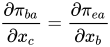
rests on the relations
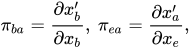
(37)
which follow from
The integral which occurs in (36) differs from
(38)
by the infinitely small factor under the sign of integration
Now we have calculated in § 26 integrals like (38) by taking together each time two opposite sides, one of which passes through while the second is obtained from the first by a shift in the