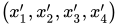
§ 64. Equations (122) show that in the coordinates the system has a velocity of translation in the direction of . If this velocity is denoted by , we have according to (123)


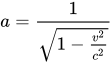
If therefore we put

we find
| (126) |
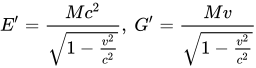
When the system moves as a whole we may therefore ascribe to it an energy and a momentum which depend on the velocity of translation in the way known from the theory of relativity. The quantity , to which the energy of the gravitation field also contributes a certain part, may be called the "mass" of the system. From what has been said in § 62 it follows that within certain limits it depends on the way in which the system and the gravitation field are described.

It must be remarked however that, if for the gravitation field we had chosen the stress-energy-tensor (§ 52), the total energy of the system even when in motion would be zero. The same would be true of the total momentum and we should have to put .


At first sight it may seem strange that we may arbitrarily ascribe to the moving system the momentum determined by (126) or a momentum 0; one might be inclined to think that, when a definite system of coordinates has been chosen, the momentum must have a definite value, which might be determined by an experiment in which the system is brought to rest by "external" forces. We must remember however (comp. § 52) that in the theory of gravitation we may introduce no "external" forces without considering also the material system in which they originate. This system together with the system with which we were originally concerned, will form an entity, in which there is a gravitation field, part of which is due to (and a part also to the simultaneous existence of and ). There is no doubt that we may apply the above considerations to the total system () without being led into contradiction with any observation.


