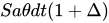
the beginning of this time the quantity of ether in the volume BC (if S=surface of the base of the prism,) is . At the end of the time the quantity will be . Hence in this time a quantity of ether has been introduced into this volume equal to .


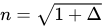
It is required to find what must be the velocity of the ether contained in the prism to give the same result. Let this velocity be . The quantity of ether (density=) introduced will then be and this is to be the same as , whence . But the ratio of the velocity of light in the external ether to that within the prism is n, the index of refraction, and is equal to the inverse ratio of the square root of the densities, or whence which is Fresnel's formula.[1]




- ↑ The following reasoning leads to nearly the same result; and though incomplete, may not be without interest, as it also gives a very simple explanation of the constancy of the specific refraction.
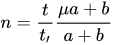
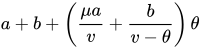
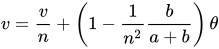
Let l be the mean distance light travels between two successive encounters with a molecule; then l is also the "mean free path" of the molecule. The time occupied in traversing this path is , where a is the diameter of a molecule, and , and is the velocity of light within the molecule, and v, the velocity in the free ether; or if then . In the ether the time would be , hence. (1) If now the ether remains fixed while the molecules are in motion, the mean distance traversed between encounters will no longer be , but ; where is the distance the first molecule moves while light is passing through it, and is the distance the second one moves while light is moving between the two. If is the common velocity of the molecules then , and . The time occupied is therefore or . The distance traversed in this time is ; therefore the resulting velocity .
Substituting the value of and neglecting the higher powers of , this becomes
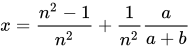
. (2) But is the velocity of light in the stationary medium; the coefficient of is therefore the factor
. (3) It seems probable that this expression is more exact than Fresnel's; for when the particles of the moving medium are in actual contact, then the light must be accelerated by the full value of ; that is the factor must be 1, whereas can