A Treatise on Electricity and Magnetism/Part IV/Chapter XIX
CHAPTER XIX.
COMPARISON OF THE ELECTROSTATIC WITH THE ELECTROMAGNETIC UNITS. .
Determination of the Number of Electrostatic Units of Electricity in one Electromagnetic Unit.
768.] The absolute magnitudes of the electrical units in both systems depend on the units of length, time, and mass which we adopt, and the mode in which they depend on these units is different in the two systems, so that the ratio of the electrical units will be expressed by a different number, according to the different units of length and time.
It appears from the table of dimensions, Art. 628, that the number of electrostatic units of electricity in one electromagnetic unit varies inversely as the magnitude of the unit of length, and directly as the magnitude of the unit of time which we adopt.
If, therefore, we determine a velocity which is represented numerically by this number, then, even if we adopt new units of length and of time, the number representing this velocity will still be the number of electrostatic units of electricity in one electromagnetic unit, according to the new system of measurement.
This velocity, therefore, which indicates the relation between electrostatic and electromagnetic phenomena, is a natural quantity of definite magnitude, and the measurement of this quantity is one of the most important researches in electricity.
To shew that the quantity we are in search of is really a velocity, we may observe that in the case of two parallel currents the attraction experienced by length a of one of them is, by Art. 686,
| , |


| . |

Now the quantity of electricity transmitted by the current in the time is in electromagnetic measure, or in electrostatic measure, if is the number of electrostatic units in one electromagnetic unit.
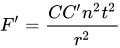
Let two small conductors be charged with the quantities of electricity transmitted by the two currents in the time , and placed at a distance from each other. The repulsion between them will be


| . |
| . |
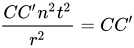
| Hence | ; |

or the distance must increase with the time at the rate . Hence is a velocity, the absolute magnitude of which is the same, whatever units we assume.
769.] To obtain a physical conception of this velocity, let us imagine a plane surface charged with electricity to the electrostatic surface-density , and moving in its own plane with a velocity . This moving electrified surface will be equivalent to an electric current-sheet, the strength of the current flowing through unit of breadth of the surface being in electrostatic measure, or in electromagnetic measure, if is the number of electrostatic units in one electromagnetic unit. If another plane surface, parallel to the first, is electrified to the surface-density , and moves in the same direction with the velocity , it will be equivalent to a second current-sheet.


The electrostatic repulsion between the two electrified surfaces is, by Art. 124, for every unit of area of the opposed surfaces.

The electromagnetic attraction between the two current-sheets is, by Art. 653, for every unit of area, and being the surface-densities of the currents in electromagnetic measure.
But , and , so that the attraction is


| . |

The ratio of the attraction to the repulsion is equal to that of to . Hence, since the attraction and the repulsion are quantities of the same kind, must be a quantity of the same kind as , that is, a velocity. If we now suppose the velocity of each of the moving planes to be equal to , the attraction will be equal to the repulsion, and there will be no mechanical action between them. Hence we may define the ratio of the electric units to be a velocity, such that two electrified surfaces, moving in the same direction with this velocity, have no mutual action. Since this velocity is about 288000 kilometres per second, it is impossible to make the experiment above described.


770.] If the electric surface-density and the velocity can be made so great that the magnetic force is a measurable quantity, we may at least verify our supposition that a moving electrified body is equivalent to an electric current.
It appears from Art. 57 that an electrified surface in air would begin to discharge itself by sparks when the electric force reaches the value 130. The magnetic force due to the current-sheet is . The horizontal magnetic force in Britain is about 0.175. Hence a surface electrified to the highest degree, and moving with a velocity of 100 metres per second, would act on a magnet with a force equal to about one-four-thousandth part of the earth's horizontal force, a quantity which can be measured. The electrified surface may be that of a non-conducting disk revolving in the plane of the magnetic meridian, and the magnet may be placed close to the ascending or descending portion of the disk, and protected from its electrostatic action by a screen of metal. I am not aware that this experiment has been hitherto attempted.


I. Comparison of Units of Electricity.
771.] Since the ratio of the electromagnetic to the electrostatic unit of electricity is represented by a velocity, we shall in future denote it by the symbol . The first numerical determination of this velocity was made by Weber and Kohlrausch[1].
Their method was founded on the measurement of the same quantity of electricity, first in electrostatic and then in electromagnetic measure.
The quantity of electricity measured was the charge of a Leyden jar. It was measured in electrostatic measure as the product of the capacity of the jar into the difference of potential of its coatings. The capacity of the jar was determined by comparison with that of a sphere suspended in an open space at a distance from other bodies. The capacity of such a sphere is expressed in electrostatic measure by its radius. Thus the capacity of the jar may be found and expressed as a certain length. See Art. 227.
The difference of the potentials of the coatings of the jar was measured by connecting the coatings with the electrodes of an electrometer, the constants of which were carefully determined, so that the difference of the potentials, , became known in electrostatic measure.

By multiplying this by , the capacity of the jar, the charge of the jar was expressed in electrostatic measure.

To determine the value of the charge in electromagnetic measure, the jar was discharged through the coil of a galvanometer. The effect of the transient current on the magnet of the galvanometer communicated to the magnet a certain angular velocity. The magnet then swung round to a certain deviation, at which its velocity was entirely destroyed by the opposing action of the earth's magnetism.
By observing the extreme deviation of the magnet the quantity of electricity in the current may be determined in electromagnetic measure, as in Art. 748, by the formula| , |
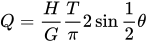
where is the quantity of electricity in electromagnetic measure. We have therefore to determine the following quantities:—

, the intensity of the horizontal component of terrestrial magnetism; see Art. 456.

, the principal constant of the galvanometer; see Art. 700.

, the time of a single vibration of the magnet; and

, the deviation due to the transient current.
The value of obtained by MM. Weber and Kohlrausch was
| metres per second. |

The property of solid dielectrics, to which the name of Electric Absorption has been given, renders it difficult to estimate correctly the capacity of a Leyden jar. The apparent capacity varies according to the time which elapses between the charging or discharging of the jar and the measurement of the potential, and the longer the time the greater is the value obtained for the capacity of the jar.
Hence, since the time occupied in obtaining a reading of the electrometer is large in comparison with the time during which the discharge through the galvanometer takes place, it is probable that the estimate of the discharge in electrostatic measure is too high, and the value of , derived from it, is probably also too high.
II. expressed as a Resistance.
772.] Two other methods for the determination of lead to an expression of its value in terms of the resistance of a given conductor, which, in the electromagnetic system, is also expressed as a velocity.
In Sir William Thomson's form of the experiment, a constant current is made to flow through a wire of great resistance. The electromotive force which urges the current through the wire is measured electrostatically by connecting the extremities of the wire with the electrodes of an absolute electrometer, Arts. 217, 218. The strength of the current in the wire is measured in electromagnetic measure by the deflexion of the suspended coil of an electrodynamometer through which it passes, Art. 725. The resistance of the circuit is known in electromagnetic measure by comparison with a standard coil or Ohm. By multiplying the strength of the current by this resistance we obtain the electromotive force in electromagnetic measure, and from a comparison of this with the electrostatic measure the value of is obtained.
This method requires the simultaneous determination of two forces, by means of the electrometer and electrodynamometer respectively, and it is only the ratio of these forces which appears in the result.
773.] Another method, in which these forces, instead of being separately measured, are directly opposed to each other, was employed by the present writer. The ends of the great resistance coil are connected with two parallel disks, one of which is moveable. The same difference of potentials which sends the current through the great resistance, also causes an attraction between these disks. At the same time, an electric current which, in the actual experiment, was distinct from the primary current, is sent through two coils, fastened, one to the back of the fixed disk, and the other to the back of the moveable disk. The current flows in opposite directions through these coils, so that they repel one another. By adjusting the distance of the two disks the attraction is exactly balanced by the repulsion, while at the same time another observer, by means of a differential galvanometer with shunts, determines the ratio of the primary to the secondary current.
In this experiment the only measurement which must be referred to a material standard is that of the great resistance, which must be determined in absolute measure by comparison with the Ohm. The other measurements are required only for the determination of ratios, and may therefore be determined in terms of any arbitrary unit.
Thus the ratio of the two forces is a ratio of equality.
The ratio of the two currents is found by a comparison of resistances when there is no deflexion of the differential galvanometer.
The attractive force depends on the square of the ratio of the diameter of the disks to their distance.
The repulsive force depends on the ratio of the diameter of the coils to their distance.
The value of is therefore expressed directly in terms of the resistance of the great coil, which is itself compared with the Ohm.
The value of , as found by Thomson's method, was 28.2 Ohms[2]; by Maxwell's, 28.8 Ohms[3].
III. Electrostatic Capacity in Electromagnetic Measure.

| , |
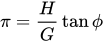
where is the horizontal component of terrestrial magnetism, and is the principal constant of the galvanometer.
If is the resistance of the coil through which this current is made to flow, the difference of the potentials at the ends of the coil is
| , |

| . |

| . |
| . |
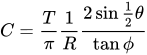
The capacity of the condenser is thus determined in terms of the following quantities:—
, the time of vibration of the magnet of the galvanometer from rest to rest.
, the resistance of the coil.
, the extreme limit of the swing produced by the discharge.
, the constant deflexion due to the current through the coil .
This method was employed by Professor Fleeming Jenkin in determining the capacity of condensers in electromagnetic measure[4].
If be the capacity of the same condenser in electrostatic measure, as determined by comparison with a condenser whose capacity can be calculated from its geometrical data,| . |

| Hence | . |
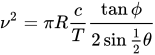
The quantity may therefore be found in this way. It depends on the determination of in electromagnetic measure, but as it involves only the square root of , an error in this determination will not affect the value of so much as in the method of Arts. 772, 773.
Intermittent Current.
775.] If the wire of a battery-circuit be broken at any point, and the broken ends connected with the electrodes of a condenser, the current will flow into the condenser with a strength which diminishes as the difference of the potentials of the condenser increases, so that when the condenser has received the full charge corresponding to the electromotive force acting on the wire the current ceases entirely.
If the electrodes of the condenser are now disconnected from the ends of the wire, and then again connected with them in the reverse order, the condenser will discharge itself through the wire, and will then become recharged in the opposite way, so that a transient current will flow through the wire, the total quantity of which is equal to two charges of the condenser.
By means of a piece of mechanism (commonly called a Commutator, or wippe) the operation of reversing the connexions of the condenser can be repeated at regular intervals of time, each interval being equal to . If this interval is sufficiently long to allow of the complete discharge of the condenser, the quantity of electricity transmitted by the wire in each interval will be , where is the electromotive force, and is the capacity of the condenser.
If the magnet of a galvanometer included in the circuit is loaded, so as to swing so slowly that a great many discharges of the condenser occur in the time of one free vibration of the magnet, the succession of discharges will act on the magnet like a steady current whose strength is
| . |

| ; | (1) |

| or | . | (2) |

We may thus compare the condenser with its commutator in motion to a wire of a certain electrical resistance, and we may make use of the different methods of measuring resistance described in Arts. 345 to 357 in order to determine this resistance.
776.] For this purpose we may substitute for any one of the wires in the method of the Differential Galvanometer, Art. 346, or in that of Wheatstone's Bridge, Art. 347, a condenser with its commutator. Let us suppose that in either case a zero deflexion of the galvanometer has been obtained, first with the condenser and commutator, and then with a coil of resistance in its place, then the quantity will be measured by the resistance of the circuit of which the coil forms part, and which is completed by the remainder of the conducting system including the battery. Hence the resistance, , which we have to calculate, is equal to , that of the resistance coil, together with , the resistance of the remainder of the system (including the battery), the extremities of the resistance coil being taken as the electrodes of the system.


In the cases of the differential galvanometer and Wheatstone's Bridge it is not necessary to make a second experiment by substituting a resistance coil for the condenser. The value of the resistance required for this purpose may be found by calculation from the other known resistances in the system.
Using the notation of Art. 347, and supposing the condenser and commutator substituted for the conductor in Wheatstone's Bridge, and the galvanometer inserted in , and that the deflexion of the galvanometer is zero, then we know that the resistance of a coil, which placed in would give a zero deflexion, is

| . | (3) |


| . | (4) |

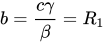
In this expression denotes the internal resistance of the battery and its connexions, the value of which cannot be determined with certainty; but by making it small compared with the other resistances, this uncertainty will only slightly affect the value of .
The value of the capacity of the condenser in electromagnetic measure is| . | (5) |
| , | (6) |
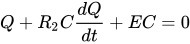
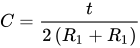
where is the charge, the capacity of the condenser, the resistance of the rest of the system between the electrodes of the condenser, and the electromotive force due to the connexions with the batter.
| Hence | , | (7) |

where is the initial value of .
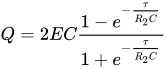
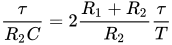
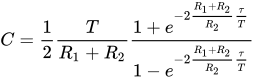
If is the time during which contact is maintained during each discharge, the quantity in each discharge is

| . | (8) |


| , | (9) |
| . | (10) |
IV. Comparison of the Electrostatic Capacity of a Condenser with the Electromagnetic Capacity of Self-induction of a Coil.

Fig. 64.
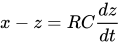
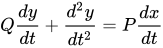
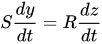
778.] If two points of a conducting circuit, between which the resistance is , are connected with the electrodes of a condenser whose capacity is , then, when an electromotive force acts on the circuit, part of the current, instead of passing through the resistance , will be employed in charging the condenser. The current through will therefore rise to its final value from zero in a gradual manner. It appears from the mathematical theory that the manner in which the current through rises from zero to its final value is expressed by a formula of exactly the same kind as that which expresses the value of a current urged by a constant electromotive force through the coil of an electromagnet. Hence we may place a condenser and an electromagnet on two opposite members of Wheatstone's Bridge in such a way that the current through the galvanometer is always zero, even at the instant of making or breaking the battery circuit.
In the figure, let , , , be the resistances of the four members of Wheatstone's Bridge respectively. Let a coil, whose coefficient of self-induction is be made part of the member , whose resistance is , and let the electrodes of a condenser, whose capacity is , be connected by pieces of small resistance with the points and . For the sake of simplicity, we shall assume that there is no current in the galvanometer , the electrodes of which are connected to and . We have therefore to determine the condition that the potential at may be equal to that at . It is only when we wish to estimate the degree of accuracy of the method that we require to calculate the current through the galvanometer when this condition is not fulfilled.
Let be the total quantity of electricity which has passed through the member , and that which has passed through at the time , then will be the charge of the condenser. The electromotive force acting between the electrodes of the condenser is, by Ohm's law, , so that if the capacity of the condenser is ,


| . | (1) |

| . | (2) |

| . | (3) |
| . | (4) |

| . | (5) |

| . | (6) |

Here and are the time-constants of the members and respectively, and if, by varying or , we can adjust the members of Wheatstone's Bridge till the galvanometer indicates no current, either at making and breaking the circuit, or when the current is steady, then we know that the time-constant of the coil is equal to that of the condenser.


The coefficient of self-induction, , can be determined in electromagnetic measure from a comparison with the coefficient of mutual induction of two circuits, whose geometrical data are known (Art. 756). It is a quantity of the dimensions of a line.
The capacity of the condenser can be determined in electrostatic measure by comparison with a condenser whose geometrical data are known (Art. 229). This quantity is also a length, . The electromagnetic measure of the capacity is| . | (7) |


| , | (8) |

where is the capacity of the condenser in electrostatic measure, the coefficient of self-induction of the coil in electromagnetic measure, and and the resistances in electromagnetic measure. The value of , as determined by this method, depends on the determination of the unit of resistance, as in the second method, Arts. 772, 773.
V. Combination of the Electrostatic Capacity of a Condenser with the Electromagnetic Capacity of Self-induction of a Coil.
779.] Let be the capacity of the condenser, the surfaces of which are connected by a wire of resistance . In this wire let the coils and be inserted, and let denote the sum of their capacities of self-induction. The coil is hung by a bifilar suspension, and consists of two coils in vertical planes, between which 
Fig. 65.
passes a vertical axis which carries the magnet , the axis of which revolves in a horizontal plane between the coils . The coil has a large coefficient of self-induction, and is fixed. The suspended coil is protected from the currents of air caused by the rotation of the magnet by enclosing the rotating parts in a hollow case.


The motion of the magnet causes currents of induction in the coil, and these are acted on by the magnet, so that the plane of the suspended coil is deflected in the direction of the rotation of the magnet. Let us determine the strength of the induced currents, and the magnitude of the deflexion of the suspended coil.
Let be the charge of electricity on the upper surface of the condenser , then, if is the electromotive force which produces this charge, we have, by the theory of the condenser,| . | (1) |

| , | (2) |

where is the electromagnetic momentum of the circuit , when the axis of the magnet is normal to the plane of the coil, and is the angle between the axis of the magnet and this normal.
The equation to determine is therefore| . | (3) |

| . | (4) |

| . | (5) |

Finding the values of A and B by substitution in the equation (3), we obtain

The moment of the force with which the magnet acts on the coil , in which the current is flowing, is



Integrating this expression with respect to , and dividing by , we find, for the mean value of ,

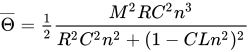
If the coil has a considerable moment of inertia, its forced vibrations will be very small, and its mean deflexion will be proportional to .

Let be the observed deflexions corresponding to angular velocities of the magnet, then in general


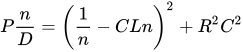
where is a constant.
Eliminating and from three equations of this form, we find

If is such that , the value of will be a minimum for this value of n. The other values of n should be taken, one greater, and the other less, than .


The value of , determined from this equation, is of the dimensions of the square of a time. Let us call it .


If be the electrostatic measure of the capacity of the condenser, and the electromagnetic measure of the self-induction of the coil, both and are lines, and the product



and

where is the value of , determined by this experiment. The experiment here suggested as a method of determining is of the same nature as one described by Sir W. R. Grove, Phil. Mag., March 1868, p. 184. See also remarks on that experiment, by the present writer, in the number for May 1868.


VI. Electrostatic Measurement of Resistance. (See Art. 355.)
780.] Let a condenser of capacity C be discharged through a conductor of resistance R, then, if x is the charge at any instant,
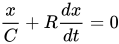
Hence

If, by any method, we can make contact for a short time, which is accurately known, so as to allow the current to flow through the conductor for the time , then, if and are the readings of an electrometer put in connexion with the condenser before and after the operation,



If is known in electrostatic measure as a linear quantity, may be found from this equation in electrostatic measure as the reciprocal of a velocity.
If is the numerical value of the resistance as thus determined, and the numerical value of the resistance in electromagnetic measure,


Since it is necessary for this experiment that should be very great, and since must be small in the electromagnetic experiments of Arts. 763, &c., the experiments must be made on separate conductors, and the resistance of these conductors compared by the ordinary methods.
- ↑ Elektrodynamische Maasbestimmungen; and Pogg. Ann. xcix, (Aug. 10, 1856.)
- ↑ Report of British Association, 1869, p. 434.
- ↑ Phil. Trans., 1868, p. 643; and Report of British Association, 1869, p. 436.
- ↑ Report of British Association, 1867.