A Treatise on Electricity and Magnetism/Part IV/Chapter XVIII
CHAPTER XVIII.
ELECTROMAGNETIC UNIT OF RESISTANCE.
On the Determination of the Resistance of a Coil in Electromagnetic Measure.
758.] The resistance of a conductor is defined as the ratio of the numerical value of the electromotive force to that of the current which it produces in the conductor. The determination of the value of the current in electromagnetic measure can be made by means of a standard galvanometer, when we know the value of the earth's magnetic force. The determination of the value of the electromotive force is more difficult, as the only case in which we can directly calculate its value is when it arises from the relative motion of the circuit with respect to a known magnetic system.

Fig. 63.
759.] The first determination of the resistance of a wire in electromagnetic measure was made by Kirchhoff[1]. He employed two coils of known form, and , and calculated their coefficient of mutual induction from the geometrical data of their form and position. These coils were placed in circuit with a galvanometer, , and a battery, , and two points of the circuit, , between the coils, and , between the battery and galvanometer, were joined by the wire whose resistance, , was to be measured.


When the current is steady it is divided between the wire and the galvanometer circuit, and produces a certain permanent deflexion of the galvanometer. If the coil is now removed quickly from and placed in a position in which the coefficient of mutual induction between and is zero (Art. 538), a current of induction is produced in both circuits, and the galvanometer needle receives an impulse which produces a certain transient deflexion.
The resistance of the wire, , is deduced from a comparison between the permanent deflexion, due to the steady current, and the transient deflexion, due to the current of induction.
Let the resistance of be , of , , and of , .


Let , and be the coefficients of induction of and .


Let be the current in , and that in , then the current from to is .
Let be the electromotive force of the battery, then


| , | (1) |

| . | (2) |

| . | (3) |


| , | (4) |

| . | (5) |

| whence | . | (6) |
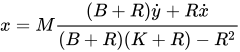
Substituting the value of in terms of from (3), we find
��x M
x~ R *
When, as in Kirchhoff's experiment, both and are large compared with , this equation is reduced to| . | (9) |

Of these quantities, is found from the throw of the galvanometer due to the induction current. See Art. 768. The permanent current, , is found from the permanent deflexion due to the steady current; see Art. 746. is found either by direct calculation from the geometrical data, or by a comparison with a pair of coils, for which this calculation has been made; see Art. 755. From these three quantities can be determined in electromagnetic measure.

These methods involve the determination of the period of vibration of the galvanometer magnet, and of the logarithmic decrement of its oscillations.
Weber's Method by Transient Currents[2].
| , | (1) |

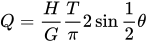
where is the magnetic moment of the coil for unit current, which in the case of a large coil may be determined directly, by measuring the dimensions of the coil, and calculating the sum of the areas of its windings. is the horizontal component of terrestrial magnetism, and is the resistance of the circuit formed by the coil and galvanometer together. This current sets the magnet of the galvanometer in motion.


If the magnet is originally at rest, and if the motion of the coil occupies but a small fraction of the time of a vibration of the
magnet, then, if we neglect the resistance to the motion of the magnet, we have, by Art. 748,| , | (2) |

| (3) |
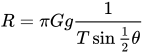
The value of does not appear in this result, provided it is the same at the position of the coil and at that of the galvanometer. This should not be assumed to be the case, but should be tested by comparing the time of vibration of the same magnet, first at one of these places and then at the other.
761.] To make a series of observations Weber began with the coil parallel to the magnetic meridian. He then turned it with its positive face north, and observed the first elongation due to the negative current. He then observed the second elongation of the freely swinging magnet, and on the return of the magnet through the point of equilibrium he turned the coil with its positive face south. This caused the magnet to recoil to the positive side. The series was continued as in Art. 750, and the result corrected for resistance. In this way the value of the resistance of the combined circuit of the coil and galvanometer was ascertained.
In all such experiments it is necessary, in order to obtain sufficiently large deflexions, to make the wire of copper, a metal which, though it is the best conductor, has the disadvantage of altering considerably in resistance with alterations of temperature. It is also very difficult to ascertain the temperature of every part of the apparatus. Hence, in order to obtain a result of permanent value from such an experiment, the resistance of the experimental circuit should be compared with that of a carefully constructed resistance- coil, both before and after each experiment.
Weber's Method by observing the Decrement of the Oscillations of a Magnet.
762.] A magnet of considerable magnetic moment is suspended at the centre of a galvanometer coil. The period of vibration and the logarithmic decrement of the oscillations is observed, first with the circuit of the galvanometer open, and then with the circuit closed, and the conductivity of the galvanometer coil is deduced from the effect which the currents induced in it by the motion of the magnet have in resisting that motion.
If is the observed time of a single vibration, and the Napierian logarithmic decrement for each single vibration, then, if we write > =

��and a = y , (2)
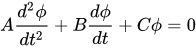
the equation of motion of the magnet is of the form| . | (3) |

This expresses the nature of the motion as determined by observation. We must compare this with the dynamical equation of motion.
Let be the coefficient of induction between the galvanometer coil and the suspended magnet. It is of the form| (4) |



| , | (5) |

where is the principal coefficient of the galvanometer, is the magnetic moment of the magnet, and is the angle between the axis of the magnet and the plane of the coil, which, in this experiment, is always a small angle.


If is the coefficient of self-induction of the coil, and its resistance, and the current in the coil,

�� ��(6)
��or L- + R-/ + Gmcos<t> -= 0. (7)
dt dt
The moment of the force with which the current acts on the magnet is , or . The angle is in this experiment so small, that we may suppose .
Let us suppose that the equation of motion of the magnet when the circuit is broken is


| , | (8) |
where is the moment of inertia of the suspended apparatus, expresses the resistance arising from the viscosity of the air and of the suspension fibre, &c., and expresses the moment of the force arising from the earth s magnetism, the torsion of the suspension apparatus, &c., tending to bring the magnet to its position of equilibrium.
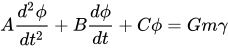
The equation of motion, as affected by the current, will be


| . | (9) |
| , | (10) |

a linear differential equation of the third order.
We have no occasion, however, to solve this equation, because the data of the problem are the observed elements of the motion of the magnet, and from these we have to determine the value of .
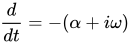
Let and be the values of and in equation (2) when the circuit is broken. In this case is infinite, and the equation is reduced to the form (8). We thus find


| ,. | (11) |


| ,where, | (12) |

| . | (13) |


| . | (14) |

We may also obtain a value of by equating the terms not involving , but as these terms are small, the equation is useful only as a means of testing the accuracy of the observations. From these equations we find the following testing equation,

��-a> 2 ) 2 }. (15)
Since is very small compared with , this equation gives

| ; | (16) |

| . | (17) |
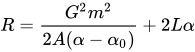
In this expression may be determined either from the linear measurement of the galvanometer coil, or better, by comparison with a standard coil, according to the method of Art. 753. is the moment of inertia of the magnet and its suspended apparatus, which is to be found by the proper dynamical method. , , and , are given by observation.
The determination of the value of , the magnetic moment of the suspended magnet, is the most difficult part of the investigation, because it is affected by temperature, by the earth s magnetic force, and by mechanical violence, so that great care must be taken to measure this quantity when the magnet is in the very same circumstances as when it is vibrating.
The second term of , that which involves , is of less importance, as it is generally small compared with the first term. The value of may be determined either by calculation from the known form of the coil, or by an experiment on the extra-current of induction. See Art. 756.
Thomson's Method by a Revolving Coil.
763.] This method was suggested by Thomson to the Committee of the British Association on Electrical Standards, and the experiment was made by M. M. Balfour Stewart, Fleeming Jenkin, and the author in 1863[3].
A circular coil is made to revolve with uniform velocity about a vertical axis. A small magnet is suspended by a silk fibre at the centre of the coil. An electric current is induced in the coil by the earth's magnetism, and also by the suspended magnet. This current is periodic, flowing in opposite directions through the wire of the coil during different parts of each revolution, but the effect of the current on the suspended magnet is to produce a deflexion from the magnetic meridian in the direction of the rotation of the coil.
764.] Let be the horizontal component of the earth's magnetism.
| Let | be the strength of the current in the coil. | ||
| the total area inclosed by all the windings of the wire. | |||
| the magnetic force at the centre of the coil due to unit-current. | |||
| the coefficient of self-induction of the coil. | |||
| the magnetic moment of the suspended magnet. | |||
| the angle between the plane of the coil and the magnetic meridian. | |||
| the angle between the axis of the suspended magnet and the magnetic meridian | |||
| the moment of inertia of the suspended magnet. | |||
| the coefficient of torsion of the suspension fibre. | |||
| the azimuth of the magnet when there is no torsion. | |||
| the resistance of the coil. | |||


| . | (1) |

The first term, , expresses the energy of the current as depending on the coil itself. The second term depends on the mutual action of the current and terrestrial magnetism, the third on that of the current and the magnetism of the suspended magnet, the fourth on that of the magnetism of the suspended magnet and terrestrial magnetism, and the last expresses the kinetic energy of the matter composing the magnet and the suspended apparatus which moves with it.
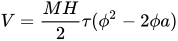
The potential energy of the suspended apparatus arising from the torsion of the fibre is
| . | (2) |
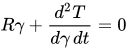
| , | (3) |

| , | (4) |
| or, since | (5) |

| . | (6) |

765.] It is the result alike of theory and observation that , the azimuth of the magnet, is subject to two kinds of periodic variations. One of these is a free oscillation, whose periodic time depends on the intensity of terrestrial magnetism, and is, in the experiment, several seconds. The other is a forced vibration whose period is half that of the revolving coil, and whose amplitude is, as we shall see, insensible. Hence, in determining , we may treat ; as sensibly constant.
We thus find
��y = (R cos B + Zo> sin 0) (7)
+)im(*--4)) J (8)
��+ Ce . (9)
The last term of this expression soon dies away when the rotation is continued uniform.
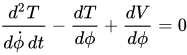
The equation of motion of the suspended magnet is| , | (10) |
| whence | . | (11) |

| , | (12) |

where is the mean value of , and the second term expresses the free vibrations gradually decaying, and the third the forced vibrations arising from the variation of the deflecting current.

The value of in equation (12) is . That of , the amplitude of the forced vibrations, is . Hence, when the coil makes many revolutions during one free vibration of the magnet, the amplitude of the forced vibrations of the magnet is very small, and we may neglect the terms in (11) which involve .


Beginning with the terms in (11) which do not involve , we find ��
cos $o + I* W Sin (f> n ) H -- ^r- R
��(sin + T(^ -a)). (13)
Remembering that is small, and that is generally small compared with , we find as a sufficiently approximate value of ,

| . | (14) |

766.] The resistance is thus determined in electromagnetic measure in terms of the velocity and the deviation . It is not necessary to determine , the horizontal terrestrial magnetic force, provided it remains constant during the experiment.
To determine we must make use of the suspended magnet to deflect the magnet of the magnetometer, as described in Art. 454. In this experiment should be small, so that this correction be comes of secondary importance.

For the other corrections required in this experiment see the Report of the British Association for 1863, p. 168.
Joule's Calorimetric Method.
| , | (1) |
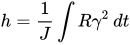
where is the equivalent in dynamical measure of the unit of heat employed.
Hence, if is constant during the experiment, its value is
| . | (2) |

This method of determining involves the determination of , the heat generated by the current in a given time, and of , the square of the strength of the current.


In Joule's experiments[4], was determined by the rise of temperature of the water in a vessel in which the conducting wire was immersed. It was corrected for the effects of radiation, &c. by alternate experiments in which no current was passed through the wire.
The strength of the current was measured by means of a tangent galvanometer. This method involves the determination of the intensity of terrestrial magnetism, which was done by the method described in Art. 457. These measurements were also tested by the current weigher, described in Art. 726, which measures directly. The most direct method of measuring , however, is to pass the current through a self-acting electrodynamometer (Art. 725) with a scale which gives readings proportional to , and to make the observations at equal intervals of time, which may be done approximately by taking the reading at the extremities of every vibration of the instrument during the whole course of the experiment.
