122. Continuous functions of two or more independent variables. A function of two independent variables and is defined as continuous for the values of when
no matter in what way and approach their respective limits and . This definition is sometimes roughly summed up in the statement that a very small change in one or both of the independent variables shall produce a very small change in the value of the junction.[1]
We may illustrate this geometrically by considering the surface represented by the equation
Consider a fixed point P on the surface where and .
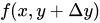
Denote by and the increments of the independent variables and , and by the corresponding increment of the dependent variable , the coordinates of P' being
Point on surface.
At P the value of the function is
If the function is continuous at P, then, however and may approach the limit zero, will also approach the limit zero. That is, will approach coincidence with MP, the point approaching the point P on the surface from any direction whatever.
A similar definition holds for a continuous function of more than two independent variables.
In what follows, only values of the independent variables are considered for which a function is continuous. 123. Partial derivatives. Since and are independent in
may be supposed to vary while remains constant, or the reverse.
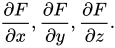
The derivative of with respect to when varies and remains constant[2] is called the partial derivative of with respect to , and is denoted by the symbol We may then write
(A)
Similarly, when remains constant[2] and varies, the partial derivative of z with respect to is
(B)
is also written or
Similarly,
is also written or .
In order to avoid confusion the round [3] has been generally adopted to indicate partial differentiation. Other notations; however, which are in use are
Our notation may be extended to a function of any number of independent variables. Thus, if
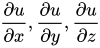
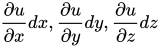
then we have the three partial derivatives
; or,
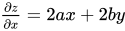
Illustrative Example 1. Find the partial derivatives of
Solution.
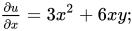
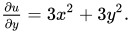
, treating as a constant,
, treating as a constant.
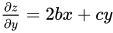
Illustrative Example 2. Find the partial derivatives of
Solution.
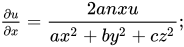
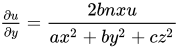
, treating and as constants,
, treating and as constants,
, treating and as constants.
Again turning to the function
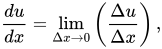
we have, by (A), §123, defined as the limit of the ratio of the increment of the function ( being constant) to the increment of , as the increment of approaches the limit zero. Similarly, (B), §123, has defined . It is evident, however, that if we look upon these partial derivatives from the point of view of § 94, then
may be considered as the ratio of the time rates of change of and when is constant, and
as the ratio of the time rates of change of and when is constant.
124. Partial derivatives interpreted geometrically. Let the equation of the surface shown in the figure be
Plane through point
Pass a plane EFGH through the point P (where and ) on the surface parallel to the XOZ-plane. Since the equation of this plane is
the equation of the section JPK cut out of the surface is
if we consider EF as the axis of and EH as the axis of : In this plane means the same as and we have
slope of section JK at P.
Similarly, if we pass the plane BCD through P parallel to the YOZ-plane, its equation is
and for the section means the same as . Hence
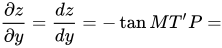
slope of section DI at P.
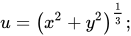
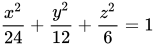
Illustrative Example 1. Given the ellipsoid ; find the slope of the section of the ellipsoid made (a) by the plane at the point where and is positive; (b) by the plane at the point where and is positive.
Solution.
Considering as constant,
= 0, or
When is a constant
= 0, or
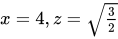
(a) When and . ∴ Ans.
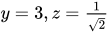
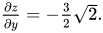
(b) When and . ∴ Ans.
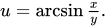
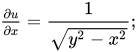
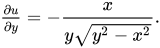
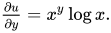
EXAMPLES
1.
Ans.
2.
3.
4.
5.
6.
7.; show that
8. show that
9.; show that
10. show that
11. show that
12. show that
13. show that
14. show that
15. show that
16. Let be the altitude of a right circular cone and the radius of its base. Show (a) that if the base remains constant, the volume changes times as fast as the altitude; (b) that if the altitude remains constant, the volume changes times as fast as the radius of the base.
17. A point moves on the elliptic paraboloid and also in a plane parallel to the XOZ-plane. When ft. and is increasing at the rate of 9 ft. per second, find (a) the time rate of change of ; (b) the magnitude of the velocity of the point; (c) the direction of its motion.
Ans. (a) ft. per sec.; (b) ft. per sec.; (c) , the angle made with the XOY-plane.
18. If, on the surface of Ex. 17, the point moves in a plane parallel to the plane YOZ, find, when and increases at the rate of 5 ft. per sec., (a) the time rate of change of ; (b) the magnitude of the velocity of the point; (c) the direction of its motion.
Ans. (a) 5 ft. per sec.; (b) ft. per sec.; (c) the angle made with the plane XOY.
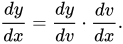
125. Total derivatives. We have already considered the differentiation of a function of one function of a single independent variable. Thus, if
and
it was shown that
We shall next consider a function of two variables, both of which depend on a single independent variable. Consider the function
where and are functions of a third variable .
Let take on the increment , and let , , be the corresponding increments of , , respectively. Then the quantity
is called the total increment of .
Adding and subtracting in the second member,
(A)
Applying the Theorem of Mean Value (46), §106, to each of the two differences on the right-hand side of (A), we get, for the first difference,
(B)
[, and since varies while remains constant, we get the partial derivative with respect to .]
For the second difference we get
(C)
[ and since varies while remains constant, we get the partial derivative with respect to .]
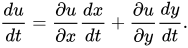
The student should observe that and have quite different meamngs. The partial derivative is formed on the supposition that the particular variable x alone varies, while
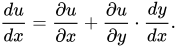
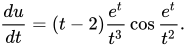
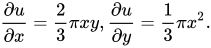
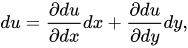
where is the total increment of caused by changes in all the variables, these increments being due to the change in the independent variable. In contradistinction to partial derivatives, are called total derivatives with respect to and respectively.[5] Illustrative Example 1. Given ; find
NOTE. In examples like the above, could, by substitution, be found explicitly in terms of the independent variable and then differentiated directly, but generally this process would be longer and in many cases could not be used at all.
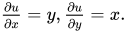
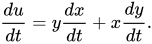
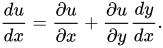
Formulas (51) and (52) are very useful in all applications involving time rates of change of functions of two or more variables. The process is practically the same as that outlined in the rule given on §94 except that, instead of differentiating with respect to (Third Step), we find the partial derivatives and substitute in (51) or (52). Let us illustrate by an example.
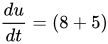
Illustrative Example 3. The altitude of a circular cone is 100 inches, and decreasing at the rate of 10 inches per second; and the radius of the base is 50 inches, and increasing at the rate of 5 inches per second. At what rate is the volume changing?
Circular cone.
Solution. Let radius of base, = altitude; then = volume,
Illustrative Example 2. The base and altitude of a rectangle are 5 and 4 inches respectively. At a certain instant they are increasing continuously at the rate of 2 inches and 1 inch per second respectively. At what rate is the area of the rectangle increasing at that instant?
NOTE. Considering as an infinitesimal increment of area due to the infinitesimal increments and , is evidently the sum of two thin strips added on to the two sides. For, in (multiplying (A) by ),
= area of vertical strip, and
= area of horizontal strip.
But the total increment due to the increments and is evidently
Hence the small rectangle in the upper right-hand corner () is evidently the difference between and . This figure illustrates the fact that the total increment and the total differential of a function of several variables are not in general equal.
127. Differentiation of implicit functions. The equation
(A)
defines either or as an implicit function of the other.[7] It represents any equation containing and when all its terms have been transposed to the first member. Let
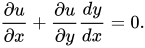
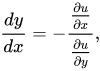
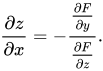
a formula for differentiating implicit functions. This formula in the form (C) is equivalent to the process employed in §62, for differentiating implicit functions, and all the examples at the end of §63 may be solved by using formula (57). Since
(D)
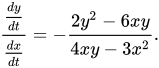
for all admissible values of and , we may say that (57) gives the relative time rates of change of and which keep from changing at all. Geometrically this means that the point must move on the curve whose equation is (D), and (57) determines the direction of its motion at any instant. Since
Illustrative Example 2. If increases at the rate of 2 inches per second as it passes through the value inches, at what rate must change when inch, in order that the function shall remain constant?
Let P be the point (x, y, z) on the surface given by the equation
(E)
and let PC and AP be sections made by planes through P parallel to the YOZ- and XOZ-planes respectively. Along the curve AP, y is constant; therefore, from (E), z is an implicit function of x alone, and we have, from (57a),
is used instead of in the first member, since z was originally, from (E), an implicit function of x and y; but (58) is deduced on the hypothesis that y remains constant.
Similarly, the slope at P of the curve PC is
(59)
EXAMPLES
Find the total derivatives, using (51), (52), or (53), in the following six examples:
1.
Ans.
2.
Ans.
3.
4.
5.
6.
Using (55) or (56), find the total differentials in the next eight examples:
7.
Ans.
8.
9.
Ans.
10.
11.
12.
13.
14.
15. Assuming the characteristic equation of a perfect gas to be
where v = volume, p = pressure, t = absolute temperature, and R a constant, what is the relation between the differentials dv, dp, dt? Ans.vdp + pdv = Rdt.
16. Using the result in the last example as applied to air, suppose that in a given case we have found by actual experiment that
t = 300° C., p = 2000 lb. per sq. ft., v = 14.4 cubic feet.
Find the change in ;;p;;, assuming it to be uniform, when t changes to 301° C., and v to 14.5 cubic feet. R = 96.
Ans. -7.22 lb. per sq. ft.
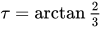
17. One side of a triangle is 8 ft. long, and increasing 4 inches per second; another side is 5 ft., and decreasing 2 inches per second. The included angle is 60°, and increasing 2° per second. At what rate is the area of the triangle changing?
Ans. Increasing 71.05 sq. in. per sec.
18. At what rate is the side opposite the given angle in the last example increasing?
Ans. 4.93 in. per sec.
19. One side of a rectangle is 10 in. and increasing 2 in. per sec. The other side is 15 in. and decreasing 1 in. per sec. At what rate is the area changing at the end of two seconds?
Ans. Increasing 12 sq. in. per sec.
20. The three edges of a rectangular parallelepiped are 3, 4, 5 inches, and are each increasing at the rate of .02 in. per min. At what rate is the volume changing?
21. A boy starts flying a kite. If it moves horizontally at the rate of 2 ft. a sec. and rises at the rate of 5 ft. a sec., how fast is the string being paid out?
Ans. 5.38 ft. a sec.
22. A man standing on a dock is drawing in the painter of a boat at the rate of 2 ft. a sec. His hands are 6 ft. above the bow of the boat. How fast is the boat moving when it is 8 ft. from the dock?
Ans. ft. a sec.
23. The volume and the radius of a cylindrical boiler are expanding at the rate of 1 cu. ft. and .001 ft. per min. respectively. How fast is the length of the boiler changing when the boiler contains 60 cu. ft. and has a radius of 2 ft.?
Ans. .078 ft. a, min.
24. Water is running out of an opening in the vertex of a conical filtering glass, 8 inches high and 6 inches across the top, at the rate of .005 cu. in. per hour. How fast is the surface of the water falling when the depth of the water is 4 inches?
25. A covered water tank is made of sheet iron in the form of an inverted cone of altitude 8 ft. surmounted by a cylinder of altitude 5 ft. The diameter is 6 ft. If the sun's heat is increasing the diameter at the rate of .002 ft. per min., the altitude of the cylinder at the rate of .003 ft. per min., and the altitude of the cone at the rate of .0025 ft. per minute, at what rate is (a) the volume increasing; (b) the total area increasing?
In the remaining examples find , using formula (57a):
26.
Ans.
27.
28.
128. Successive partial derivatives. Consider the function
then, in general,
and
are functions of both and , and may be differentiated again with respect to either independent variable, giving successive partial derivatives. Regarding alone as varying, we denote the results by
or, when alone varies,
the notation being similar to that employed for functions of a single variable.
If we differentiate with respect to , regarding as constant, and then this result with respect to , regarding as constant, we obtain
which we denote by
Similarly, if we differentiate twice with respect to and then once with respect to , the result is denoted by the symbol
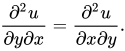
129.Order of differentiation immaterial. Consider the function . Changing into and keeping constant, we get from the Theorem of Mean Value, (46), § 106,
(A)
and since varies while remains constant, we get the partial derivative with respect to .
If we now change to and keep and constant, the total increment of the left-hand member of (A) is
(B)
The total increment of the right-hand member of (A) found by the Theorem of Mean Value, (46), § 106, is
(C)
and since varies while and remain constant, we get the partial derivative with respect to .
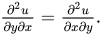
That is, the operations of differentiating with respect to and with respect to are commutative.
This may be easily extended to higher derivatives. For instance, since (58) is true,
Similarly for functions of three or more variables.
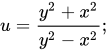
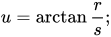
Illustrative Example 1. Given verify
Solution.
hence verified.
EXAMPLES
1.
verify
2.
verify
3.
verify
4.
verify
5.
verify
6.
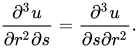
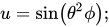
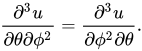
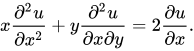
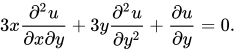
show that
7.
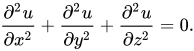
show that
8.
show that
9.
show that
10.
show that
11.
show that
↑This will be better understood if the student again reads over §18, on continuous functions of a single variable.
↑ 2.02.1The constant values are substituted in the function before differentiating
↑This is really only a special case of a general theorem which may be stated as follows:
If is a function of the independent variables , , ,..., each of these in turn being a function of the independent variables , , , ..., then (with certain assumptions as to continuity)
and similar expressions hold for etc.
↑It should be observed that has a perfectly definite value for any point , while depends not only on the point , but also on the particular direction chosen to reach that point. Hence
is called a point function; while
is not called a point function unless it is agreed to approach the point from some particular direction.
↑A geometric interpretation of this result will be given in §161.
↑We assume that a small change in the value of causes only a small change in the value of .









![{\displaystyle {\frac {\partial z}{\partial x}}=\lim _{\Delta x\to 0}\left[{\frac {f(x+\Delta x,y)-f(x,y)}{\Delta x}}\right]}](https://wikimedia.org/api/rest_v1/media/math/render/svg/bf7e6e92c1d176006d8507ca094deeb56b943437)
![{\displaystyle {\frac {\partial z}{\partial y}}=\lim _{\Delta y\to 0}\left[{\frac {f(x,y+\Delta y)-f(x,y)}{\Delta y}}\right]}](https://wikimedia.org/api/rest_v1/media/math/render/svg/bbf9818a0ce86fd2f5f47f54a638c36288129ee0)


























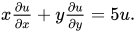

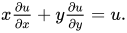

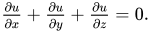

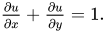

















![{\displaystyle \Delta u=[f(x+\Delta x,\ y+\Delta y)-f(x,\ y+\Delta y)]+[f(x,\ y+\Delta y)-f(x,\ y)].}](https://wikimedia.org/api/rest_v1/media/math/render/svg/27cf5e377189717998b0603c31131f4a1886f299)



































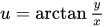


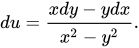


































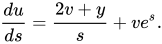

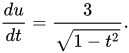

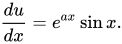



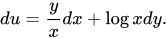



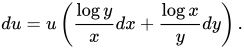

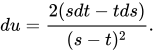
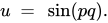
![{\displaystyle du\ =\ \cos(pq)[qdp+pdq].}](https://wikimedia.org/api/rest_v1/media/math/render/svg/c504f84c7720faea292899289ab184e814f90ddf)







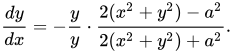

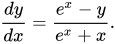

![{\displaystyle {\frac {dy}{dx}}={\frac {y[\cos(xy)-e^{xy}-2x]}{x[x+e^{xy}-\cos {xy}]}}.}](https://wikimedia.org/api/rest_v1/media/math/render/svg/230128af3460f949b8e528db3d8987ee32047c81)


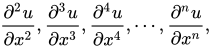
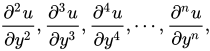







![{\displaystyle \left[f\left(x+\delta x,y+\delta y\right)-f\left(x,y+\delta y\right)\right]-\left[f\left(x+\delta x,y\right)-f\left(x,y\right)\right]}](https://wikimedia.org/api/rest_v1/media/math/render/svg/bda4121d0821a07fb194d4ba36cf6ebc6c56aaf2)






![{\displaystyle \left[f\left(x+\delta x,y+\delta y\right)-f\left(x+\delta x,y\right)\right]-\left[f\left(x,y+\delta y\right)-f\left(x,y\right)\right]}](https://wikimedia.org/api/rest_v1/media/math/render/svg/5e23b3b35dc4ac6ef7aeffb07d31efab03b820d3)