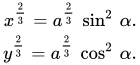
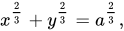
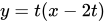
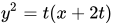
130. Family of curves. Variable parameter. The equation of a curve generally involves, besides the variables and , certain constants upon which the size, shape, and position of that particular curve depend. For example, the locus of the equation
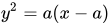
(A)
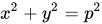
is a circle whose center lies on the axis of at a distance of from the origin, its size depending on the radius . Suppose to take on a series of values; then we shall have a corresponding series of circles differing in their distances from the origin, as shown in the figure.
Any system of curves formed in this way is called a family of curves, and the quantity , which is constant for any one curve, but changes in passing from one curve to another, is called a variable parameter.
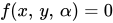
As will appear later on, problems occur which involve two or more parameters. The above series of circles is said to be a family depending on one parameter. To indicate that enters as a variable parameter it is usual to insert it in the functional symbol, thus:
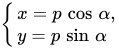
131. Envelope of a family of curves depending on one parameter. The curves of a family may be tangent to the same curve or groups of curves, as in the above figure. In that case the name envelope of the family is applied to the curve or group of curves. We shall now explain a method for finding the equation of the envelope of a family of curves. Suppose that the curve whose parametric equations are
(A)
touches (i.e. has a common tangent with) each curve of the family
(B)
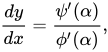
the parameter being the same in both cases. The slope of (A) at
any point is
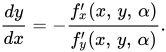
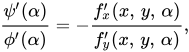
Hence if the curves (A) and (B) are tangent, the slopes (C) and (D) will be equal (for the same value of ), giving
or
(E)
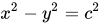
By hypothesis (A) and (B) are tangent for every value of ; hence for all values of the point given by (A) must lie on a curve of the family (B). If we then substitute the values of and from (A) in (B), the result will hold true for all values of ; that is,
(F)
The total derivative of (F) with respect to must therefore vanish, and we get
Therefore the equations of the envelope satisfy the two equations (B) and (H), namely,
(I)
and
that is, the parametric equations of the envelope may be found by solving the two equations (I) for and in terms of the parameter .
General directions for finding the envelope.
First Step. Differentiate with respect to the variable parameter, considering all other quantities involved in the given equation as constants.
Second Step. Solve the result and the given equation of the family of curves for and in terms of the parameter. These solutions will be the parametric equations of the envelope.
Note. In case the rectangular equation of the envelope is required we may either eliminate the parameter from the parametric equations of the envelope, or else eliminate the parameter from the given equation (B) of the family and the partial derivative (H).
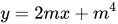
Illustrative Example 1. Find the envelope of the family of straight lines , being the variable parameter.
Illustrative Example 3. Find the rectangular equation of the envelope of the
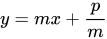
straight line , where the slope is the variable parameter.
Solution.
First Step.
.
Solving,
.
Substitute in the given equation,
.
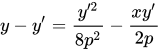
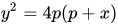
and squaring, , a parabola, is the equation of the envelope. The family of straight lines formed by varying the slope is shown in the figure, each line being tangent to the envelope, for we know from Analytic Geometry that is the tangent to the parabola expressed in terms of its own slope .
132. The evolute of a given curve considered as the envelope of its normals. Since the normals to a curve are all tangent to the evolute, §118, p. 181, it is evident that the evolute of a curve may also be defined as the envelope of its normals; that is, as the locus of the ultimate intersections of neighboring normals. It is also interesting to notice that if we find the parametric equations of the envelope by the method of the previous section, we get the coordinates and of the center of curvature; so that we have here a second method for finding the coordinates of the center of curvature. If we then eliminate the variable parameter, we have a relation between and which is the rectangular equation of the evolute (envelope of the normals).
Illustrative Example 1. Find the evolute of the parabola considered as the envelope of its normals.
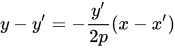
Solution. The equation of the normal at any point is
from (§2), p. 77. As we are considering the normals all along the curve, both and will vary. Eliminating by means of , we get the equation of the normal to be
(A)
.
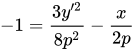
Considering as the variable parameter, we wish to find the envelope of this family of normals. Differentiating (A) with respect to ,
,
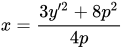
and solving for ,
(B)
.
Substituting this value of in (A) and solving for ,
(C)
.
(B) and (C) are then the coordinates of the center of curvature of the parabola. Taken together, (B) and (C) are the parametric equations of the evolute in terms of the parameter . Eliminating between (B) and (C) gives
,
the rectangular equation of the evolute of the parabola. This is the same result we obtained in Illustrative Example 1., §181 p. 183, by the first method.
133. Two parameters connected by one equation of condition. Many
problems occur where it is convenient to use two parameters connected by an equation of condition. For instance, the example given in the last section involves the two parameters and which are connected by the equation of the curve. In this case we eliminated , leaving only the one parameter .
However, when the elimination is difficult to perform, both the given equation and the equation of condition between the two parameters may be differentiated with respect to one of the parameters, regarding either parameter as a function of the other. By studying the solution of the following problem the process will be made clear.
Illustrative Example 1. Find the envelope of the family of ellipses whose axes
coincide and whose area is constant.
Solution.(A)
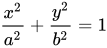
is the equation of the ellipse where and are the variable parameters connected by the equation
(B)
,
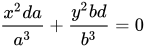
being the area of an ellipse whose semi-axes are and . Differentiating (A) and (B), regarding and as variables and and as constants, we have, using differentials,
2. Find the envelope of the family of parabolas , being the variable parameter.
Ans., ; or .
3. Find the envelope of the family of circles , being the variable parameter.
Ans.
4. Find the equation of the curve having as tangents the family of straight lines , the slope being the variable parameter.
Ans. The ellipse .
5. Find the envelope of the family of circles whose diameters are double ordinates of the parabola .
Ans. The parabola .
6. Find the envelope of the family of circles whose diameters are double ordinates of the ellipse .
Ans. The ellipse .
7. A circle moves with its center on the parabola , and its circumference passes through the vertex of the parabola. Find the equation of the envelope of the circles.
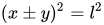
12. Find the envelope of a line such that the sum of its intercepts on the axes equals .
Ans. The parabola .
13. Find the equation of the envelope of the system of circles , where is the parameter. Draw a figure illustrating the problem.
Ans..
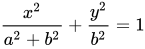
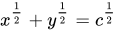
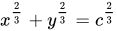
14. Find the envelope of the family of ellipses , when the sum of its semiaxes equals .
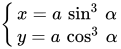
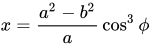
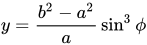
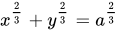
Ans. The hypocycloid .
15. Find the envelope of the ellipses whose axes coincide, and such that the distance between the extremities of the major and minor axes is constant and equal to .
Ans. A square whose sides are .
16. Projectiles are fired from a gun with an initial velocity . Supposing the gun
can be given any elevation and is kept always in the same vertical plane, what is the envelope of all possible trajectories, the resistance of the air being neglected?
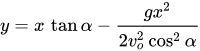
Hint. The equation of any trajectory is
,
being the variable parameter.
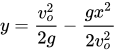
Ans. The parabola .
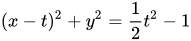
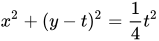
17. Find the equation of the envelope of each of the following family of curves, being the parameter; draw the family and the envelope :
(a) .
(i) .
(b) .
(j) .
(c) .
(k) .
(d) .
(l) .
(e) .
(m) .
(f) .
(n) .
(g) .
(o) .
(h) .
(p) .
↑When two answers are given, the first is in parametric form and the second in rectangular form.










![{\displaystyle f[\phi (\alpha ),\,\psi (\alpha ),\,\alpha ]=0.}](https://wikimedia.org/api/rest_v1/media/math/render/svg/321b1fe99d920b3e812a68820c102f77f74c6ec7)