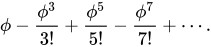
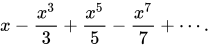
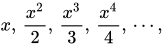
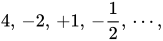
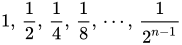
134. Introduction. A series is a succession of separate numbers which is formed according to some rule or law. Each number is called a term of the series. Thus
is a series whose law of formation is that each term after the first is found by multiplying the preceding term by 2; hence we may write down as many more terms of the series as we please, and any particular term of the series may be found by substituting the number of that term in the series for in the expression , which is called the general or nth term of the series.
EXAMPLES
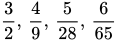
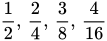
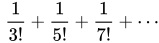
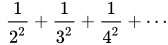
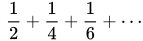
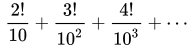
In the following six series:
(a) Discover by inspection the law of formation;
(b) write down several terms more in each;
(c) find the nth or general term.
Series
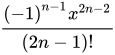
nth term
1.
.
2.
.
3.
.
4.
.
5.
.
6.
.
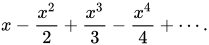
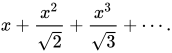
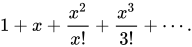
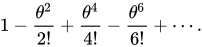
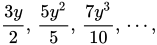
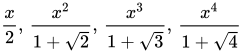
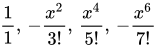
Write down the first four terms of each series whose nth or general term is given below :
nth term
Series
7..
.
8..
.
9..
.
10..
.
11.
.
12..
.
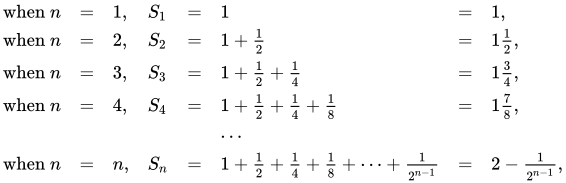
135. Infinite series. Consider the series of terms
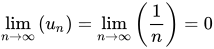
[Since when increases without limit approaches zero as a limit.]
We have so far discussed only a particular series (A) when the number of terms increases without limit. Let us now consider the general problem, using the series
(C)
,
whose terms may be either positive or negative. Denoting by the sum of the first terms, we have,
,
and is a function of . If we now let the number of terms () increase without limit, one of two things may happen: either
Case I. approaches a limit, say , indicated by
; or
Case II. approaches no limit.
In either case (C) is called an infinite series. In Case I the infinite series is said to be convergent and to converge to the value , or to have the value , or to have the sum . The infinite geometric series discussed at the beginning of this section is an example of a convergent series, and it converges to the value 2. In fact, the simplest example of a convergent series is the infinite geometric series
where is numerically less than unity. The sum of the first terms of this series is, by 6, § 1,
.
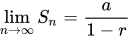
If we now suppose to increase without limit, the first fraction on the right-hand ,side remains unchanged, while the second approaches zero as a limit. Hence
,
a perfectly definite number in any given case.
In Case II the infinite series is said to be nonconvergent[3]. Series under this head may be divided into two classes.
First Class. Divergent series, in which the sum of terms increases indefinitely in numerical value as increases without limit; take for example the series
.
As increases without limit, increases without limit and therefore the series is divergent.
Second Class. Oscillating series, of which
is an example. Here is zero or unity according as is even or odd, and although does not become infinite as increases without limit, it does not tend to a limit, but oscillates. It is evident that if all the terms of a series have the same sign, the series cannot oscillate.
Since the sum of a converging series is a perfectly definite number, while such a thing as the sum of a nonconvergent series does not exist, it follows at once that it is absolutely essential in any given problem involving infinite series to determine whether or not the series is convergent. This is often a problem of great difficulty, and we shall consider only the simplest cases.
136. Existence of a limit. When a series is given we cannot in general, as in the case of a geometric series, actually find the number which is the limit of . But although we may not know how to compute the numerical value of that limit, it is of prime importance to know that a limit does exist, for otherwise the series may be non-convergent. When examining a series to determine whether or not it is convergent, the following theorems, which we state without proofs, are found to be of fundamental importance.[4]
Theorem I.If is a variable that always increases as increases, but always remains less than some definite fixed number , then as increases without limit, will approach a definite limit which is not greater than .
Theorem II.If is a variable that always decreases as increases, but always remains greater than some definite fixed number , then as increases without limit, will approach a definite limit which is not less than .
Theorem III.The necessary and sufficient condition that shall approach some definite fixed number as a limit as increases without limit is that
for all values of the integer .
137.Fundamental test for convergence. Summing up first and then terms of a series, we have
From Theorem III we know that the necessary and sufficient condition that the series shall be convergent is that
for every value of . But this is the same as the left-hand member of (C); therefore from the right-hand member the condition may also be written
(D)
.
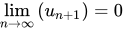
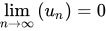
Since (D) is true for every value of , then, letting , a necessary condition for convergence is that
;
or, what amounts to the same thing,
(E)
.
Hence, if the general (or nth) term of a series does not approach zero as approaches infinity, we know at once that the series is non- convergent and we need proceed no further. However, (D) is not a sufficient condition; that is, even if the nth term does approach zero, we cannot state positively that the series is convergent ; for, consider
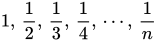
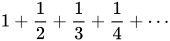
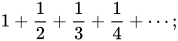
the harmonic series
.
Here
;
that is, condition (E) is fulfilled. Yet we may show that the harmonic series is not convergent by the following comparison:
(F)
,
(G)
,
We notice that every term of (G) is equal to or less than the corresponding term of (F), so that the sum of any number of the first terms of (F) will be greater than the sum of the corresponding terms of (G). But since the sum of the terms grouped in each bracket in (G) equals , the sum of (G) may be made as large as we please by taking terms enough. The sum (G) increases indefinitely as the number of terms increases without limit; hence (G), and therefore also (F), is divergent.
We shall now proceed to deduce special tests which, as a rule, are easier to apply than the above theorems.
138. Comparison test for convergence. In many cases, an example of which was given in the last section, it is easy to determine whether or not a given series is convergent by comparing it term by term with another series whose character is known. Let
(A)
be a series of positive terms which it is desired to test for convergence. If a series of positive terms already known to be convergent, namely,
(B)
can be found whose terms are never less than the corresponding terms in the series (A) to be tested, then (A) is a convergent series and its sum does not exceed that of (B).
Proof. Let
,
and
;
and suppose that
.
Then, since
and ,
it follows that . Hence, by Theorem I, §136, approaches a
limit; therefore the series (A) is convergent and the limit of its sum is not greater than .
Illustrative Example 1. Test the series
(C)
.
Solution. Each term after the first is less than the corresponding term of the geometric series
(D)
.
which is known to be convergent; hence (C) is also convergent.
Following a line of reasoning similar to that applied to (A) and (B), it is evident that, if
(E)
is a series of positive terms to be tested, which are never less than the corresponding terms of the series of positive terms, namely,
(F)
known to be divergent, then (E) is a divergent series.
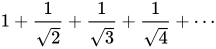
Illustrative Example 2.. Test the series
.
Solution. This series is divergent, since its terms are greater than the corresponding terms of the harmonic series
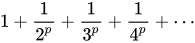
Illustrative Example 3.. Test the following series (called the p series) for different values of p:
(G)
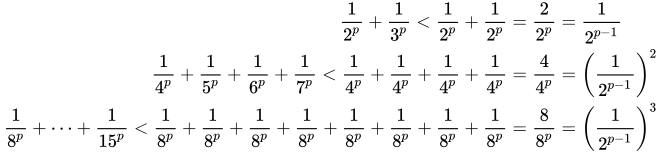
Solution. Grouping the terms, we have, when ,
and so on. Construct the series
(H)
When , series (H) is a geometric series with the common ration less than unity, and is therefore convergent. But the sum of (G) is less than the sum of (H), as shown in the above inequalities; therefore (G) is also convergent.
When series (G) becomes the harmonic series which we saw was divergent, and neither of the above tests apply.
When , the terms of series (G) will, after the first, be greater than the corresponding terms of the harmonic series; hence (G) is divergent.
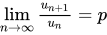
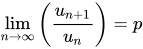
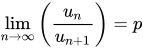
139. Cauchy's ratio test for convergence. Let
(A)
be a series of positive termes to be tested.
Divide any general term by the one that immediately precedes it; i.e. form the test ratio .
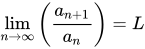
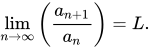
As increases without limit, let .
I. When . By the definition of a limit (§13) we can choose n so large, say , that when the ratio shall differ from by as little as we please, and therefore be less than a proper fraction . Hence
and so on. Therefore, after the term , each term of the series (A) is less than the corresponding term of the geometrical series
(B)
But since , the series (B), and therefore also the series is convergent.[5]
II. When (or). Following the same line of reasoning as in I, the series (A) may be shown to be divergent.
III. When , the series maybe either convergent or divergent; that is, there is no test. For, consider the series, namely,
The test ratio is
and
Hence , no matter what value may have. But in §138 we showed that
when the series converges, and
when , the series diverges.
Thus it appears that can equal unity both for convergent and for divergent series, and the ratio test for convergence fails. There are other tests to apply in cases like this, but the scope of our book does not admit of their consideration.
Our results may then be stated as follows:
Given the series of positive terms
140. Alternating series. This is the name given to a series whose
terms are alternately positive and negative. Such series occur frequently in practice and are of considerable importance.
If
is an alternating series whose terms never increase in numerical value, and if
then the series is convergent.
Proof. The sum of (an even number) terms may be written in the two forms
(A)
or
(B)
Since each difference is positive (if it is not zero, and the assumption excludes equality of the terms of the series), series (A) shows that is positive and increases with , while series (B) shows that is always less than ; therefore, by Theorem I, §136, must approach a limit less than when increases, and the series is convergent.
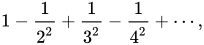
Illustrative Example 4. Test the alternating series
Solution. Since each term is less in numerical value than the preceding one, and
the series is convergent.
141. Absolute convergence. A series is said to be absolutely[7] or unconditionally convergent when the series formed from it by making all its terms positive is convergent. Other convergent series are said
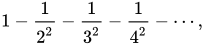
to be not absolutely convergent or conditionally convergent. To this latter class belong some convergent alternating series. For example, the series
is absolutely convergent, since the series (C), §138, namely,
is convergent. The series
is conditionally convergent, since the harmonic series
is divergent.
A series with terms of different signs is convergent if the series deduced from it by making all the signs positive is convergent.
The proof of this theorem is omitted.
Assuming that the ratio test in §139 holds without placing any restriction on the signs of the terms of a series, we may summarize our results in the following.
General directions for testing the series
When it is an alternating series whose terms never increase in numerical value, and if
then the series is convergent.
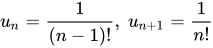
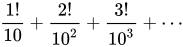
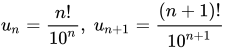
In any series in which the above conditions are not satisfied, we determine the form of and and calculate the limit
I.
When, the series is absolutely convergent.
II.
When, the series is divergent.
III.
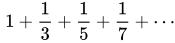
When, there is no test, and we should compare the series with some series which we know to be convergent, as
(geometric series)
(p series)
or compare the given series with some series which is known to be divergent, as
This being an indeterminate form, we evaluate it, using the rule in §112.
Differentiating,
Differentiating again,
This gives no test (III, §141). But if we compare series (C) with (G), §138,making , namely,
(D)
we see that (C) must be convergent, since its terms are less than the corresponding terms of (D), which was proved convergent.
EXAMPLES
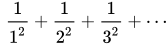
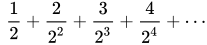
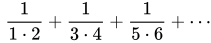
Show that the following ten series are convergent:
1.
6.
2.
7.
3.
8.
4.
9.
5.
10.
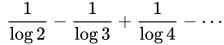
Show that the following four series are divergent :
11.
13.
12.
14.
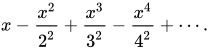
142. Power series. A series of ascending integral powers of a variable, say , of the form
(A)
where the coefficients, are independent of , is called a power series in x. Such series are of prime importance in the further study of the Calculus.
In special cases a power series in may converge for all values of , but in general it will converge for some values of and be divergent for other values of . We shall examine (A) only for the case when the coefficients are such that
which is convergent by comparison with the p series ().
The series in the above example is said to have as the interval of convergence. This may be written , or indicated graphically as follows:
EXAMPLES
For what values of the variable are the following series convergent?
Graphical representation of intervals of convergence[8]
15.
Ans.
16.
Ans.
17.
Ans.
18.
Ans.
19.
Ans. All values of .
20.
Ans. All values of .
21.
Ans. All values of .
22.
Ans. All values of .
23.
Ans..
Hint. Neither the sine nor cosine can exceed 1 numerically.
24.
Ans. All values of .
25.
Ans.
26.
Ans.
27.
28.
29.
30.
↑Found by 6, § 1, for the sum of a geometric series
↑Such a result is sometimes for the sake of brevity, called the sum of the series; but the student must not forget that 2 is not the sum but the limit of the sum, as the number of terms increases without limit.
↑Some writers use divergent as equivalent to nonconvergent
↑See Osgood's Introduction To Infinite Series, pp. 4, 14, 64.
↑When examining a series for convergence we are at liberty to disregard any finite number of terms; the rejection of terms would affect the value but not the existence of the limit.
↑It is not enough that becomes and remains less than unity for all values of but this test requires the limit of shall be less than unity. For instance, in the case of the harmonic series this ratio is always less than unity and yet the series diverges as we have seen. The limit, however, is not less than unity but equals unity.
↑The terms of the new series are the numerical (absolute) values of the terms of the given series.
↑End points that are not included in the interval of convergence have circles drawn around them.












































![{\displaystyle 1+{\frac {1}{2}}+\left[{\frac {1}{3}}+{\frac {1}{4}}\right]+\left[{\frac {1}{5}}+{\frac {1}{6}}+{\frac {1}{7}}+{\frac {1}{8}}\right]+\left[{\frac {1}{9}}+\cdots +{\frac {1}{16}}\right]+\cdots }](https://wikimedia.org/api/rest_v1/media/math/render/svg/8783fb7300bbb1b1740c504db0a478f160052a96)
![{\displaystyle {\frac {1}{2}}+{\frac {1}{2}}+\left[{\frac {1}{4}}+{\frac {1}{4}}\right]+\left[{\frac {1}{8}}+{\frac {1}{8}}+{\frac {1}{8}}+{\frac {1}{8}}\right]+\left[{\frac {1}{16}}+\cdots +{\frac {1}{16}}\right]+\cdots }](https://wikimedia.org/api/rest_v1/media/math/render/svg/dae15ecf1b4204295a70fa319bae2d148b6fbbd0)
















































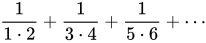

![{\displaystyle \therefore \lim _{n\to \infty }\left({\frac {u_{n+1}}{u_{n}}}\right)=\lim _{n\to \infty }\left[{\frac {\left(2n-1\right)2n}{\left(2n+1\right)\left(2n+2\right)}}\right]={\frac {\infty }{\infty }}}](https://wikimedia.org/api/rest_v1/media/math/render/svg/22d58ae7751a0b4bcfce9335826b8de44efc3f4e)
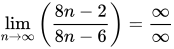
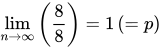

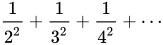

















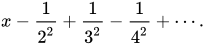
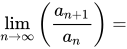
![{\displaystyle \lim _{n\to \infty }\left[-{\frac {n^{2}}{\left(n+1\right)^{2}}}\right]={\frac {\infty }{\infty }}.}](https://wikimedia.org/api/rest_v1/media/math/render/svg/d2dbb97f7cc5a0bcae293cb5589943c7611a8bab)
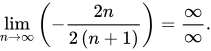
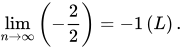
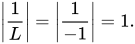




![{\displaystyle [-1,1]}](https://wikimedia.org/api/rest_v1/media/math/render/svg/51e3b7f14a6f70e614728c583409a0b9a8b9de01)