(c) The Accent of Interrogation.

(d) The Tonus Prophetiae.

ending on the reciting note; and differing, in this respect only, from the Tonus Lectionis.

(e) The Tonus Epistolae, Accent for the Epistle. Monotonic except that the Accent of Interrogation is used when a question is asked.
(f) The Tonus Evangelii, or Accent for the Gospel.

6. The Sarum use was in some parts of the service more varied than the Roman, as given above from Guidetti. But the general rules were not widely different, and, from a review of the whole subject, it may be stated briefly that there are some seven ecclesiastical accents, viz. (1) The monotonic; (2) The semitonic
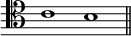
(3) The medial

; (4) The accent of a final fourth

; (5)The grave

; of this there is a variation used in Rome, thus,

ending with the fall of a major sixth. It does not appear to be prescribed in any Gregorian Treatise or Directorium, but is well known to musical travellers, and is mentioned by Mendelssohn in his letter from Rome, 1831, to Zelter, on the music of the Holy Week; (6) The interrogative, before explained; (7) The acute

, used specially for monosyllabic and Hebrew words, when otherwise the medial accent would be employed. These, including the semipunctum, and with the addition of the punctum principale, and perhaps a few other varieties, constitute the first and simplest portion of that voluminous Plaintune from which Marbeck selected the notes set to the English Prayer-book, and which was ordered by Queen Elizabeth's famous Injunctions to be used in every part of the Divine Service of the Reformed Church of England.
[ T. H. ]
ACCIACCATURA. (Ital. from acciacare, to crush, to pound; Ger. Zusammenschlag; Fr. Pincé etouffé.) A now nearly obsolete description of ornament, available only on keyed instruments, in which an essential note of a melody is struck at the same moment with the note immediately below it, the latter being instantly released, and the principal note sustained alone (Ex. 1). It is generally indicated by a small note with an oblique stroke across the stem (Ex. 2), or when used in chords by a line across the chord itself (Ex. 3).


Its use is now confined exclusively to the organ, where it is of great service in giving the effect of an accent, or sforzando, to either single notes or chords.
The term Acciacatura is now very generally applied to another closely allied form of ornament, the short appoggiatura (see that word).
[ F. T. ]
ACCIDENTALS. The signs of chromatic alteration, employed in music to show that the notes to which they are applied have to be raised or lowered a semitone or a tone. They are five in number, the sharp (♯) (Fr. dièse, Ger. Kreuz) and double sharp (𝄪) (Fr. double-dièse, Ger.
