750.]
METHOD OF RECOIL.
349
Suppose that we set the magnet swinging by means of a transient current whose value is  . If, for brevity, we write
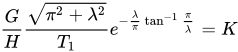 , ,
|
(19)
|
then the first elongation
 (say). (say).
|
(19)
|
The velocity instantaneously communicated to the magnet at starting is
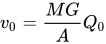 . .
|
(20)
|
When it returns through the point of equilibrium in a negative direction its velocity will be
 . .
|
(21)
|
The next negative elongation will be
 . .
|
(22)
|
When the magnet returns to the point of equilibrium, its velocity will be
 . .
|
(23)
|
Now let an instantaneous current, whose total quantity is  , be transmitted through the coil at the instant when the magnet is at the zero point. It will change the velocity
  into
into  , where
 . .
|
(24)
|
If  is greater than
  , the new velocity will be negative and equal to
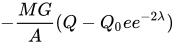 .
.
The motion of the magnet will thus be reversed, and the next elongation will be negative,
 . .
|
(25)
|
The magnet is then allowed to come to its positive elongation
 , ,
|
(26)
|
and when it again reaches the point of equilibrium a positive current whose quantity is is transmitted. This throws the magnet back in the positive direction to the positive elongation
 ; ;
|
(27)
|
or, calling this the first elongation of a second series of four,
 . .
|
(28)
|
Proceeding in this way, by observing two elongations + and −, then sending a positive current and observing two elongations
