We have then, by Art. 276,]
| , | (3) | ||||||
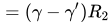
| or | , | (4) | |||||
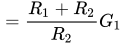
| and | . | (5) |



If there is any uncertainty about the actual resistance of the galvanometer coil (on account, say, of an uncertainty as to its temperature) we may add resistance coils to it, so that the resistance of the galvanometer itself forms but a small part of , and thus introduces but little uncertainty into the final result.

754.] To determine , the magnetic moment of a small coil due to a unit-current flowing through it, the magnet is still suspended at the centre of the standard coil, but the small coil is moved parallel to itself along the common axis of both coils, till the same current, flowing in opposite directions round the coils, no longer deflects the magnet. If the distance between the centres of the coils is , we have now


| . | (6) |

By repeating the experiment with the small coil on the opposite side of the standard coil, and measuring the distance between the positions of the small coil, we eliminate the uncertain error in the determination of the position of the centres of the magnet and of the small coil, and we get rid of the terms in , , &c.


If the standard coil is so arranged that we can send the current through half the number of windings, so as to give a different value to , we may determine a new value of , and thus, as in Art. 454, we may eliminate the term involving .


It is often possible, however, to determine by direct measurement of the small coil with sufficient accuracy to make it available in calculating the value of the correction to be applied to in the equation
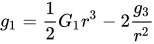
| . | (7) |
| where | , by Art. 700. |

Comparison of Coefficients of Induction.
755.] It is only in a small number of cases that the direct calculation of the coefficients of induction from the form and