796.]
DOUBLE REFRACTION.
393
d
2
F
d
y
2
+
d
2
F
d
z
2
−
d
2
G
d
x
d
y
−
d
2
H
d
z
d
x
=
K
1
μ
(
d
2
F
d
t
2
−
d
2
Ψ
d
x
t
d
)
,
d
2
G
d
z
2
+
d
2
G
d
x
2
−
d
2
H
d
y
d
z
−
d
2
F
d
x
d
y
=
K
2
μ
(
d
2
G
d
t
2
−
d
2
Ψ
d
y
d
t
)
,
d
2
H
d
x
2
+
d
2
H
d
y
2
−
d
2
F
d
z
d
x
−
d
2
G
d
y
d
z
=
K
3
μ
(
d
2
H
d
t
2
−
d
2
Ψ
d
z
d
t
)
,
}
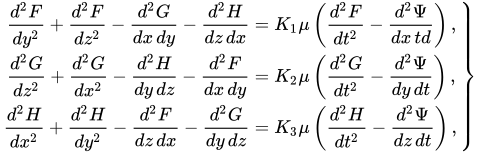
{\displaystyle \left.{\begin{aligned}{\frac {d^{2}F}{dy^{2}}}+{\frac {d^{2}F}{dz^{2}}}-{\frac {d^{2}G}{dx\,dy}}-{\frac {d^{2}H}{dz\,dx}}&=K_{1}\mu \left({\frac {d^{2}F}{dt^{2}}}-{\frac {d^{2}\Psi }{dx\,td}}\right){\mbox{,}}\\{\frac {d^{2}G}{dz^{2}}}+{\frac {d^{2}G}{dx^{2}}}-{\frac {d^{2}H}{dy\,dz}}-{\frac {d^{2}F}{dx\,dy}}&=K_{2}\mu \left({\frac {d^{2}G}{dt^{2}}}-{\frac {d^{2}\Psi }{dy\,dt}}\right){\mbox{,}}\\{\frac {d^{2}H}{dx^{2}}}+{\frac {d^{2}H}{dy^{2}}}-{\frac {d^{2}F}{dz\,dx}}-{\frac {d^{2}G}{dy\,dz}}&=K_{3}\mu \left({\frac {d^{2}H}{dt^{2}}}-{\frac {d^{2}\Psi }{dz\,dt}}\right){\mbox{,}}\end{aligned}}\right\}}
(2)
795.] If
l
{\displaystyle l}
,
m
{\displaystyle m}
,
n
{\displaystyle n}
are the direction-cosines of the normal to the wave-front, and
V
{\displaystyle V}
the velocity of the wave, and if
l
x
+
m
y
+
n
z
−
V
t
=
w
{\displaystyle lx+my+nz-Vt=w}
,
(3)
and if we write
F
′
′
{\displaystyle F^{\prime \prime }}
,
G
′
′
{\displaystyle G^{\prime \prime }}
,
H
′
′
{\displaystyle H^{\prime \prime }}
,
Ψ
′
′
{\displaystyle \Psi ^{\prime \prime }}
for the second differential coefficients of
F
{\displaystyle F}
,
G
{\displaystyle G}
,
H
{\displaystyle H}
,
Ψ
{\displaystyle \Psi }
respectively with respect to
w
{\displaystyle w}
, and put
K
1
μ
=
1
a
2
{\displaystyle K_{1}\mu ={\frac {1}{a^{2}}}}
,
K
2
μ
=
1
b
2
{\displaystyle K_{2}\mu ={\frac {1}{b^{2}}}}
,
K
3
μ
=
1
c
2
{\displaystyle K_{3}\mu ={\frac {1}{c^{2}}}}
,
(4)
where
a
{\displaystyle a}
,
b
{\displaystyle b}
,
c
{\displaystyle c}
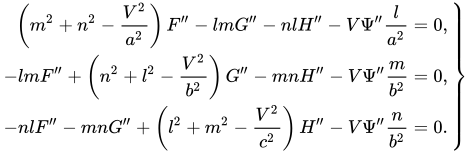
are the three principal velocities of propagation, the equations become
(
m
2
+
n
2
−
V
2
a
2
)
F
′
′
−
l
m
G
′
′
−
n
l
H
′
′
−
V
Ψ
′
′
l
a
2
=
0
,
−
l
m
F
′
′
+
(
n
2
+
l
2
−
V
2
b
2
)
G
′
′
−
m
n
H
′
′
−
V
Ψ
′
′
m
b
2
=
0
,
−
n
l
F
′
′
−
m
n
G
′
′
+
(
l
2
+
m
2
−
V
2
c
2
)
H
′
′
−
V
Ψ
′
′
n
b
2
=
0
.
}
{\displaystyle \left.{\begin{aligned}\left(m^{2}+n^{2}-{\frac {V^{2}}{a^{2}}}\right)F^{\prime \prime }-lmG^{\prime \prime }-nlH^{\prime \prime }-V\Psi ^{\prime \prime }{\frac {l}{a^{2}}}&=0{\mbox{,}}\\-lmF^{\prime \prime }+\left(n^{2}+l^{2}-{\frac {V^{2}}{b^{2}}}\right)G^{\prime \prime }-mnH^{\prime \prime }-V\Psi ^{\prime \prime }{\frac {m}{b^{2}}}&=0{\mbox{,}}\\-nlF^{\prime \prime }-mnG^{\prime \prime }+\left(l^{2}+m^{2}-{\frac {V^{2}}{c^{2}}}\right)H^{\prime \prime }-V\Psi ^{\prime \prime }{\frac {n}{b^{2}}}&=0{\mbox{.}}\end{aligned}}\right\}}
(5)
796.] If we write
l
2
V
2
−
a
2
+
m
2
V
2
−
b
2
+
n
2
V
2
−
c
2
=
U
{\displaystyle {\frac {l^{2}}{V^{2}-a^{2}}}+{\frac {m^{2}}{V^{2}-b^{2}}}+{\frac {n^{2}}{V^{2}-c^{2}}}=U}
,
(6)
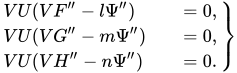
we obtain from these equations
V
U
(
V
F
′
′
−
l
Ψ
′
′
)
=
0
,
V
U
(
V
G
′
′
−
m
Ψ
′
′
)
=
0
,
V
U
(
V
H
′
′
−
n
Ψ
′
′
)
=
0
.
}
{\displaystyle \left.{\begin{aligned}&VU(VF^{\prime \prime }-l\Psi ^{\prime \prime })&=0{\mbox{,}}\\&VU(VG^{\prime \prime }-m\Psi ^{\prime \prime })&=0{\mbox{,}}\\&VU(VH^{\prime \prime }-n\Psi ^{\prime \prime })&=0{\mbox{.}}\end{aligned}}\right\}}
(7)
Hence, either
V
=
0
{\displaystyle V=0}
, in which case the wave is not propagated at all; or,
U
=
0
{\displaystyle U=0}
, which leads to the equation for
V
{\displaystyle V}
given by Fresnel; or the quantities within brackets vanish, in which case the vector whose components are
F
′
′
{\displaystyle F^{\prime \prime }}
,
G
′
′
{\displaystyle G^{\prime \prime }}
,
H
′
′
{\displaystyle H^{\prime \prime }}
is normal to the wave-front and proportional to the electric volume-density. Since the medium is a non-conductor, the electric density at any given point is constant, and therefore the disturbance indicated by these equations is not periodic, and cannot constitute a wave. We may therefore consider
Ψ
′
′
=
0
{\displaystyle \Psi ^{\prime \prime }=0}
in the investigation of the wave.