In this expression l, m, n are the direction-cosines of the axis of the magnet, and K is the magnetic moment of the magnet. If ε is the angle which the axis of the magnet makes with the direction of the magnetic force , the value of W may be written

| (9) |

If the magnet is suspended so as to be free to turn about a vertical axis, as in the case of an ordinary compass needle, let the azimuth of the axis of the magnet be , and let it be inclined to the horizontal plane. Let the force of terrestrial magnetism be in a direction whose azimuth is and dip , then


| (10) |

| (11) |

whence W K$ (cos cos0 cos(< 8) + sin <>in 0). (12)
The moment of the force tending to increase φ by turning the magnet round a vertical axis is
| (13) |

On the Expansion of the Potential of a Magnet in Solid Harmonics.
391.] Let V be the potential due to a unit pole placed at the point (ξ, η, ζ). The value of V at the point x, y, z is
| (1) |
![{\displaystyle V=\left[(\xi -x)^{2}+(\eta -y)^{2}+(\zeta -z)^{2}\right]^{-1/2}.}](https://wikimedia.org/api/rest_v1/media/math/render/svg/d12594eb48ad2550670b0574f182ca2009c08d1a)
This expression may be expanded in terms of spherical harmonics, with their centre at the origin. We have then
| &c., | (2) |

| when |
r being the distance of (ξ, η, ζ) from the origin, | (3) |

|
| (4) |
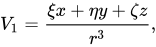
|
| (5) |

| &c. |
To determine the value of the potential energy when the magnet
is placed in the field of force expressed by this potential, we have to integrate the expression for W in equation (3) with respect to x, y and z considering ξ, η, ζ as constants.
If we consider only the terms introduced by V0, V1 and V2 the result will depend on the following volume-integrals,
